Pseudoexfoliation syndrome is a condition that develops as we age in which abnormal flaky material accumulates in the front of the eye. Often there are no noticeable symptoms which is why it is brought to attention during a routine eye exam. While the condition may not in itself cause vision issues, pseudoexfoliation syndrome is an issue to bring to attention because it is associated with increased eye pressure and a greater risk of glaucoma.
The National Eye Institute reports that in some people extra material may build up in the eye which in turn interferes with the normal flow of fluid. Also this type may progress more quickly and cause higher eye pressure than primary open angle glaucoma.
What Is Pseudoexfoliation Syndrome?
In pseudoexfoliation syndrome, white or gray deposits which are very small in size accumulate on structures like the lens, iris and drainage tissues. These deposits may be identified by an ophthalmologist during a slit-lamp exam. Pseudoexfoliation tends to present itself more as we age and is a particular issue in the senior population.
The cause of pseudoexfoliation syndrome is still a mystery. It is reported that genetic factors, age and environment play a role. Also we see that the LOXL1 gene is related to pseudoexfoliation but that genetics by itself doesn’t determine which individuals will get the disease or glaucoma.
What Are the Eye Signs of Pseudoexfoliation?
Many at the early stages of pseudoexfoliation syndrome do not see anything out of the ordinary. That is why it is very important to have regular eye exams done. At the time of these exams an ophthalmologist may also note out the white deposits on the front of the lens or around the pupil.
Pseudoexfoliation in eye structures also reports to cause an increase in pigmentation at the drainage angle, poor response to pupil dilation and weakness of the fibers which support the lens. These changes tend to play a greater role when a person develops cataracts or is to undergo cataract surgery.
| Eye finding | What it may indicate |
| White or grey flaky deposits | Typical pseudoexfoliation eye material |
| Raised eye pressure | Increased glaucoma risk |
| Poor pupil dilation | May make examination or surgery more challenging |
| Weak lens-supporting fibres | Greater care may be needed during cataract surgery |
| Optic nerve changes | Possible pseudoexfoliation glaucoma |
Why Does Pseudoexfoliation Increase Glaucoma Risk?
The eye is also a constant producer of a clear fluid which we call aqueous humour. Usually this fluid exits through special tissue in the front of the eye. In pseudoexfoliation syndrome that same fluid may instead see atypical material and pigment in the drainage path. Thus the fluid may not exit as easily which in turn causes intraocular pressure to rise.
When raised intraocular pressure affects the optic nerve what you have is pseudoexfoliation glaucoma which also tends to be more aggressive than primary open angle glaucoma. Also eye pressure may fluctuate more widely.
Not everyone with pseudoexfoliation syndrome develops glaucoma. However, regular monitoring matters because pseudoexfoliation glaucoma can gradually damage peripheral vision before a person notices a problem.
How Is Pseudoexfoliation Syndrome Diagnosed?
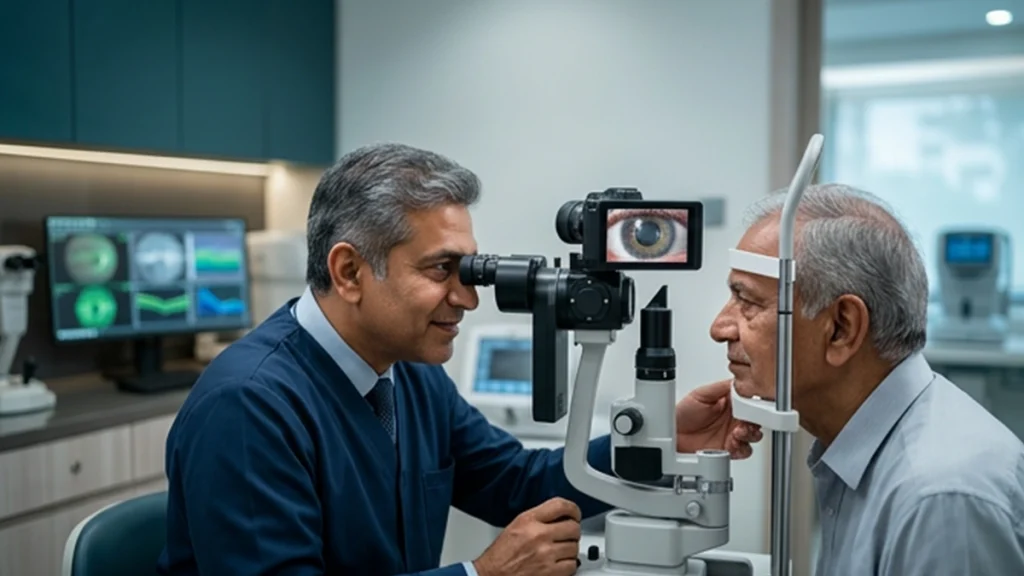
An ophthalmologist at the time of a full eye exam will diagnose pseudoexfoliation syndrome. In a slit lamp exam we see to identify characteristic pseudoexfoliation material in the eyes. Also we will do a measurement of the eye pressure.
If glaucoma is present we may have a look at the optic nerve, do a visual field test and in some cases of which I will talk to you more at the end we will do optical coherence tomography which in turn will allow us to see the retinal nerve fibre layer. Also we will do gonioscopy which is a test that looks at the eye’s drainage angle. These tests will tell us if pseudoexfoliation in eye structures which in turn may be affecting the pressure or the optic nerve.
| Examination | Purpose |
| Slit-lamp examination | Detects pseudoexfoliation deposits |
| Tonometry | Measures intraocular pressure |
| Gonioscopy | Examines the drainage angle |
| OCT | Assesses optic nerve and retinal nerve fibres |
| Visual field test | Checks for glaucoma-related vision loss |
Treatment for Pseudoexfoliation Syndrome
At present there is no cure which will remove or to put a stop to pseudoexfoliation material production. If pseudoexfoliation syndrome has brought about no damage to pressure in the eye or to the optic nerve then maybe what is needed is just regular checkups.
When it comes to pseudoexfoliation glaucoma what we do is lower eye pressure and protect the optic nerve. In each case we tailor treatment which may include pressure reducing eye drops, laser treatment or glaucoma surgery. What we do is individualize treatment and follow up.
People who present with pseudoexfoliation in their eyes that also have cataracts may require more in depth surgical planning; the pupil may not open fully and the lens supporting fibers are more weak.
Conclusion
Pseudoexfoliation is a condition which may go undetected for many years, still its association with high eye pressure puts forward the case for regular eye checkups. Early detection of pseudoexfoliation gives ophthalmologists a chance to watch for pressure variations and signs of pseudoexfoliation glaucoma which in turn may help to prevent large scale vision loss.
If an eye exam reports pseudoexfoliation in eye structures that does not mean your follow up is required only when vision is affected. At ASG Eye Hospital we recommend regular full eye exams which will help to identify early changes and in turn guide what treatment is necessary.
Frequently Asked Questions
1. Is pseudoexfoliation syndrome the same as glaucoma?
No. Pseudoexfoliation syndrome which is characterized by the abnormal material that deposits in the eye. Glaucoma results from damage to the optic nerve which in many cases also sees an increase in eye pressure.
2. Can pseudoexfoliation syndrome cause blindness?
Pseudoexfoliation syndrome itself does not automatically cause blindness. However, untreated pseudoexfoliation glaucoma can cause irreversible optic nerve damage and permanent vision loss.
3. Can pseudoexfoliation affect only one eye?
Yes. Pseudoexfoliation in eye is first noted in one eye at times. This may be a reason why we as medical professionals continue to examine both of your eyes over that period.
4. Is pseudoexfoliation syndrome curable?
Presently there is no definitive cure for pseudoexfoliation syndrome. We instead have methods to watch over eye pressure and we treat complications as they arise.
5. How often should someone with pseudoexfoliation have an eye examination?
The right follow up schedule depends on eye pressure, optic nerve findings and other risk factors. An ophthalmologist will put together a personal monitoring interval.