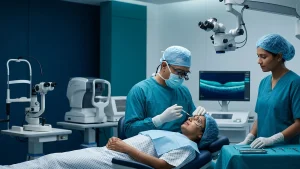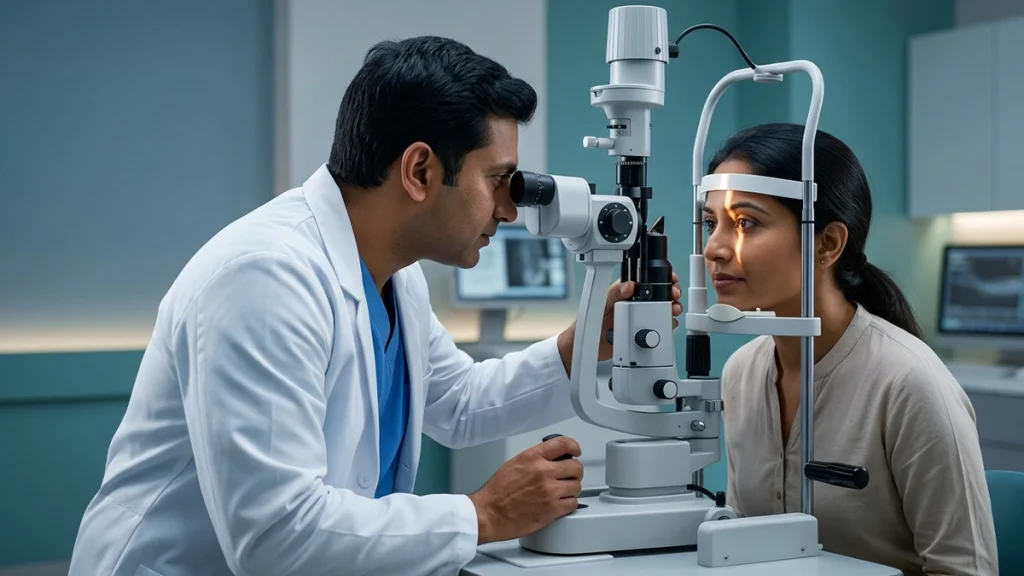
An eye exam is actually a more in depth process that is not limited to the evaluation of your ability to read the chart at distance. Also we look at the internal structures of the eye as well as those which are adjacent to it. By far the best tool we use for this is the slit lamp.
A slit lamp is a type of microscope and also a concentrated beam of bright light. It allows the ophthalmologist to see magnified different parts of the eye. A slit lamp eye exam which in turn may reveal changes that may not come up in a routine vision test.
The exam is usually quick and painless. It also plays a key role in many routine and specialized eye exams.
What Is a Slit Lamp Examination?
A slit lamp is a tool which ophthalmologists use to see into the eye at a large scale. The device puts out a narrow beam of light which also may be varied in width, height and angle.
During a slit lamp exam the doctor will look at the eyelids, conjunctiva, cornea, iris and natural lens. Also we use special lenses which aid in the examination of deeper structures.
The National Eye Institute reports that during eye exams doctors use a slit lamp microscope to look at eye structures and note any abnormalities. Also the device is used to assess problems with the cornea and tear film.
Some folks use Google for terms like bullseye lamp examination, which in fact is not the clinical term which is slit lamp examination.
Why Is a Slit Lamp Eye Exam Performed?
The primary aim of a slit lamp eye exam is to present a detailed view of the eye. What the microscope does is to provide strong illumination and very high magnification which in turn makes very small changes more noticeable.
Common slit lamp uses are in the evaluation of redness, irritation, eye injuries, corneal abnormalities and changes in the lens. Also doctors may use it for assessment of dry eye symptoms.
| Area Examined | What the Doctor May Assess |
| Eyelids | Swelling, inflammation or abnormal growth |
| Conjunctiva | Redness, irritation or infection |
| Cornea | Scratches, scars, swelling or deposits |
| Iris | Inflammation or structural changes |
| Lens | Cloudiness and signs of cataract |
| Tear film | Dryness and tear-film abnormalities |
A slit lamp test is not a sign that the doctor thinks you have a serious condition. It is a routine part of a full eye exam.
What Happens During a Slit Lamp Test?
During the slit lamp test,which is the slit lamp test you will sit in front of the device and will place your chin, and forehead against cushions that keep your head stable.
The ophthalmologist will aim the slit lamp at your eye and use the microscope to view. May have to look forward or to the side.
The light can feel bright, but the examination usually does not hurt.
In some reports, we see that doctors put a fluorescein dye into the eye. That dye is able to make corneal damage and tear-film changes more visible. Also the National Eye Institute reports on the use of dye and a bright slit lamp in the diagnosis of dry eye.
If the ophthalmologist requires a closer look at inner structures of the eye, we may also use dilating eye drops.
What Can a Slit Lamp Examination Detect?
The wide range of slit lamp examination uses is what makes this test useful in diagnosis and management of many eye issues.
| Eye Problem | Possible Findings During Examination |
| Cataract | Clouding or changes in the natural lens |
| Dry eye | Tear-film abnormalities or surface damage |
| Corneal injury | Scratches, foreign bodies or inflammation |
| Keratitis | Corneal inflammation or infection |
| Conjunctivitis | Inflammation of the conjunctiva |
| Uveitis | Inflammation within the eye |
| Corneal dystrophy | Abnormal deposits or corneal changes |
The slit lamp can also be used when examining glaucoma, diabetic eye disease, and other conditions, provided that additional tests are included.
For instance the U.S. The Department of Veterans Affairs reports to use the slit lamp exam as a tool in the evaluation of diabetics’ eyes.
Is a Slit Lamp Eye Examination Painful?
A typical course of a slit lamp eye exam is pain free. You may see bright light or feel mild discomfort from having your eye open.
During the course of the slit lamp exam if eye drops are applied you may notice some mild stinging which usually passes quickly.
The test itself usually is a few minutes’ time though a full eye exam may take more.
Why Is the Slit Lamp Important in Eye Care?
Many diseases of the eye may present with very fine structural changes. A slit lamp allows an ophthalmologist to see these changes up close.
This is a very important aspect of slit lamp uses in ophthalmology. Early in the exam doctors are able to determine what further testing, treatment or a regime of regular follow up is required.
At ASG Eye Care we see that an ophthalmologist may put forth a slit lamp eye exam as a part of your evaluation which is based on your symptoms, eye health and medical history.
Conclusion
The slit lamp is a very useful instrument in ophthalmology. It provides eye specialists with an in depth and magnified view of the structures which basic vision tests do not report fully.
From the evaluation of the cornea and tear film to the identification of cataracts and inflammation, we slit lamp uses which is a very important element of modern eye care. If you are seeing persistent redness, eye pain, blurred vision or any other changes in your eyesight, we recommend that you schedule a comprehensive eye exam with an ophthalmologist at ASG Eye Care.
Frequently Asked Questions
1. What is a slit lamp used for?
A slit lamp which is used to examine the cornea, conjunctiva, iris and lens under magnification.
2. How long does a slit lamp test take?
A basic slit lamp test is for a few minutes. For more tests or pupil dilation the total time may increase.
3. Can a slit lamp detect cataracts?
Yes. One of the practices of slit lamp examination uses is to look at the natural lens for signs of clouding and other changes related to cataracts.
4. Can a slit lamp detect dry eye?
Yes. A slit lamp eye exam is used by the doctor to study the tear film and surface of the eye. Fluorescein dye also may provide extra info.
5. Do I need pupil dilation for a slit lamp exam?
Not always. During a routine slit lamp exam many structures may be evaluated without the use of dilation. Your ophthalmologist may suggest dilating drops for a more in depth evaluation.
Reference Links
- National Eye Institute – Testing for Dry Eye: (National Eye Institute)
National Eye Institute – Testing for Dry Eye - National Eye Institute – Corneal Dystrophies: (National Eye Institute)
National Eye Institute – Corneal Dystrophies - U.S. Department of Veterans Affairs – Diabetic Retinopathy Eye Evaluation: (veteranshealthlibrary.va.gov)
U.S. Department of Veterans Affairs – Diabetic Retinopathy Eye Evaluation