
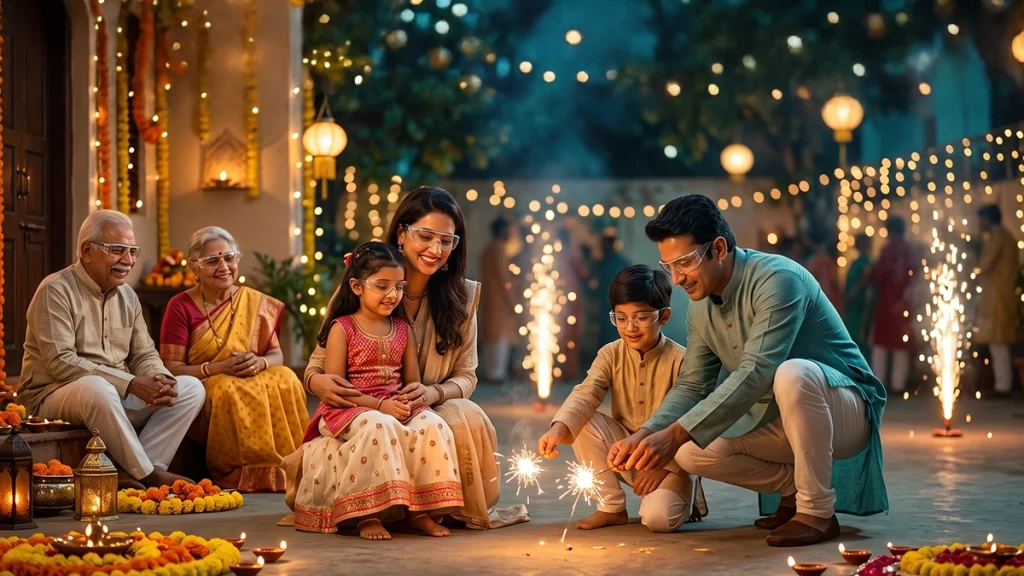
Diwali brings families together with bright lights and old traditions. As for the firecrackers they can put sparks, heat, smoke, or fast moving particles in the eyes. Easy Diwali eye safety tips reduce the chance of injury which in turn does not take away from the celebration.
A firework injury of the eye can cause mild irritation, serious burn, or penetration of debris. What may at first appear to be a minor issue may in fact have in depth complications, and so before anyone sets a firework off at Diwali, care measures include how to react in the case of an emergency.
Why Can Firecrackers Injure the Eyes?
| Firecracker Hazard | Possible Effect on the Eye |
| Sparks and hot particles | Burns and corneal surface injury |
| Flying fragments | Cuts, abrasions or penetrating trauma |
| Smoke and fumes | Irritation, redness and watering |
| Explosion at close range | Serious trauma and possible vision damage |
8 Simple Diwali Eye Safety Tips
1. Keep a Safe Distance
Distance is a basic tip for Diwali eye safety. Set off crackers in large open spaces only, and then step back right away. Spectators should keep a great distance from the fireworks which is to say do not crowd around them.
2. Never Bend Over a Firecracker
Keep your face well away from a firecracker as you light it. An unexpected explosion can send sparks or fragments toward your eyes, so eye protection starts with staying clear of the ignition point.
3. Do Not Relight a Failed Cracker
A Diwali cracker that seems to have gone out can still explode without warning. Stay away, don’t relight it or move closer. That small Diwali eye care precaution can prevent severe injuries to the face and eyes
4. Supervise Children Closely
Children look to us for the things they cannot get from the world of their own — like supervision near firecrackers. Sparklers in fact may get to very high temperatures which is why it is best to have in place very strict safety measures and to keep small children away from any which are set off.
5. Consider Protective Eyewear
Suitable protective eyewear does put up an extra physical barrier against sparks and small particles. As for regular spectacles they shouldn’t pass for dedicated safety goggles. What we see is that proper eye protection is of great importance for people handling fireworks.
6. Never Rub an Injured Eye
If dust, sparks or foreign matter get into the eye do not rub it. Rubbing may increase a scratch’ or press the matter further into the eye. For Diwali eye safety the best thing is to protect that which is affected until you can get in to see a health professional.
7. Keep Clean Water Available
Keep at all times clean running water available for use during festivities. The government’s fire works advice is to wash out injured eyes with tap water and take the affected person to the hospital. Do not put in oils, creams or non-prescribed medicines to an eye which is injured.
8. Seek Medical Care for Warning Signs
A firecracker eye injury requires prompt assessment when you see very painful eyes, decreased or blurry vision, bleeding, very red eyes, light sensitivity or if there is a foreign body which is embedded. Do not try to remove a foreign body which is in the eye.
| After an Eye Injury | Recommended Response |
| Mild loose dust or debris | Rinse gently with clean water; do not rub |
| Eye burn | Flush with clean running water and seek medical care |
| Embedded fragment | Do not remove it yourself; seek emergency care |
| Blurred vision or severe pain | Arrange urgent ophthalmic assessment |
| Bleeding or major trauma | Seek emergency medical attention immediately |
What Should You Do After a Firecracker Eye Injury?
Immediate action is of great importance in case of firecracker eye injury. Keep the person calm and out of this which may cause further damage to the affected eye. If there is a foreign body or puncture wound do not attempt to remove it.
An ophthalmologist will do a full assessment of the eye’s surface and in turn report with certainty on inner structures that may be affected from which they will base the best course of action. Also at ASG Eye Hospital we advise that in case of an injury you should not rub the eye or try to remove something embedded in the eye until you have seen a professional.
Conclusion
A happy festival season should not see reports of avoidable eye emergencies. For Diwali eye safety is in large part within our control. We must keep a safe distance from fireworks and also make sure that our family members are using firecrackers responsibly, that we have adult supervision present, that all are wearing proper eye protection and that we can react fast in case of injury.
If you experience pain, blurry vision, bleeding or constant pain from a firework injury take professional advice instead of home remedies. Careful Diwali eye care will help families to enjoy the holiday and also protect what is perhaps their most precious sense.
Frequently Asked Questions
1. What should I do immediately if a firecracker spark enters my eye?
Do not rub the eye. In most cases of foreign body do not use embedded or penetrating objects which require gentle rinsing with clean water. Report to a health care professional persistent pain, redness or blurred vision.
2. Can firecracker injuries cause permanent vision loss?
Severe burns, penetrating traumas or internal eye injuries which are issues to sight. Timely ophthalmic evaluation helps determine the extent of the injury and which treatments to apply.
3. Are sparklers safe for children’s eyes?
Sparklers may not be used to play things. They have burns and extremely high temperatures that cause eye injuries. At all times they should be under very close adult supervision.
4. Is eye protection useful during Diwali?
App proper eye protection does present an extra layer of defense against sparks and flying particles. Also of great importance is safe handling and keeping a large distance.
5. When should I visit an eye hospital?
Seek prompt medical attention after a firecracker eye injury which has resulted in a loss of vision, sharp pain, blood in the eye, persistent redness, sensitivity to light or an object that is stuck in the eye.
References Links
- Petroleum & Explosives Safety Organisation (PESO), Government of India — https://www.peso.gov.in/web/en/dos-donts-fireworks
- Directorate General of Health Services, Ministry of Health & Family Welfare, Government of India —https://dghs.mohfw.gov.in/uploads/assets/cocrHyjl08iBKHAlwErjfhovlRd9AP2Exy8dc3lc.pdf
- National Health Mission, Government of India — https://nhm.hp.gov.in/storage/app/media/Training%20module/Eye%20Care%20Training%20Manual%20for%20MPW-English.pdf
- ASG Eye Hospital — https://www.asgeyehospital.com/blog/how-to-give-first-aid-and-care-for-eye-emergencies/