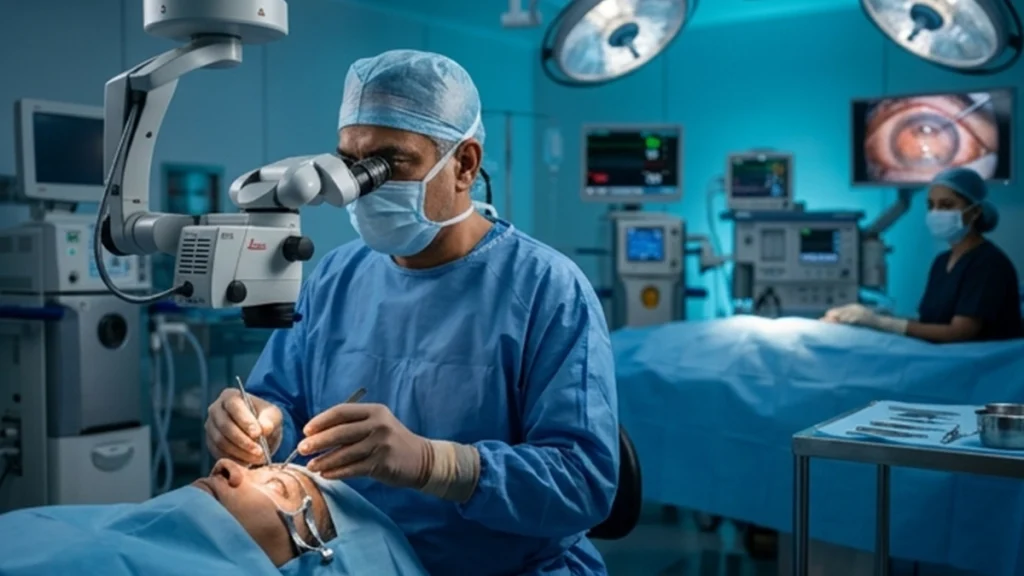
The cornea which is the clear dome shaped tissue at the front of the eye also plays a role in the refraction of light which in turn enables us to see clearly. Disease, injury, infection, or scarring may cause damage to this clear structure. When damage is extensive through the full thickness of the cornea, penetrating keratoplasty may become a treatment option.
Also known as a corneal transplant surgery, that procedure puts in place healthy donor tissue for the affected corneal tissue. We do this when other options do not improve vision enough or in case of extensive damage to the corneal thickness.
This guide goes over the reasons for which doctors recommend penetrating keratoplasty,, how the procedure is performed, what to expect during recovery, and what issues related to corneal graft rejection we should be aware of.
What Is Penetrating Keratoplasty?
Penetrating keratoplasty is a procedure which removes all layers of the affected cornea. At the time of the surgery an ophthalmologist will remove a circular piece out of the diseased cornea. The surgeon then puts in healthy donor cornea tissue.
Donor tissue is what becomes the new corneal graft. Very fine sutures hold it in place as the eye heals.
Unlike in partial thickness transplants which only affect some layers of the cornea, in PKP surgery we are talking of total layer replacement in the area of cornea in question. That is so when disease or scarring has affected many layers of the cornea.
Also as reported by the U.S. National Eye Institute, full thickness transplant is performed when scarring or injury has affected the entire cornea.
Why Is the Cornea Important for Vision?
The cornea is also over what the eye uses it for. It has a curved surface which in turn causes light that is coming in to be focused properly.
When the cornea is clear and of a regular shape light passes through it easily. Scar tissue, swelling, thinning or irregular curvature will interrupt this. Vision may then become blurred, distorted or cloudy.
Some folks improve with glasses, contact lenses, medication, or other corneal procedures. But in the case of serious structural damage we may require corneal transplant surgery.
When Is Penetrating Keratoplasty Recommended?
An ophthalmologist may turn to penetrating keratoplasty in cases of large scale corneal damage which affects vision or causes other serious issues.
Conditions which may require PKP surgery are in late stage keratoconus, deep corneal scarring, certain corneal dystrophies, severe infections, and prior transplant failure. Also serious eye injuries may affect multiple layers of the cornea.
However also some health issues are not sufficient for a transplant to take place what we mean is that it is a complex case by case analysis based on the specific degree and extent of organ damage that has taken place the stage your vision has reached, the degree of corneal damage if present also we have into account general health of the eye the patient may already have had treatment which was successful or not at the prior attempts that we have in our records.
MedlinePlus reports that which is also true for severe infection, injury, damage, scarring, or an opaque cornea.
| Corneal Problem | Why Transplantation May Be Considered |
| Advanced keratoconus | Severe thinning or distortion can reduce useful vision |
| Deep corneal scarring | Scars can block or distort incoming light |
| Corneal dystrophy | Progressive tissue changes may reduce transparency |
| Severe corneal infection | Infection may leave extensive structural damage |
| Serious eye injury | Trauma can damage multiple corneal layers |
| Failed previous transplant | A new corneal graft may sometimes be considered |
Penetrating Keratoplasty vs Partial-Thickness Transplant
Not all patients requiring transplant do in fact require a penetrating keratoplasty. Today we see in corneal surgery the use of techniques which replace specific layers.
Lamellar techniques we do which preserve the healthy corneal tissue as much as we can. For example in DALK we mostly remove the affected front and middle layers and at the same time we preserve the healthy endothelium. Endothelial procedures we do which affect tissue near the inner surface.
In that it does PKP surgery which affects the entire thickness of the selected corneal area.
The type of corneal transplant surgery which is right for you depends on which layers are affected. You will have a corneal exam by your ophthalmologist before a treatment is recommended.
| Procedure | Tissue Replaced | General Application |
| Penetrating keratoplasty | Full corneal thickness | Disease or damage involving multiple or full-thickness layers |
| DALK | Front and middle layers | Disease with healthy inner endothelial tissue |
| Endothelial keratoplasty | Inner corneal layers | Disorders mainly affecting the endothelium |
How Is PKP Surgery Performed?
Before the procedure of penetrating keratoplasty, your ophthalmologist will do a very in depth eye exam. The assessment is to determine the extent of corneal damage as well as to check other structures within the eye.
During PKP surgery anesthetics are used to manage pain and discomfort. The surgeon carefully excises a round segment of the diseased cornea. Then in comes healthy donor tissue of proper size which takes the place of the removed section.
Fine threads are used to attach the new corneal graft to the surrounding corneal tissue. These may stay in place for months. The surgeon at his discretion removes which sutures he wants at what time.
The National Eye Institute also reports that for corneal transplant they may use general anesthesia or topical anesthetics along with sedatives.
What Happens After Corneal Transplant Surgery?
Recovery from corneal transplant surgery is a slow process. The cornea, which is what the eye that is transplanted in this case is, heals at a slower rate than most other body tissues so the vision does not usually improve right away.
Patients report in for frequent check ups after penetrating keratoplasty. The ophthalmologist looks at the healing process, eye pressure, sutures, vision, and the state of the transplanted tissue.
Prescription eye drops are a key part of care after PKP surgery. We see that doctors give out a lot of medication to reduce inflammation and to also minimize the chance of rejection. Patients should follow the directions exactly.
Protect your operated eye. Do not rub or put pressure on it. At certain points in the recovery your doctor may recommend the use of protective glasses or an eye shield.
How Long Does Recovery Take?
Recovery is variable among patients. That which underlies the disease, wound healing, sutures, eye pressure, and also other eye conditions may play a role in the time frame.
Vision changes out in the first few months post penetrating keratoplasty. Sutures which are put in can temporarily change the corneal shape and produce astigmatism.
Some patients will in fact require glasses or contacts for better vision post corneal transplant surgery. As to the final visual result that is dependent on the retina, the optic nerve, and other components of the eye.
The National Eye Institute reports that in some cases of corneal transplantation full recovery may take a year.
What Is Corneal Graft Rejection?
The immune system usually protects the body from foreign cells. But at times it may identify transplanted corneal tissue as foreign. This response is called corneal graft rejection.
Rejection does not automatically mean that the transplant has permanently failed. Early medical attention can be very important.
Warning signs may present as increased redness, pain in the eye, light sensitivity, and blurry or foggy vision. See an ophthalmologist at the first sign of these symptoms.
The National Eye Institute reports that pain, light sensitivity, redness, and cloudy or hazy vision are signs of rejection which is also.
What Are the Risks of Penetrating Keratoplasty?
Like with any surgical procedure, penetrating keratoplasty has its risks.
Complications may include infection, bleeding, raised intraocular pressure, glaucoma, retinal issues, wound problems, irregular astigmatism, and rejection of the corneal graft or failure of the cornea to take. Some patients may also require a second procedure.
The risk profile varies between patients. Your ophthalmologist should go over the expected benefits and possible complications before PKP surgery.
Following the prescribed medication schedule and attending follow-up appointments can help doctors identify problems early.
Can Vision Improve After PKP Surgery?
The primary aim of penetrating keratoplasty is to restore clear vision which is impaired by damaged corneal tissue.
However a perfect outcome of a corneal graft transplant is not guaranteed. Other factors may play a role in results. This includes retinal disease, glaucoma, optic nerve damage, or issues within the eye.
Glasses or contact lenses may also be required post corneal transplant surgery. Also we see in some patients that as the transplanted and natural cornea tissue heal together there is an uneven curvature which causes astigmatism.
Thus improvement in vision after PKP surgery is a gradual process which happens over time.
Caring for Your Eye After Penetrating Keratoplasty
Long term care is a key element of penetrating keratoplasty.
As per your ophthalmologist’s instructions we will put you on certain eye drops. Do not discontinue the medication at your own will because the eye may have improved.
Avoid rubbing the operated eye. Protect it from injury and do as your doctor has scheduled for your check ups. You will be told by the doctor when it is ok for you to go back to your regular routine of exercise, work, driving, swimming or other activities.
Promptly report to your ophthalmologist if you notice a sudden change in vision or if the eye is painful, red, or more sensitive to light. These changes may require urgent evaluation of the corneal graft.
Why Regular Follow-Up Matters After PKP Surgery
A transplant requires close follow up even post initial recovery.
After PKP surgery your ophthalmologist will check the corneal clarity, sutures, eye pressure, inflammation, and visual improvement. Also this follow up is to identify rejection or other issues at the earliest.
Some issues present with few symptoms in early stages. Thus routine exams may still be of great value when the eye feels fine.
If you have had penetrating keratoplasty follow up per the schedule put forth by your care ophthalmologist.
Conclusion
Penetrating keratoplasty is a major treatment option for patients which have severe full thickness corneal damage. What the procedure does is replace the unhealthy tissue with a healthy corneal graft which in turn restores corneal clarity and may improve visual function.
In many cases of corneal transplant surgery success goes beyond the operation itself. We see also that postop care which includes prescribed medicine, eye protection, and regular follow up play very key roles.
If you have corneal disease or scarring which is affecting your vision see a cornea specialist at ASG Eye Hospital. We will do a detailed exam to determine if PKP surgery, another transplant procedure, or a non-transplant treatment is best for your eye.
Frequently Asked Questions
1. Is penetrating keratoplasty a full corneal transplant?
Yes. Penetrating keratoplasty is a procedure which replaces the full thickness of a selected circular area of damaged cornea with that of healthy donor tissue.
2. Is PKP surgery painful?
Anesthesia is used in PKP surgery for pain control. Some patients report discomfort, irritation or sensitivity at early recovery. Your doctor may give you info on postop care.
3. How long does corneal transplant surgery take to heal?
Healing from corneal transplant surgery is a slow process which may extend over many months. The exact timeline will vary based on the patient’s eye health, the procedure, the sutures used, and how the eye is healing.
4. Can the corneal graft be rejected?
Yes. Corneal graft rejection is a recognized issue. Symptoms such as redness, pain, light sensitivity, or a change in vision post transplant are reasons to seek medical care right away.
5. Are stitches used during penetrating keratoplasty?
Yes. Surgeons at times use very fine sutures during penetrating keratoplasty which in turn leave in place for an extended period.
6. Can I get normal vision after PKP surgery?
Visual results post PKP surgery will vary. Some patients may still require glasses or contacts. Also other eye issues may play a role in the final result.
7. Can penetrating keratoplasty be repeated?
A repeat penetrating keratoplasty may be performed if the first one fails. But the ophthalmologist has to do a thorough evaluation of the eye as risks may vary with a repeat transplantation.