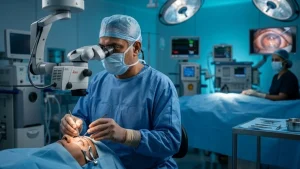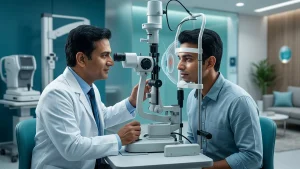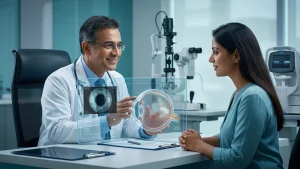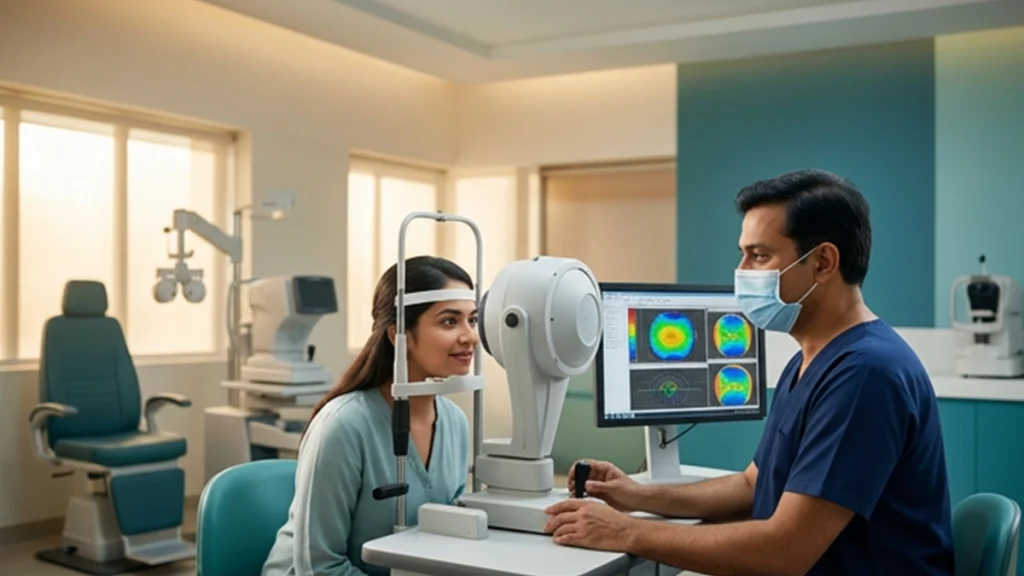
LASIK does in fact reduce the use of glasses and contact lenses but not all eyes are good candidates for the procedure. A key element we look at is corneal thickness for LASIK. As the cornea is reshaped by the removal of a precise amount of tissue with the procedure, it is necessary that there be enough healthy corneal tissue remaining post treatment.
Before surgery a very in depth cornea test is done. Corneal thickness, shape, prescription, eye health, and other measures are looked at which in turn the ophthalmologist uses to determine if you are a candidate for LASIK.
Why Does Corneal Thickness Matter for LASIK?
The cornea is the transparent front of the eye which also does the job of focusing on incoming light. In a LASIK procedure a flap is created and a laser which in turn restructures the inner corneal tissue. Also of great importance in the surgery is the corneal thickness for LASIK which is used in the planning process.
A very thin cornea may not have enough tissue for safe correction which in turn may increase the chance of postoperative weakness or corneal ectasia. The FDA reports that thin corneas are a very important issue to consider in determining if a person is a poor LASIK candidate.
Thickness is a factor which in itself does not determine eligibility. Also we look at the corneal shape, prescription strength, age, eye health and what is the tissue which will remain post treatment.
What Is Pachymetry?
Pachymetry is a cornea test which measures corneal thickness usually in microns (µm). It is an important element of the evaluation of corneal thickness for LASIK.
In the present time we see that which clinics do in fact use optical pachymetry, ultrasound pachymetry, corneal tomography, or other imaging systems. These measures are used by the ophthalmologist to determine that there is sufficient corneal tissue for the planned correction.
| Test | What It Evaluates | Why It Matters |
| Pachymetry | Corneal thickness | Helps assess available corneal tissue |
| Corneal topography/tomography | Corneal shape and curvature | Helps identify irregularities |
| Refraction | Vision prescription | Determines correction required |
| Eye examination | Overall eye health | Identifies conditions that may affect LASIK |
A cornea test may in fact be a series of measurements. The doctor requires that full picture which is not a single unit of thickness.
What Is the Minimum Corneal Thickness for LASIK Surgery?
Patients report they are looking for a minimum corneal thickness for LASIK surgery, which is a single number. In fact we do not have a single value that determines safety for LASIK eligibility.
In an average adult the cornea is to be had at about 500 to 550 microns in thickness though also it does vary. Also in that range under it is not to say that person is out, as also over that range does not mean that person is in.
When it comes to assessment of corneal thickness for LASIK surgeons determine what tissue the procedure will remove and what stromal tissue is to be left behind. Some FDA device reports put forth a 250 micrometers residual stromal thickness warning threshold which is not to be used as a universal patient selection criteria.
| Factor | Why the Surgeon Checks It |
| Corneal thickness for LASIK | Determines available tissue |
| Prescription | Higher corrections may require more tissue removal |
| Corneal shape | Irregular patterns may indicate increased risk |
| Residual stromal tissue | Helps assess structural safety after treatment |
| Eye health | Conditions such as keratoconus may affect eligibility |
Therefore the minimum corneal thickness for LASIK surgery is variable based on the patient’s eye, type of treatment and surgical technique.
Can You Have LASIK With Thin Corneas?
Having a thin cornea is not a bar to vision correction. It means that during your LASIK evaluation your ophthalmologist will pay close attention to corneal thickness for LASIK
A cornea test which goes into great detail is useful in determining if LASIK is right for you or if another refractive procedure is which to choose. The National Eye Institute reports that options to LASIK include PRK and phakic IOL implantation.
The safest choice depends on your prescription, corneal structure and overall eye health. At ASG Eye Hospital, a comprehensive refractive evaluation can help determine which approach may be appropriate for your eyes.
Why Corneal Mapping Matters Along With Thickness
Two people may have the same corneal thickness for LASIK but very different corneal shapes. This is why thickness should not be assessed by itself.
Corneal topography also maps out the shape and curvature of the cornea. It may present irregular patterns which require more in depth assessment. When we combine this data with the results from a cornea test we have a better set of info for treatment planning.
Conclusion
Understanding the role of corneal thickness for LASIK is a key element of making an informed decision for laser vision correction. But a thickness measurement should not be looked at in vacuum. The minimum corneal thickness for LASIK surgery varies by individual eye, prescription, corneal shape and treatment plan.
A full cornea test, which includes pachymetry and corneal mapping as is appropriate helps us to evaluate these elements. If you are a LASIK candidate we at ASG Eye Hospital will do a thorough assessment which in turn will determine if LASIK or some other vision correction option is right for you.
FAQs
1. Is 500 microns enough for LASIK?
A single measurement at 500 microns is not enough to determine eligibility. Doctors must consider corneal thickness for LASIK, prescription, corneal shape and expected remaining tissue.
2. What is the minimum corneal thickness for LASIK surgery?
There isn’t a universal minimum corneal thickness for LASIK surgery which applies to all. What is important is that several factors are looked at along with the degree of correction you wish to achieve.
3. How is corneal thickness measured?
A cornea test is what we use to measure corneal thickness in microns. Also we use optical or ultrasound based methods.
4. Can thin corneas make LASIK unsafe?
Very thin or anatomic variant corneas may see an increased risk of complications. Your ophthalmologist will look at the corneal thickness for LASIK evaluation also which is in conjunction with the corneal shape and other factors.
5. Is pachymetry painful?
Pachymetry is typically a quick process which is also well tolerated. The exact experience may vary depending on the type of cornea test used.
Reference Links
- U.S. Food & Drug Administration (FDA) – LASIK Surgery Checklist
https://www.fda.gov/medical-devices/lasik/lasik-surgery-checklist - U.S. National Eye Institute – Surgery for Refractive Errors
https://www.nei.nih.gov/eye-health-information/eye-conditions-and-diseases/refractive-errors/surgery-refractive-errors - U.S. FDA – What Is LASIK?
https://www.fda.gov/medical-devices/lasik/what-lasik