Knowledge of Entropion and its effects on eye health.
A continuous itchy sensation is a sign of an inward turning eyelid. This is a condition which we know as entropion in which the eyelid turns in toward the eye, usually the lower lid is affected.
With the eyelid turning inward in the eyes’ lashes can rub against the eye which causes irritation, redness and excessive tearing. Early entropion treatment is sought to protect the cornea and to reduce the risk of permanent damage.
What Causes an Inward-Turning Eyelid?
Age at which the muscle and tissue which support the eyelids breaks down which in turn causes them to roll in. Also we see this with the eyelid turning inward or scarring. Injuries, burns, inflammation and scarring are also causes of this.
This eyelid turning inward can cause the lashes to rub the cornea at each blink. Proper entropion treatment is to identify and correct the cause as well as to reduce ongoing irritation.
Warning Indicators You Can’t Disregard
Symptoms present mildly at first. It may seem as if there is dust in your eye. Also you may notice redness, watering, soreness, light sensitivity and blurred vision.
When a lashes rubbing cornea comes into contact and causes a scratch or an open wound the issue may become more serious. It may lead to infection, scarring or reduced vision. If you have severe pain, see a increase in redness, light sensitivity or sudden changes in vision seek immediate eye care. Also if you have persistent issues of lashes rubbing cornea they need to be evaluated.
| Symptom | Why it matters |
| Watering and redness | May indicate ongoing surface irritation |
| Gritty or scratchy feeling | Can occur when lashes touch the eye |
| Light sensitivity or blurred vision | Needs prompt professional assessment |
| Persistent pain | May indicate corneal injury |
How does Entropion affect the Cornea?
The cornea requires a smooth surface in order to function well. Repeated lashes rubbing cornea can damage its protective layer and also increase the chance of infection. In severe or go untreated cases this may lead to corneal ulcers and scarring which in turn affects vision. Lashes rubbing cornea should be evaluated by an eye specialist.
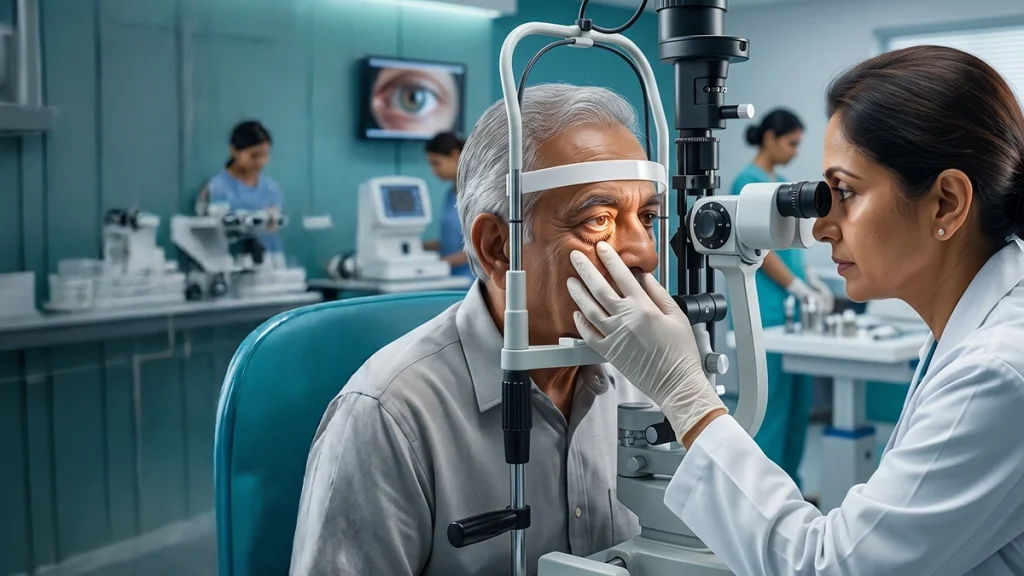
An ophthalmologist is able to check the eyelid and cornea for injury. We see that early entropion treatment protects the eye. It is of import to entropion treatment early before vision changes. Timely entropion treatment may prevent complications.
Diagnosis and Treatment Options
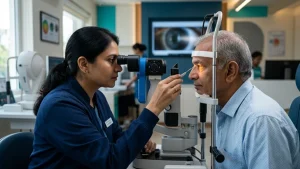
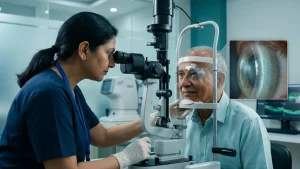
An ophthalmologist looks at the eyelid and cornea. We use a special microscope and diagnostic dye to see issues.
The proper entropion treatment is based on the cause and severity. We see that lubricating drops and ointments may relieve some friction. Also a specialist may recommend the use of eyelid tape as a temporary measure. They just may not fully correct the eyelid’s position.
Comparing Treatment Options
| Treatment option | Main purpose | Important consideration |
| Lubricating drops or ointment | Reduce dryness and irritation | Helps relieve symptoms but may not correct eyelid position |
| Specialist-guided eyelid taping | Temporarily keeps lashes away from the eye | Requires proper instruction and careful application |
| entropion surgery | Corrects the eyelid’s position | The procedure depends on the cause and severity |
| Follow-up examinations | Monitor healing and corneal health | Helps identify complications or recurrence |
When Is Surgery Necessary?
An ophthalmologist will put forth which of the entropion surgery is right for you if you have an eyelid that is very much a recurring issue or a serious issue which affects the cornea. The operation will tighten or reposition the affected lid tissue to keep the lashes away from the eye. Which approach is used depends on your particular anatomy and the cause of the issue.
Entropion surgery can provide for a long term solution although there is a chance of the issue returning. Your doctor will go over the risks and post surgery care.
Conclusion
An in-turned lid may be a minor issue but it’s the repeated friction which may damage the cornea. Timely entropion treatment will help protect eyesight. It is best to discuss what entropion treatment options are available with your ophthalmic specialist. For persistent symptoms like irritation or watering, see an ophthalmologist at ASG Eye Care.
Frequently Asked Questions
1. Can entropion result in permanent vision loss?
Untreated entropion may cause corneal scarring and which in turn affects vision.
2. Is entropion treated without surgery?
Lubricating drops and specialist guided eyelid taping may provide temporary relief. That said, these do not always correct the position of the eyelid permanently. An ophthalmologist can best put forth the right entropion treatment for your situation.
3. Is it painful to have entropion surgery?
The procedure which is usually done with local anesthetic. Post op you may experience some pain, swelling or bruising but your surgeon will give you post care info.
4. When to see an eye specialist?
If you notice the eyelid turning inward or your lashes are constantly in the eye, get in for an exam. Go to the emergency room for severe pain, light sensitivity or vision changes.
Medical References
- National Health Service (NHS): Eyelid problems
https://www.nhs.uk/symptoms/eyelid-problems/ - American Academy of Ophthalmology: Entropion — causes, symptoms and treatment
https://eyewiki.aao.org/Entropion - National Eye Institute (NEI): Eye conditions and diseases
https://www.nei.nih.gov/learn-about-eye-health/eye-conditions-and-diseases