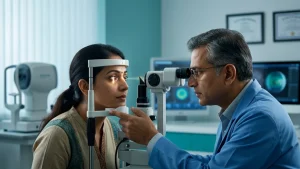
In an eye test what you will see are numbers like 6/6, 6/9, 6/12, 6/18. If your report has 6/9 in it you may wonder right away if your vision is weak or if you need glasses.what 6/9 vision means may clarify that up for you and make your eye test results easy to understand.
In other words,6/9 vision reports how well you see at a certain distance but it does not give the precise measure of what lenses you may require. Also, it is not a test which will diagnose an eye disease.
Many people that are researching what is 6/9 vision also see which it is in relation to natural eyesight. We see that 6/9 is a moderate drop in distance clarity as compared to 6/6. But what caused that drop in clarity is more of an issue than the number itself.
This guide covers what 6/9 vision means , how it is measured by doctors, what causes it, if glasses are a solution, and when you should have a full eye exam.
What Is 6/9 Vision?
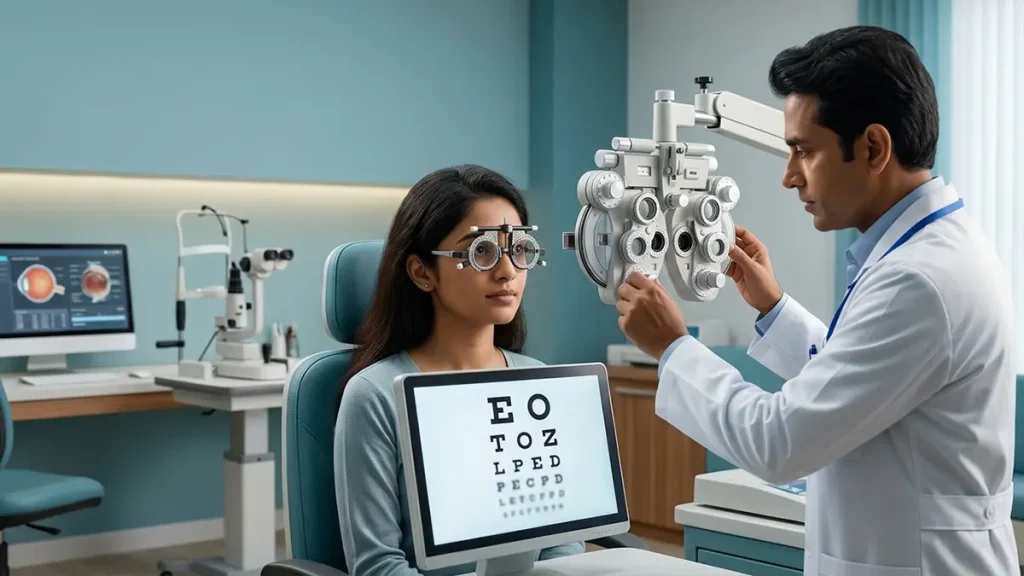
To get an idea of what is 6/9 vision is like, you should know how visual acuity works. Eye care professionals usually determine distance vision with a Snellen or a similar visual acuity chart. The chart has rows of letters which get progressively smaller.
During the test you will be at a standard distance from the chart. Each of the eyes are tested separately. Your eye doctor and optometrist will note down the smallest letter which you are able to read.
The NHS reports that for Snellen and LogMAR charts which they use for visual assessment they put out rows of letters and numbers that get smaller as you go along. Go to the NHS website for more info on eye tests and visual acuity.
So, what exactly does 6/9 vision means in practical terms?
A score of 6/9 means that which a person with 6/6 vision can see at 9 meters you will only be able to see at 6 meters. Thus your distance vision is not as sharp as the 6/6 standard.
This does not mean you have lost one third of your eyesight. Visual acuity fractions do not represent percentages of vision.
Understanding the Numbers in a 6/9 Vision Test
In a 6/9 vision test the numbers are used for different purposes. The first is for the testing distance. The second is for the distance at which a person with the reference level of visual acuity is able to identify that same line.
For instance with 6/6 vision which is normal, you will be able to identify a line at 6 meters that a person with perfect vision would see at 6 meters. With 6/9 vision, you will have to be at 6 meters to notice detail which a person with normal vision would see at 9 meters.
UK government guidance also reports on Snellen measurements for eyesight standards. For example from the GOV.UK guidance we see that visual acuity requirements are put out in terms of 6/12 and 6/7.5
| Snellen Result | General Interpretation | Distance Clarity |
| 6/6 | Common reference for standard visual acuity | Clear |
| 6/9 vision | Mild reduction from 6/6 | Slightly reduced |
| 6/12 | Greater reduction in distance clarity | Reduced |
| 6/18 | More noticeable reduction | Moderately reduced |
| 6/24 or lower | Significant reduction that needs assessment | Considerably reduced |
These figures describe visual acuity only. They do not provide a complete assessment of eye health.
Is 6/9 Normal Eye Vision?
People usually compare 6/9 vision to that of normal eye vision which is that 6/6 is what we use as the standard for distance acuity.
A 6/9 result reports slightly reduced visual acuity as compared to 6/6. But what that means in terms of importance is a different story. Your age, symptoms, refractive error, eye health, and the difference between your two eyes all play a role.
For some people a mild refractive error is the cause. We see improvement in vision to 6/6 with glasses. For others the issue may be in the eye itself rather than the power of the spectacle.
This is that some of us may think 6/9 vision means is best determined by what we see on an eye chart. This is that some of us think to determine 6/9 vision we only look at what an eye chart says.
A full eye exam may show that what we see is a simple focusing issue or it may point out something that requires more investigation.
What Can Cause 6/9 Vision?
Some factors can cause a 6/9 vision test result. Refractive errors are the most typical causes which happen when the eye is unable to focus light exactly on the retina.
Myopia results in distant objects being blurred. Hyperopia causes issues with focus, and astigmatism produces blurred or distorted vision at variable distances.
At times eye test results may also change due to dry eyes, fatigue, poor concentration, or from the environment in which the test is taken. Also in some cases cataracts, corneal issues, retinal diseases, or other eye diseases may cause a reduction in visual acuity.
Children do have special needs when they present with different vision in each eye. In childhood some visual issues may also be a sign of amblyopia or another development related vision issue.
Therefore in each case 6/9 vision means a personal diagnosis. Doctors will look at the number in relation to your symptoms and what they find from the exam.
6/9 Vision Means How Much Power?
A common question post eye exam is: In what terms of 6/9 vision means how much power?
There is no set answer.
Visual acuity and spectacle power are different things. A Snellen test measures what degree of detail at a distance you are able to identify. Spectacle power is what determines the optical correction which in turn focuses light properly on your retina.
Two people may have 6/9 vision but require different prescriptions. One may have mild myopia. Another may have astigmatism. Also a third person may have little to no refractive error but reduced acuity from another eye condition.
For that which is put out there you are not able to accurately convert a 6/9 vision test result into a prescription for glasses.
As for what 6/9 vision means how much power, an optometrist or ophthalmologist will do refraction which is the test they use to determine if lenses will improve your sight and to identify the proper prescription.
Does 6/9 Vision Require Glasses?
Another frequent question is, does 6/9 vision require glasses?
Not necessarily.
Some individuals with this degree of visual acuity may benefit from glasses which includes when distance vision is blurred for activities like driving, in the classroom, during presentations, while viewing a screen or for other day to day activities. Also some people may do just fine without any correction..
The issue is based on what is causing the visual acuity reduction. Also it is based on if lenses improve your sight.
If you have 6/9 vision due to refractive error, we see that which is a result of that which can be corrected with prescription glasses. But if it is the result of another ocular condition, that may not be improved with the use of glasses alone which in some cases may still leave you at 6/6 acuity.
So with the question of whether does 6/9 vision require glasses, it is important to note that what we see on an eye chart does not in itself give us the whole story. Refraction and a full eye exam will give you the information to determine that.
How Is a 6/9 Vision Test Performed?
During a 6/9 vision test, the eye care professional has you look at a visual acuity chart which is at a set testing distance. You will cover one eye and read out progressively smaller letters. Then we do the same for the other eye.
The examiner notes down the smallest mark which you can see accurately. We do also perform the test uncorrected and while you are wearing your present glasses or contact lenses.
If your vision improves with the use of lenses then your refractive error is the cause of reduced acuity. If it does not improve as expected we may suggest that you have a more in depth evaluation at your eye doctor’s office.
The test may be easy to perform yet correct form is important. What you put forward for lighting, testing distance, chart design, and which eye is covered in the other will play into the results
An eye test chart 6/9 should be used in conjunction with other tests as a component of a larger assessment and not stand as a diagnosis in itself.
6/6 Vision vs 6/9 Vision
The difference in between 6/6 and 6/9 vision is minimal but it reports to the eye doctor on how the patient’s distance vision is doing.
| Feature | 6/6 Vision | 6/9 Vision |
| Visual acuity | Reference level | Mildly reduced |
| Distance comparison | Sees at 6 m what the reference observer sees at 6 m | Sees at 6 m what the reference observer sees at 9 m |
| Glasses automatically needed? | No | No |
| Refraction may be useful? | Depends on symptoms | Often useful |
| Full eye examination needed? | Based on age, symptoms and risk | Recommended if new, unexplained or symptomatic |
This issue also is why 6/9 vision means a mild drop in acuity not severe visual impairment.
Can 6/9 Vision Be Corrected?
In some cases, yes. Also correction is a function of the cause.
When myopia, hyperopia, or astigmatism is the issue which causes reduced acuity then glasses or contact lenses may improve clarity. The degree of improvement varies between individuals.
Some grown ups also may do well with refractive procedures which is after we do a very in depth evaluation. What determines suitability includes stable prescription, corneal health, age, and the overall state of the eye..
When an illness of the eye is the cause, treatment is directed to that which is present. For example we see that which pertains to management of an ocular surface issue is very different from that of cataract or retinal disease.
This is also a reason why 6/9 vision means not to be looked at as a diagnosis.
Is 6/9 Vision a Serious Problem?
In and of itself 6/9 vision is not to be taken as a sign of a serious eye issue. It is a measure of visual acuity.
However at the first sign of a vision change or an unexplained one pay attention. This is very important to note when there is a sudden shift in which the eye sees less out of the two.
You should have an eye exam if you have persistent or daily impaired blurred vision. See a doctor right away if you see a sudden change in vision or it occurs with eye pain, flashes, new floaters, a curtain like shadow, very red eyes, or after an eye injury.
Even at the best of vision days, routine eye exams still are of great value. They look at much more than what you see on the normal eye vision on a chart.
Can 6/9 Vision Become 6/6?
Some people do improve from 6/9 vision to 6/6 vision after they get the right refractive correction.
For instance a person with mild uncorrected myopia or astigmatism may read only the 6/9 line without glasses. Once they are given the proper lenses that may enable them to read the 6/6 line.
That which is not guaranteed. If an eye condition is affecting vision, correction with glasses may not return you to 6/6 sight.
Your eye care professional may determine the cause through refraction and a full eye exam.
Why Regular Eye Tests Matter
An eye test chart 6/9 result is a tool which does provide useful information but visual acuity is only one element of health of the eye.
A full scale exam will also check for refractive error and at the same time look into changes in the cornea, lens, retina, optic nerve, and other internal structures.
Regular regular check ups are very important if you see your vision change, you have recurring eye issues, or you have risk factors for eye disease.
what is 6/9 vision can be understood by you from your report but for best results professional interpretation is used to explain your results.
Conclusion
Knowing what 6/9 vision means will make an eye exam report less confusing. In other words it is a note of mild reduction in distance visual acuity as compared to 6/6. It does not tell you what power of corrective glasses you will need, also it does not mean that there is a problem with your eyes.
If in your report you have 6/9 vision the next step will depend on what is causing it. A refraction test may show that glasses will improve your vision. In other cases your ophthalmologist may need to do a more in depth eye exam.
Rather than just reporting that your results match what is typical in normal eye vision, we should look at the whole picture. During regular eye exams we are able to spot refractive errors, to monitor eye health, and to see changes which may require treatment. If you are seeing persistent or sudden changes in your vision it is best to see an eye care professional for the right assessment.
Frequently Asked Questions
1. What does 6/9 vision mean?
6/9 vision means that you have what a person with 6/6 vision is able to see at 9 meters. It indicates a mild reduction in distance clarity as compared to the 6/6 base.
2. Is 6/9 vision considered normal?
6/9 vision is a little below the reported 6/6 which is the common mark. It doesn’t in itself mean that you have an eye disease. What we see is that your age, symptoms, refraction error, eye health, and response to wearing glasses will be taken into account.
3. Does 6/9 vision require glasses?
If you are asking does 6/9 vision require glasses the reason will depend on what is causing your blurred vision. For some it may be refractive error that is the issue in which case glasses will help. Also some people may not need correction if they are not functionally affected.
4. 6/9 vision means how much power?
There isn\’t a direct correlation between visual acuity and spectacle prescription. So if you have 6/9 vision means how much power. A refraction test will determine the lens power required.
5. Is 6/9 vision better than 6/12?
Yes. On a Snellen scale 6/9 is a better visual acuity than 6/12. What a person with 6/9 vision can identify at the same testing distance which a person with 6/12 vision can see is smaller.
6. Can glasses improve 6/9 vision to 6/6?
They do at times. If it is refractive error which has caused the reduction in acuity we may see an improvement from the right prescription which in some cases will change 6/9 vision back to 6/6. What we see in terms of improvement is very much dependent on the base cause and the health of the eye.
7. What is an eye test chart 6/9 result?
An eye test chart 6/9 result reports the smallest standard which you were able to identify during the visual acuity test. Your eye care professional will then do refraction and other tests to determine what is causing your vision to be at that level.
8. Should I visit an eye doctor if my vision is 6/9?
An eye exam is recommended if the change is recent, unaccounted for, present in one eye to a greater degree than the other, or is an issue in day to day life. A doctor is to determine if corrective lenses are needed or if in depth investigation is required.
Reference Links
- Eye Tests for Children – NHS
https://www.nhs.uk/tests-and-treatments/eye-tests-in-children/ - Visual Disorders: Assessing Fitness to Drive – GOV.UK
https://www.gov.uk/guidance/visual-disorders-assessing-fitness-to-drive - Driving Eyesight Rules – GOV.UK
https://www.gov.uk/driving-eyight-rules