
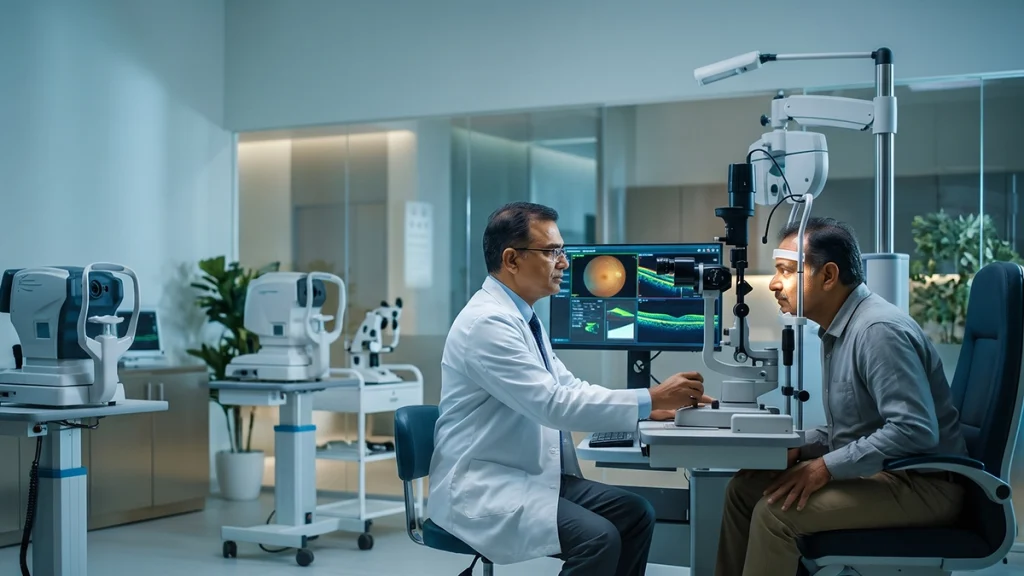
Most people put off eye exams until a problem comes up. In the clinic chair you may wonder what those strange machines are doing. This guide goes over what happens in a full eye checkup, we use plain language to break it down and also what each test is looking for.
Why a Full Eye Checkup Matters
Serious eye diseases often begin without pain. Glaucoma, diabetic eye damage, and macular degeneration can develop unnoticed. The National Eye Institute says only a dilated eye exam can detect these conditions early. Knowing what happens in a full eye checkup involves may ease your worries and make you more likely to schedule one.
The Tests, Step by Step
Step 1: Your eye history. Your appointment begins with a conversation. The doctor asks about your vision, current glasses, medical history, medications, and eye conditions in your family. Those details help determine which tests your eyes need.
Step 2: Reading the letter chart. Rows of letters shrink as you read downward. That simple exercise measures visual acuity, or how clearly you see at close range and from a distance. It is the first answer to what is checked in eye test visits.
Step 3: Finding your glasses power. The doctor tests your vision by placing different lenses before your eyes. You report which lens makes the letters look sharper. That helps identify refractive and vision disorders., including short sight, long sight, and astigmatism.
Step 4: Checking colours. You’re shown cards covered with coloured dots, arranged to make numbers. Difficulty reading them can indicate trouble distinguishing certain colours. Our guide to the colour vision test explains more.
Step 5: Eye muscles and pupils. Track the small moving light with your eyes. That lets the doctor check the muscles controlling eye movement. Then a light is shone into each pupil to observe its response.
Step 6: Side vision.Keep your eyes fixed ahead, then identify objects as they appear off to either side. The test measures peripheral vision—the area outside your direct line of sight—and can reveal early glaucoma damage, which often begins there.
Step 7: The slit lamp examination. You place your chin on a support while the doctor examines your eye through a brightly lit microscope. This slit lamp examination gives a close view of the eye’s front, including the eyelids, cornea, white of the eye, and iris. It can detect early cataracts, dry eye, infections, or scratches.
Step 8: The eye pressure test.Doctors call this test tonometry. After numbing the eye with drops, the doctor either sends a brief eye pressure test of air toward it or touches it gently. It takes only seconds and does not hurt. Elevated pressure may signal glaucoma early.
Step 9: The dilated eye exam.Finally, eye drops enlarge your pupils so the doctor can examine the back of your eye, including the retina, blood vessels, and optic nerve. This dilated eye exam may detect diabetic retinopathy, glaucoma, or macular degeneration at an early stage.
What Each Test Catches
Now you know what happens in a full eye checkup step by step. The table below puts all the eye checkup tests in one place.
| Test | What Happens | What It Can Catch |
| Letter chart | You read smaller and smaller letters | Blurry or weak sight |
| Glasses power | You compare lenses | Short sight, long sight, astigmatism |
| Coloured dot cards | You read numbers in dots | Colour blindness |
| Eye muscles and pupils | You follow a light | Squint, nerve problems |
| Side vision | You spot objects at the sides | Glaucoma, nerve damage |
| Slit lamp | Doctor looks through a microscope | Cataract, dry eye, infections |
| Eye pressure check | Puff of air or gentle touch | Glaucoma risk |
| Eye drops (dilation) | Drops widen your pupils | Diabetic retinopathy, macular degeneration |
How Often Should You Get One?
The National Eye Institute gives clear advice for people at higher risk.
| Who You Are | How Often to Go |
| Over 60 | Every 1 to 2 years |
| Family history of glaucoma | Every 1 to 2 years |
| Diabetes or high blood pressure | At least once a year |
| Children and young adults | As advised by your eye doctor |
If you fall into any of these groups, don’t skip your regular check. For everyone else, ask your doctor what schedule suits you.
How to Prepare for Your Visit
A full what happens in a full eye checkup less uncertain when you know what to expect. Bring your glasses or contact lenses, along with a list of the medicines you take. Eye drops can leave your vision blurry and your eyes sensitive to light for several hours, so pack sunglasses and arrange a ride home. Our eye exam explained guide has more advice for first-time patients.
Conclusion
Now you are aware of what happens in a full eye checkup from the letter chart to the slit lamp examination. Together these eye check up tests present a full picture of your eye health. You no longer have to wonder what is done in eye checkup tests visits or which drops we use. We at ASG Eye Hospital remove the fear out of it. Our doctors go through each step as we go. Book an appointment with us today. If anyone asks what is checked in eye test visits at ASG you can tell them : Everything that is important. We see what happens in a full eye checkup as the first step to a lifetime of healthy vision.
Frequently Asked Questions
1. What happens in a full eye checkup for adults?
Here is the routine for a full eye checkup. We do a sight test, power check and color test. Then we do a slit lamp examination, an eye pressure test and a retina check.
2. What is checked in eye test visits for glasses?
When people ask what is checked in eye test for glasses the answer is simple. We check sharpness and determine your exact power.
3. Does the eye pressure test hurt?
No. During the eye pressure test we use a puff of air or a gentle touch after we put in numbing drops. It may feel strange for a second but it does not hurt.
4. Why do I need a dilated eye exam?
A dilated eye exam allows the doctor to see the back of your eye. It also identifies which silent diseases which may in the future affect your sight.
5. How long do eye checkup tests take?
Most eye checkup tests are quick. Dilation adds to the wait.