Wearing glasses is a common way to correct vision problems such as myopia, hyperopia, and astigmatism. While spectacles work well, many people eventually look for a permanent solution that reduces their dependence on them.
This is where modern vision correction procedures come in.
Surgery that changes how the eye focuses light can now fix refractive errors, thanks to new developments in eye care. People who are good candidates for LASIK and other laser-based procedures may not need glasses at all or may only need them very little.
But not everyone should get these treatments. The choice depends on things like how healthy your eyes are, how thick your corneas are, how old you are, and how stable the power of the glasses is.
Patients can make better choices about how to get rid of their specs for good if they know what their options are.
Why People Start Looking for Ways to Remove Specs Permanently
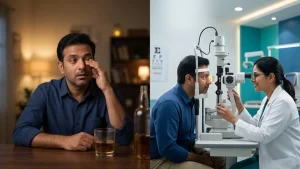
Most patients who walk into an eye clinic aren’t thinking about surgery at first. Usually, they’re tired of the small inconveniences that come with glasses.
Long screen hours are a big reason. Office workers and students now spend 8–10 hours a day in front of laptops and phones. Eye strain builds slowly.
Then there are practical frustrations.
- Glasses sliding down during workouts
- Lenses fogging while wearing masks
- Difficulty playing sports
- Trouble during rainy or dusty commutes
And sometimes, it’s simply the desire for visual freedom.
A common question patients ask is simple: Is there a permanent way to stop wearing glasses?
Often, there is.
How does Eye Surgery to Remove Glasses work?
Vision correction surgeries reshape the cornea, the clear front layer of the eye. This helps the light focus correctly on the retina.
When light focuses correctly, it helps with myopia (nearsightedness), hyperopia (farsightedness), or astigmatism, which all cause blurry vision.
The goal of eye surgery to get rid of glasses is simple: to change the shape of the cornea so that the eye can focus naturally again.
But first, doctors do a thorough eye exam.
Most of the time, this includes:
- Corneal topography is a way to map the surface of the eye.
- Pachymetry is a way to find out how thick the cornea is.
- Refraction tests to find out exactly how strong the glasses are
- Tear film analysis to look for dry eye
Before any laser procedure is done, the thickness and stability of the cornea are important.
Can LASIK surgery remove your glasses permanently
LASIK is the procedure most people hear about first.
And yes, LASIK can remove glasses permanently for many patients.
During LASIK (Laser-Assisted In Situ Keratomileusis), a thin flap is created on the cornea. A laser then reshapes the underlying tissue to correct the refractive error.
The entire treatment usually takes around 10–15 minutes for both eyes.
Vision often improves within a day.
But suitability depends on a few factors:
- Stable spectacle number for at least a year
- Adequate corneal thickness
- No active eye infections or corneal disease
- Age typically above 18
Because not every eye responds the same way.
And sometimes another procedure may be recommended instead.
When is LASIK not recommended for removing glasses?
Some patients have thin corneas or irregular corneal shapes. In those cases, LASIK might not be advised.
Alternative treatments can include:
- SMILE (Small Incision Lenticule Extraction)
- PRK (Photorefractive Keratectomy)
- ICL implantation for high-power prescriptions
Each option addresses different eye conditions.
So the best treatment to remove glasses permanently varies from person to person.
What does recovery look like after vision correction surgery?
Recovery tends to be quicker than many people imagine.
Most LASIK patients return to normal routines within 24–48 hours. Mild irritation, watery eyes, or light sensitivity may occur briefly.
But the cornea heals quickly.
Doctors usually advise:
- Avoid rubbing the eyes
- Use prescribed lubricating drops
- Limit heavy workouts for a few days
- Reduce screen time initially
And yes, patients often notice clearer vision the very next morning.
One small detail surprises many first-time patients.
The surgery itself is painless.
Who Is Usually a Good Candidate for Vision Correction Surgery?
Not everyone who wants to remove glasses permanently will qualify immediately.
Doctors typically look for a few conditions:
- Age above 18–21 years
- Stable spectacle number
- Healthy corneal structure
- No uncontrolled diabetes or severe dry eye
Because vision numbers that are still changing can affect long-term results.
And certain corneal conditions, such as keratoconus, may rule out laser procedures altogether.
Which raises another question patients often ask.
If LASIK isn’t possible, does that mean glasses are permanent?
Not necessarily.
Lens-based procedures like Implantable Collamer Lens (ICL) can still correct high prescriptions in many cases.
What is the best treatment to remove glasses permanently?
People often search for the best treatment to remove glasses permanently as if there is one universal answer.
But eyes vary.
Two patients with the same spectacle number may still need different procedures. Corneal shape, tear quality, and lifestyle habits all play a role.
Because someone who spends long hours on computers may experience dryness differently from someone working outdoors.
Most eye specialists prefer a customized approach after diagnostic scans.
And that evaluation usually takes less than an hour.
What changes do patients notice after removing glasses permanently?
Vision correction procedures have been around for decades now.
Yet the biggest change patients mention afterwards is surprisingly simple.
They stop thinking about their glasses.
Morning routines get shorter. Rainy commutes feel easier. Even small things like watching a late-night movie without searching for spectacles suddenly feel different.
But surgery is always preceded by a detailed consultation and eye scan.
ASG Eye Hospital provides vision correction consultations across several cities, including ASG Eye Hospital in Mumbai, ASG Eye Hospital in Jaipur, ASG Eye Hospital in Patna, ASG Eye Hospital in Uttar Pradesh, and many others. Evaluations there determine whether LASIK or another procedure is suitable for someone exploring how to remove specs permanently.
Frequently Asked Questions
Can LASIK remove glasses permanently?
Yes, in most suitable candidates LASIK reshapes the cornea so that light focuses correctly on the retina. This often eliminates the need for glasses for distance vision.
Is eye surgery to remove glasses safe?
Laser vision correction has been performed for decades and is widely considered safe when patients are carefully screened and treated by trained specialists.
What is the best treatment to remove glasses permanently?
The best treatment depends on the patient’s eye structure. LASIK, SMILE, PRK, or ICL may be recommended after corneal scans and a detailed eye examination.