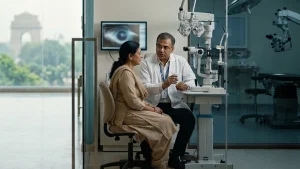

Your eye doctor has recommended surgery for you and also you have diabetes. Will your sugar levels play a role in this? Will the healing process take longer? The good news is that eye surgery with diabetes is very common and does usually go well. You just need a bit more preparation. This guide goes over how to prepare and what to expect in simple terms.
Why Diabetes Changes Eye Surgery
Diabetes affects small blood vessels which are present all over the body which include that in the eyes. Over many years of high sugar levels the retina, the thin tissue at the back of the eye, may be damaged. This is what doctors term diabetic retinopathy. Also there may be swelling in the center of the retina which is known as macular edema.
Diabetes also brings on cataracts early. In a 2019 report from Community Eye Health which is available on the U.S. National Library of Medicine’s PMC site It is put out that cataract tends to appear at an earlier age in people with diabetes. Also it progresses faster when sugar is high. That is the reason why diabetes and cataract surgery often go hand in hand.
The report also notes that post surgery swelling and redness is a greater issue in diabetics. Also present retinal issues may play a role in the degree of improvement in vision. Thus for eye surgery with diabetes a very careful pre and post op work up.
Cataract and Diabetes: What to Expect
Cataract is the most frequent operation for diabetics. In cataract surgery the doctor removes the cloudy lens and puts in a clear artificial one. The surgery itself is the same for all. What changes is the pre operative planning.
Before the diabetes and cataract surgery your doctor will do a close look at your retina. If we see swelling or bleeding they may go in with laser treatment or injections. Treating the retina first also tends to do better for sight post op. Per the PMC article a smooth cataract op in itself does not make retinopathy worse.
Many patients are also very worried about the results. In a 2025 study of 300 patients with diabetes and cataract surgery we saw that in general people did better post operation. We had that 69% achieved good reading vision. Those with better sugar control did slightly better.
How to Prepare: Your Sugar Levels
The primary issue is blood sugar before eye surgery. You do not need perfect numbers, but we do see that steady control is what is recommended. The 2025 study reports that the diabetes guidelines put out a range of 140 to 180 mg/dL for sugar around the time of surgery. Also it is not a good idea to push sugar levels too low as that may cause a sudden drop.
Your eye doctor may have you see your physician prior to surgery. They will look at your recent sugar tests and HbA1c. If the day of the blood sugar before eye surgery is very high the team may change your insulin. Also the procedure may be put off for a short time.
Never change or stop your diabetes medications on your own. On the day of surgery check in with your doctor.
| Step Before Surgery | What to Do | Why It Matters |
| Check sugar reports | Share recent fasting sugar and HbA1c | Shows how stable your sugar is |
| Retina check | Get a dilated eye exam | Finds swelling or bleeding to treat first |
| Physician visit | Review insulin and tablets | Keeps sugar steady on surgery day |
| Medicine list | Bring all your medicines | Helps the team plan safely |
| Morning plan | Ask what to eat and take | Avoids very high or very low sugar |
Keeping your sugar steady for a few weeks helps more than a last-minute fix. Small daily habits, like regular meals and walks, make a real difference. Your eyes reflect your whole health, as our guide on systemic disease and eyes explains.
What Changes After Surgery
Healing is where diabetes matters most. High sugar can slow the body’s repair work and raise the risk of swelling. For better wound healing diabetes eye surgery patients should keep sugar steady in the weeks after the operation.
Use every eye drop exactly as told. Anti-inflammatory drops are especially important, because swelling is more common in diabetic eyes. Do not rub the eye, and keep dirty water away from it. Go to every follow-up visit, even if you feel fine.
Your doctor will also recheck the retina after surgery. Sometimes the retina needs laser or injections later. This is part of normal care for eye surgery with diabetes, not a sign that something went wrong.
| What You Notice | Normal or Not? | What to Do |
| Mild redness or grittiness | Normal | Use drops as advised |
| Slight blur for a few days | Normal | Rest and use drops |
| Rising pain or heavy redness | Warning sign | Call your eye doctor at once |
| Sudden drop in vision | Warning sign | Seek urgent care |
| Very high sugar readings | Needs attention | Call your physician |
Other Eye Surgeries and Diabetes
Cataract is not the only operation people with diabetes may need. Some need retina surgery or injections for diabetic eye disease. The same rules apply. Keep sugar steady, treat the retina on time and never skip follow-ups.
Conclusion
Eye surgery with diabetes is not to be feared. Plan ahead, keep your sugar stable and get your retina checked first. Stable blood sugar before eye surgery and great aftercare support wound healing diabetes eye surgery. Most people see much better after eye surgery with diabetes. At ASG Eye Hospital we work with your physician to make eye surgery with diabetes safe and simple. Book a consultation, and let us walk you through your eye surgery with diabetes step by step. With the right care, worry over diabetes eye surgery goes down.
Frequently Asked Questions
1. Is eye surgery with diabetes safe?
Yes. Eye surgery with diabetes is very common and is also usually safe. Good sugar control and a retina check make it safer.
2. What should my blood sugar before eye surgery be?
Guidelines from research report 140 to 180 mg/dL for pre op. Your doctor will set the right blood sugar before eye surgery.
3. Does diabetes and cataract surgery need a longer recovery?
Not always. But for diabetes and cataract surgery we may need to do more frequent follow up and prescribe additional drops.
4. What helps wound healing diabetes eye surgery patients most?
Steady sugar levels, regular drops and clean hands are key. For good results in diabetes, eye surgery care does not rub the eye.
5. Can surgery make retina damage worse?
A smooth cataract procedure in itself does not speed the process. But in the case of pre-existing retina disease close follow up is required after eye surgery with diabetes.
References
- (PMC, U.S. National Library of Medicine) https://pmc.ncbi.nlm.nih.gov/articles/PMC6390521/
- (PMC, U.S. National Library of Medicine) https://pmc.ncbi.nlm.nih.gov/articles/PMC12357705/