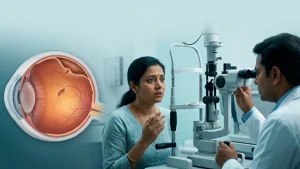
The retina is a thin layer which is light sensitive and at the back of the eye and plays a key role in what we see. As fluid builds up under this layer the retina may pull away from the support tissue which it is connected to. This is what we call exudative retinal detachment. Also unlike some other cases of retinal detachment which may be a result of a retinal tear or hole, in this case it usually does not have a retinal tear or hole present.
An exudative retinal detachment may present due to inflammation, abnormal blood vessels, tumors, vascular disorders, or other ophthalmic conditions. Early identification of the cause is key in treatment which in turn depends greatly on what initiated the fluid accumulation.
What Is Exudative Retinal Detachment?
Exudative retinal detachment is a condition which presents with fluid accumulation between the neurosensory retina and the retinal pigment epithelium. Also known by ophthalmologists as exudative RD or serous retinal detachment.
In exudative RD, what is usually seen is that there is no retinal break which allows fluid under the retina. Rather it is the result of leaky blood vessels, inflammation, or impaired fluid movement. As the amount of fluid increases some of the retina may lift out of its normal position.
| Type of Retinal Detachment | What Happens? |
| Rhegmatogenous | A retinal tear or break allows fluid beneath the retina |
| Tractional | Scar tissue pulls the retina away from its normal position |
| Exudative RD | Fluid accumulates beneath the retina without a retinal tear |
Exudative Retinal Detachment Causes
Understanding exudative retinal detachment causes is key in that this condition which at times presents as a result of another eye or systemic disease. The National Eye Institute reports that among the common causes are leaky blood vessels and swelling at the back of the eye.
Inflammatory eye diseases are important exudative retinal detachment causes. What happens is that inflammation breaks down the blood retinal barrier which in turn causes fluid to accumulate under the retina. Also to this may be added that injury to the eye, age related macular degeneration, certain eye tumors, and Coats disease play a role.
Other exudative retinal detachment causes are due to vascular issues, infections, postoperative complications, and some systemic diseases. Also as many conditions may present with the same retinal picture what is required is a thorough exam before we begin treatment.
Symptoms of Exudative Retinal Detachment
Symptoms of exudative retinal detachment will present based on the site and degree of the fluid that has collected. A person may report inexact or reduced vision, visual distortion, or loss of vision.
Some in the case of exudative RD patients we see that they may report a shadow or dark area in their visual field. Changes may present itself gradually over time or all of a sudden which in turn may bring on more pronounced visual symptoms. Any sudden or unexplained visual change should be brought to the attention of an ophthalmologist right away.
Retinal detachment is considered a medical emergency because delayed treatment may increase the risk of permanent vision loss.
How Is Exudative RD Diagnosed?
An ophthalmologist who is a medical doctor that specializes in the eye diagnoses what is known as exudative retinal detachment through a detailed eye exam. The doctor will look at the retina to see if there is fluid build up and also to determine if there is a retinal tear.
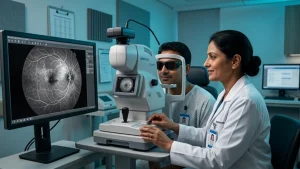
Tests like optical coherence tomography which provide in depth cross sectional views of the retina. Also fundus photography and fluorescein angiography may be used to study the cause of leakage. ATG Eye Hospital reports that we use diagnostic methods like OCT, retinal imaging, fundus photography and fluorescein angiography for retinal assessment.
Exudative Retinal Detachment Treatment
Treatment of exudative retinal detachment is mainly directed at managing the base disease which in turn will reduce the build up of fluid in the retina this may differ for each patient. Thus two people with exudative RD may present with and require very different treatments.
| Underlying Problem | Possible Treatment Approach |
| Inflammatory eye disease | Medicines to control inflammation |
| Abnormal retinal blood vessels | Laser or other targeted treatment when appropriate |
| Infection | Treatment directed at the infection |
| Ocular tumour | Specialist evaluation and tumour-specific management |
| Persistent retinal fluid | Further medical or surgical assessment |
Medical management is a mainstay in the treatment of exudative retinal detachment. Surgery is not a routine option and may be brought in for certain cases which do not respond to medical management.
Treatment of exudative RD will always be based on the cause. For instance we see a different approach is required for inflammation related disease as we do for a tumor or vascular disorder. Early identification of exudative retinal detachment causes therefore supports more appropriate treatment planning.
Can Exudative Retinal Detachment Affect Vision Permanently?
The clinical presentation of exudative retinal detachment is based on the etiology, the degree of the detachment, the length of time it has been present, and which area of the retina is affected. Fluids that are persistent under the retina also may impair retinal function.
Timely intervention at the onset of exudative RD presents a chance for doctors to identify and treat the base health issue. It is important for patients who are suddenly presented with blurred vision, distortion, shadows, or vision loss which came out of the blue to seek immediate ophthalmic care instead of waiting for the symptoms to improve on their own.
Conclusion
Exudative retinal detachment which is a result of fluid collection under the retina without a retinal tear or significant traction. We see that exudative retinal detachment causes range from inflammation and vascular leakage to tumors and other eye diseases which is why accurate diagnosis is key. Early recognition of symptoms and prompt referral to a specialist is important in preserving vision. Patients with what may be exudative RD are encouraged to see a retina specialist at ASG Eye Hospital for an in depth evaluation and a personal treatment plan.
Frequently Asked Questions
1. Is exudative retinal detachment serious?
Yes. Exudative retinal detachment is a serious threat to vision, especially when the center of the retina is affected. Early diagnosis is key in identifying the root cause and what treatment to use.
2. What are the main exudative retinal detachment causes?
Important exudative retinal detachment causes are from inflammation, leaking or abnormal blood vessels, eye injury, certain tumors, age related macular degeneration, and Coats disease.
3. Is there a retinal tear in exudative RD?
Usually, no. In exudative RD, fluid accumulates beneath the retina without the retinal tear typically seen in rhegmatogenous retinal detachment.
4. Does exudative retinal detachment require surgery?
Not at all. In many cases of exudative retinal detachment the base cause which may be medical or ophthalmic in nature requires to be treated. Surgery may be an option in selected cases when other methods prove to be inadequate.
5. Can exudative RD be treated?
Yes. Treatment of exudative RD depends on its underlying cause. Early diagnosis can help doctors select the appropriate management strategy and protect retinal function.
6. Which doctor should I consult for exudative retinal detachment?
Not at all. In many cases of exudative retinal detachment the base cause which may be medical or ophthalmic in nature requires to be treated. Surgery may be an option in selected cases when other methods prove to be inadequate.
Authoritative References
National Eye Institute (U.S. Government) – Types and Causes of Retinal Detachment:
https://www.nei.nih.gov/eye-health-information/eye-conditions-and-diseases/retinal-detachment/types-and-causes-retinal-detachment?utm_source=chatgpt.com
National Library of Medicine / NCBI – Exudative Retinal Detachment:
https://www.ncbi.nlm.nih.gov/books/NBK589701/?utm_source=chatgpt.com
National Eye Institute – Retinal Detachment:
https://www.nei.nih.gov/eye-health-information/eye-conditions-and-diseases/retinal-detachment?utm_source=chatgpt.com
ASG Eye Hospital – Retina Diseases Treatment:
https://www.asgeyehospital.com/specialities/retina-diseases/pune/?utm_source=chatgpt.com