
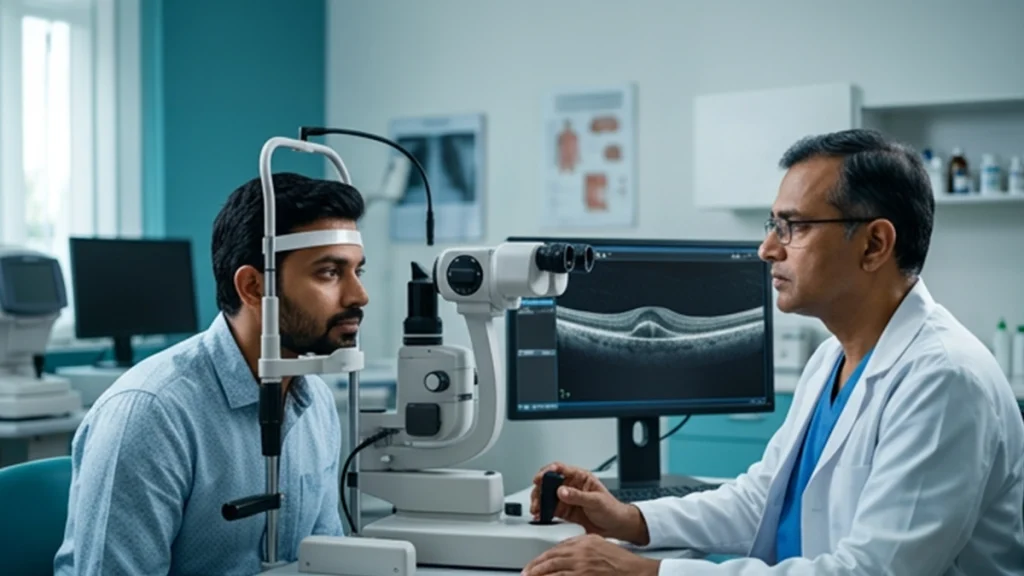
A sudden blind spot or dark area in the center of your field of vision may present itself unexpectedly. One retinal condition which causes this is central serous chorioretinopathy. which we will also refer to as CSCR This condition happens when fluid builds up under the retina which in turn affects the macula. As the macula is what is responsible for our sharp central vision that allows us to read, drive or see fine details that function is impaired.
Although in many cases of CSCR there is improvement over time, we see that persistent or recurring disease requires a proper evaluation. Early diagnosis allows an ophthalmologist to track retinal changes and determine if central serous chorioretinopathy treatment is needed.
What Is Central Serous Chorioretinopathy?
Central serous chorioretinopathy is a retinal disease that has fluid which collects under the center of the retina. The disease also features changes in the choroid and retinal pigment epithelium that in turn cause fluid to accumulate under the retina.
The term also goes by CCSR, central serous retinopathy, or CSCR. It mostly affects one eye, at the same time may play out in both eyes. In many patients the fluid will spontaneously leave the retina with no intervention at all. However chronic or recurring CSCR which doesn’t resolve can damage retinal health and visual quality.
| Feature | What It May Mean |
| Blurred central vision | Objects or words may appear less sharp |
| Central dark or grey area | A shadow-like patch may appear in the visual field |
| Distorted vision | Straight lines may appear bent or irregular |
| Micropsia | Objects may look smaller than their actual size |
| Reduced contrast | Colours and details may seem less distinct |
What Are the Symptoms of CSCR?
Symptoms of CSCR vary between people. What is reported is that blurred central vision is very common. Some report that straight lines appear wavy, others note a grey out or dim spot in the center of their vision.
Another feature of CSCR is micropsia which presents as objects that are smaller than they are. Also we see that color perception may change, and that issues with contrast sensitivity and focusing may present. While these symptoms do present in other retinal diseases it is important to have a full eye exam which also includes testing that what you report is accurate.
What Causes CSCR?
The cause of CSCR is complex. What we do know is that there is an issue with the choroid which is the vascular layer under the retina. Also there is change in the retinal pigment epithelium.
When it comes to CSR eye disease causes, We see that which has great attention is the issue of corticosteroid exposure. Steroid medications are known to have a relationship with this condition. Patients should report to their ophthalmologist the use of over the counter and prescribed tablets, injections, inhalers, nasal sprays, creams which contain steroids. Also they should bring to the doctor’s notice any which may be used for another health issue. Do not discontinue steroids which may have been prescribed for another health concern without first consulting the prescriber.
Stress also plays a role in the development of CSCR although what that role is exactly, is a bit more complex than to say stress is what causes the disease. Also there are other reports of association which include sleep issues and certain systemic conditions. An ophthalmologist will thus go over the whole health of the eye as well as related medical history.
| Clinical Situation | Usual Management Approach |
| Recent uncomplicated CSCR | Observation and regular retinal monitoring may be appropriate |
| Persistent subretinal fluid | Further assessment and active treatment may be considered |
| Chronic CSCR | Treatment may be advised to limit ongoing retinal damage |
| Recurrent CSCR | Imaging helps guide an individual treatment plan |
How Is CSCR Diagnosed?
An ophthalmologist usually does a retinal exam that includes pupil dilation. Also we use the term OCT which is very common for it produces in detail cross sectional images of the retina and also is able to show subretinal fluid.
Depending on the time of presentation we may also do fluorescein angiography, fundus autofluorescence, indocyanine green angiography, and OCT angiography. These tests are done in order to differentiate CCSR from other retinal conditions and to also find out what complications are present.
Central Serous Chorioretinopathy Treatment
Not all patients require right away central serous chorioretinopathy treatment. In many acute cases improvement is spontaneous which is why we may recommend a careful watchful wait when the ophthalmologist deems it safe.
When there is persistent fluid, vision which is to say that it is a chronic state, or the disease presents as a chronic condition, we may consider active central serous chorioretinopathy treatment in chronic cases photodynamic therapy is a very good option. Laser treatment may be used for certain leakage patterns. What we choose depends on the site of the leak, how long the disease has been present, what we see in terms of retinal imaging, history of previous episodes, and the health of the individual eye.
Patients that have CSCR should report for follow-up even when symptoms begin to improve. Repeated or extended fluid accumulation in some cases causes permanent retinal changes.
Conclusion
Central serous chorioretinopathy may cause short term problems with central vision and in some cases leads to permanent retinal changes. It is that which of the symptoms present and the results of a retinal exam which will determine if central serous chorioretinopathy treatment or close monitoring is what is needed.
If you experience blurred central vision, distorted lines, or a shadow that has appeared out of the blue, it’s a good idea to get in touch with the ophthalmologists at ASG Eye Hospital for a detailed retinal exam instead of waiting for your symptoms to progress.
Frequently Asked Questions
1. Is CSCR a serious eye condition?
In many cases acute CSCR resolution is complete with no permanent major vision loss. But in the case of persistent or recurrent disease which may lead to retinal damage we see that regular monitoring is key.
2. Can CSCR heal on its own?
Yes. Acute CSCR tends to improve as the fluid accumulates which then goes down on its own. Time of recovery is variable and an ophthalmologist should be involved in the care.
3. Are CCSR and CSCR the same?
Yes. CCSR and CCSRare used as terms for central serous chorioretinopathy.
4. What is the best central serous chorioretinopathy treatment?
There is no universal central serous chorioretinopathy treatment which will suit all patients. In the case of acute disease watchful waiting may be appropriate, but for the persistent or chronic cases we may have to go in for treatments like photodynamic therapy or selective laser procedures.
5. Can CSCR return after recovery?
Yes.CSCR may present again. If you see the return of central blur, distortion, or a dark spot make an appointment for a second retinal exam.
Reference Links
- NCBI Bookshelf – Central Serous Chorioretinopathy
https://www.ncbi.nlm.nih.gov/books/NBK558973/ - PubMed – Central Serous Chorioretinopathy
https://pubmed.ncbi.nlm.nih.gov/32644399/ - National Eye Institute – Retinal Diseases Information
https://www.nei.nih.gov/learn-about-eye-health/eye-conditions-and-diseases