
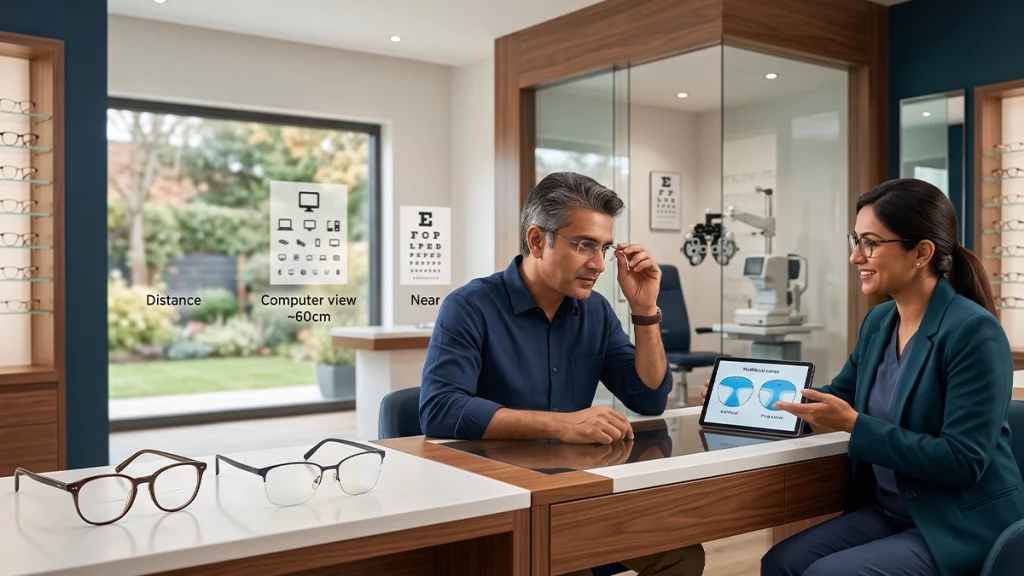
You may hold your phone at arm’s length. In dim light menus are hard to make out. If this is you, your eyes are just getting older. The issue of progressive vs. bifocal lenses is what will make your next pair of glasses comfortable.
Why Near Vision Changes After 40
As a young person your lens is soft and flexible. With age it slowly hardens and also it loses the ability to focus at close range. This is what doctors call presbyopia. The National Eye Institute reports that it usually begins at age 45. It also reports that it gets progressively worse until around 65.
Common symptoms are eye strain, headaches and the need to hold books at arm’s length. Many people already wear glasses for distance or other refractive and vision disorders. Now they are requiring corrections for near work also. That is the choice between progressive vs bifocal lenses.
What Is a Bifocal Lens?
A bifocal has two see through sections. At the top is the section for seeing far away. At the bottom is a small section for reading. There is a visible line which separates the two sections.
What Is a Progressive Lens?
A progressive lens also corrects for distance and near vision. Also it includes a smooth transition zone for arm’s length tasks like computer work. The power changes gradually from the top to the bottom. There is no line so the glasses have a very regular look.
7 Key Differences Between Progressive vs Bifocal Lenses
The first point is the visible line. In bifocals you see a clear line across the lens. In the case of progressive lenses there is no line at all which many people find very appealing. Look is a key issue and this point in many cases decides the choice between bifocal vs progressive.
The second issue is related to the number of zones. Bifocals for distance and close. Progressives have an intermediate zone for laptops, dashboards and kitchen counters. If you spend a great deal of time on screens the middle zone is very helpful.
The third issue is what we call image jump. With bifocals you notice the image jump when your eyes pass the line. With progressive lenses this issue is resolved as the power changes gradually.
The forth difference is side blur. In Progressives there are narrow clear zones which at the same time present soft blur at the edges. This is what causes most of the progressive lenses problems which include a tendency to feel like the world is moving when you turn your head. Bifocals on the other hand have wide reading areas which do not have any edge blur.
The fifth issue is adjustment time. Bifocals you may notice almost right away. As for Adjusting to progressive lenses it may take a week or two. You learn to direct your line of sight to what you want to see.
The sixth difference is cost. Bifocals cost less because the design is simpler. We cover progressive lens price India ranges in detail below.
The seventh point is lifestyle fit. Bifocals do well for people who mainly read or are looking into the distance. Progressives do better for people who are constantly changing focus between close (like a phone), mid (like a computer) and far (like the road). Your routine should play a large role in the decision between progressive vs bifocal lenses .
| Feature | Bifocal Lens | Progressive Lens |
| Visible line | Yes | No |
| Vision zones | Far and near | Far, middle and near |
| Image jump | Yes, at the line | No |
| Side blur | Very little | Some at the edges |
| Adjustment time | A few days | About one to two weeks |
| Best for | Reading and distance | Mixed tasks and screens |
| Cost | Lower | Higher |
How Much Do These Lenses Cost in India?
Price is the determinant of which progressive vs bifocal lenses families will choose. In India we see basic bifocals at around ₹1,000 to ₹3,000. Premium coated bifocals will set you back by about ₹3,000 to ₹8,000. As for the progressive lens price India consumers buy that will depend on design and brand.
| Lens Type | Approximate Price in India |
| Basic bifocal | ₹1,000 to ₹3,000 |
| Premium coated bifocal | ₹3,000 to ₹8,000 |
| Basic progressive | ₹1,500 to ₹5,000 |
| Mid-range digital progressive | ₹5,000 to ₹12,000 |
| Premium progressive | ₹12,000 to ₹30,000 or more |
These numbers we present are from Indian optical stores which vary by city and brand. A cheap progressive lenses problems with a poor fit will cause more issues than it is worth saving. It is best to check the progressive lens price India stores you visit against the quality of the fit.
Common Fit Issues and How to Fix Them
Most progressive lenses problems are a result of a poor fit or wrong frame size. A frame which is too small will cut off the reading area. Also if the lens is misaligned the clear zone will be off center. A good optician will take the time to measure your eyes properly to avoid these issues.
Some people experience dizziness on stairs at first. Look down through the top of the lens, not the bottom. Move your head, not just your eyes, when you read. These small changes will make adjusting to progressive lenses easier.
Tips for Getting Used to New Lenses
Wear your new glasses at all times. Going back to your old pair is a step back. When you read do so with your chin up and your eyes looking down. Turn your head to side to side instead of using your eyes to glance.
Give it a two week time frame before you determine how they are working. If you still have blur or dizziness, come back to your eye doctor. Patience is key to breaking in to adjusting to progressive lenses.
Which Lens Should You Choose?
In the bifocal vs progressive debate there is no right answer. We go with bifocals if you are looking for a lower price and quick comfort. Go with progressives if you use screens a lot and prefer a seamless look. An eye exam is the best way to determine which between progressive vs bifocal lenses is right for your eyes.
Conclusion
The choice of progressive vs bifocal lenses is based on your daily requirements. Bifocals present value and instant comfort. Progressives provide smooth vision at all distances. If you are still at a stand still between bifocal vs progressive we recommend you come in for an eye exam at ASG Eye Hospital. Our doctors will do a full check of your eyes and guide you to the best presbyopia treatment. Make an informed progressive vs bifocal lenses choice and enjoy clear vision again.
Frequently Asked Questions
1. Which is better, progressive vs bifocal lenses?
Neither is better for everyone. Progressive vs bifocal lenses depends on your work, budget and comfort.
2. What are the most common progressive lenses problems?
Side blur, dizziness and a narrow reading area top the list. Most progressive lenses problems fade with a proper fit.
3. How long does adjusting to progressive lenses take?
Most people adapt within about two weeks. Adjusting to progressive lenses is faster if you wear them all day.
4. Is bifocal vs progressive different for computer users?
Yes. In the bifocal vs progressive choice, progressives win for screens because of the middle zone.
5. What is the progressive lens price India buyers usually pay?
Basic to mid-range pairs cost about ₹1,500 to ₹12,000. The progressive lens price India stores charge rises with premium brands.
References
- Presbyopia, National Eye Institute, U.S. National Institutes of Health
https://www.nei.nih.gov/eye-health-information/eye-conditions-and-diseases/presbyopia - What is a Bifocal Lens? Uses, Types and Price in India, Centre for Sight
https://www.centreforsight.net/blog/everything-you-should-know-about-bifocals - Understanding Progressive Lens Pricing in Kolkata 2024 to 2026, Himalaya Optical
https://himalayaoptical.com/blogs/news/understanding-progressive-lens-pricing-in-kolkata-since-2024-2026