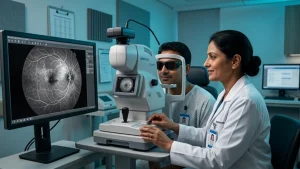
Changes indeed sometimes we see retinal changes which do not at first affect vision. A small retinal hole, tear, or weak spot may thus come as a surprise during a routine dilated eye exam. In some cases however people may notice all of a sudden flashes of light, new floaters, or a shadow in their field of vision. These symptoms require prompt medical care as some retinal breaks may progress to retinal detachment.
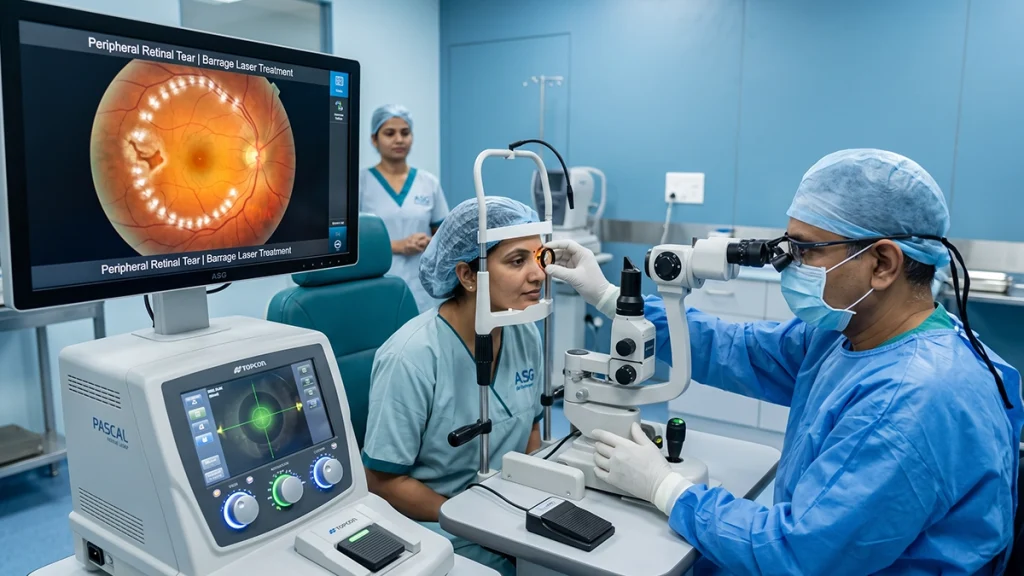
Barrage laser is a retinal procedure which an ophthalmologist will put forth for certain retinal holes, tears, or areas which have a large risk of retinal detachment. We do see the application of the laser which covers the affected retinal area. As these spots heal up they produce adhesions between the retina and the underlying tissue.
Doctors are using a wide range of barrage laser treatment to repair the retina which in turn surrounds selected lesions and which in turn reduces the chance that fluid will pass through retinal breaks and cause more separation. It is a usually a same day procedure which still requires very close retinal evaluation and follow up.
What Is Barrage Laser?
Barrage laser is a type of retinal laser photocoagulation. In the course of the treatment the retina specialist will apply a series of controlled laser spots around a retinal hole, tear or any other chosen weak area.
The result is that we see small scars in the treated area. These scars in turn produce a stronger bond between the retina and the base tissue. In this way laser barrage is put to use as a protective perimeter of an at risk area. The National Eye Institute reports that laser photocoagulation for retinal tears does this by which small burns are put around a retinal tear or hole. These burns in time heal into scars that in turn help to hold the retina in place.
It is true that a barrage laser does not ameliorate all retinal conditions. Also not all retinal holes require treatment. A retina specialist determines which of the options watch and wait, barrage laser treatment is best after a retinal exam.
Why Is Barrage Laser Treatment Done?
The primary use of barrage laser is to prevent retinal detachment in patients which are proper candidates. The retina is a thin layer which is also a very delicate light sensitive layer that lines the back of the eye. Should this layer sustain a tear, fluid will sometimes flow in that opening which will then collect under the retina. This causes the retina to lift off from the back of the eye.
A doctor may choose to use the barrage laser retina in cases where there is a retinal tear or hole that has features which indicate a high risk of progression. The decision is based on the type and location of the lesion, symptoms, related retinal findings, and the patient’s individual risk factors.
Common Situations Where Barrage Laser May Be Considered
| Retinal finding or situation | Why treatment may be considered |
| Retinal tear | To create adhesion around a tear and reduce the risk of progression |
| Selected retinal holes | Treatment may be advised when the ophthalmologist considers the hole clinically significant |
| Weak peripheral retina | Certain lesions may require preventive treatment after specialist assessment |
| Symptoms with a retinal break | New flashes or floaters may prompt urgent examination and treatment when a significant tear is detected |
| Higher-risk eye | Previous retinal problems, eye surgery, trauma, or other findings may influence the treatment decision |
The decision to perform a barrage laser should be based on results of a thorough retinal exam. Also it is not true that treatment is a given for all retinal holes or weak areas.
What Symptoms May Lead to a Retinal Examination?
Some retinal tears present with no signs at all. In other cases they do present suddenly. New flashes of light, a large increase in floaters, dark spots, a shadow which is curtain like, or loss of a portion of your visual field may be a sign of a retinal issue.
These symptoms should not be missed. Retinal detachment is a threat to vision and may require emergency surgery. Prior to large scale retinal detachment the use of barrage laser treatment is very useful which is reported to do best when an ophthalmologist identifies a retinal break which is treatable. If you see sudden retinal symptoms go in for an eye exam instead of waiting for them to go away.
How Does Barrage Laser Work?
During the course of a barrage laser procedure a medical laser is used to deliver precise energy to specific retinal areas. The ophthalmologist will place laser spots around the retinal tear, hole, or weak area instead of just the defect center.
The laser causes a precise tissue reaction. As time goes by healing brings about adhesion between the treated retina and the underlying tissue. This adhesion in turn forms a barrier around the fragile area.
This is the reason that in retinal care we barrage lasers used which does what it can to reduce the chance of fluid getting in through a retinal break. While we can’t say that this treatment guarantees to prevent retinal detachment from happening at all, also. What patients do also has to play a role they have to watch out for warning signs and to report in to their follow up exams.
What Happens Before Barrage Laser Treatment?
Before I recommend a barrage laser we first do a thorough retina exam. Also we may dilate the pupils which in turn allows for a better view of the peripheral retina. We do this exam to identify the location, size, type and extent of a retinal lesion. Also we check for signs of retinal detachment as well as other conditions which may in turn change the treatment plan.
If barrage laser retina treatment is suitable,the doctor will go over the reasons for the treatment, what you may expect to gain from it, possible risks involved, and follow up care. Also it is important that you tell your doctor of any previous eye surgery, retinal issues, medications, allergies, and any other related health issues.
What Happens During the Barrage Laser Procedure?
Barrage laser treatment is a common out patient treatment. Eye drops which cause the pupil to dilate are used as well as numbing drops which reduce discomfort. An anesthetic contact lens may be placed on the eye by the ophthalmologist. This lens is used to better view the retina and for the ophthalmologist to very accurately direct the laser.
During laser barrage, patients report seeing bright flashes of light. The doctor will then apply a designed pattern of laser spots to the affected retinal area. Time of the procedure is based on the size, number and location of the areas which require treatment. Some patients may experience only minimal discomfort, while others may report a mild stinging or pressure.
Once the barrage laser session finishes, the doctor examines the eye and gives specific aftercare instructions.
What Can You Expect After Barrage Laser?
Vision which may be blurred for some time after the barrage laser, also because the pupil was dilated. Also bright light may feel uncomfortable for a while.
Some report minor eye discomfort and also a change in vision. If the ophthalmologist says it’s not safe to drive after treatment patients should arrange for a ride home.
Barrage laser treatment does not produce results immediately. What we see is that the retina’s response is slow to produce a secure adhesion. That is why we see the importance of activity restrictions and of the scheduled reviews.
Barrage Laser Aftercare
Recovery after barrage laser is in general a simple process but what is done may differ according to the retina’s health and the scope of the treatment.
Your ophthalmologist may advise you to avoid strenuous exercise, heavy lifting, or what is in fact any activity which puts extra pressure on the body at the beginning of the healing process. Patients should follow the specific restrictions given for your eye and not rely on general online advice.
Prescribed eye drops are to be used as directed. At follow up we will assess the barrage laser retina and see that the laser treatment response is adequate. Also it is important for patients that they report any new retinal symptoms even after treatment.
Warning Signs After Barrage Laser
| Warning sign | What you should do |
| Sudden increase in floaters | Contact an ophthalmologist promptly |
| New or increasing flashes | Arrange urgent retinal assessment |
| Curtain or shadow over vision | Seek urgent eye care |
| Sudden reduction in vision | Get immediate ophthalmic evaluation |
| Significant or worsening eye symptoms | Contact the treating eye specialist |
These at times do not present that barrage laser treatment has failed. However they do require prompt evaluation as it may be that another retinal tear or retinal detachment has developed.
Are There Risks Associated With Barrage Laser?
In the same way that other medical procedures do, barrage laser treatments also have risks and issues. Most treatment decisions therefore balance the risk of the retinal lesion against that of the intervention.
Possible results may include transient blurred vision, discomfort, glare, or visual disturbances. Rare complications may occur based on the area and dose of treatment.
A major issue with laser barrage is that it targets the present area of retinal tear. It does not stop other future tears from appearing in different areas of the retina. This is the reason we still have to assess for new symptoms post successful treatment.
The retina specialist will discuss individual risks before proceeding with barrage laser treatment.
Can Barrage Laser Prevent Retinal Detachment?
The purpose of barrage laser is to reduce the risk of retinal detachment which is related to certain retinal breaks. It does this by producing adhesion around the affected area. Also it is important to note that no preventive retinal procedure guarantees results. A treated break may-stay stable, also a new retinal tear may present in a different area. Thus regular follow up is important after barrage laser retina treatment especially for people which already have risk factors for retinal tears or detachment.
Barrage Laser Treatment Cost in India
The barrage laser treatment cost varies considerably between hospitals and patients. Factors include the retinal issue, number of treatment areas, one or both eyes, number of sessions, investigations, hospital location, and specialist fees.
Government package lists may serve as a reference but should not be looked at as the be all and end all of market prices. For example in India’s public health care schedules retinal laser photocoagulation and retinal tear repair are put forth as recognized ophthalmic procedures.
Therefore in terms of exact barrage laser treatment cost what patients should do is to get an estimate after they have had a retinal specialist examine the eye. Also to note is that the advertised barrage laser treatment cost you see may be misleading as the clinical needs of each patient are different.
How Many Sessions of Barrage Laser Are Required?
Many retinal breaks can go in at once, we see that with some patients but not all. The number of treatments varies based on the extent of the retinal issue, access of the lesion to the laser, laser response, and results from follow up.
Sometimes at review an ophthalmologist may find a spot which requires more barrage laser. This is not to say the first treatment did not work. The number of barrage lasers used and the treatment pattern has to be individualized. Retina specialists choose the appropriate laser settings and placement according to what they see in the retina.
Barrage Laser vs Retinal Detachment Surgery
Barrage laser treatment and retinal detachment surgery are distinct procedures. With a barrage laser we use to go in and treat selected retinal holes or tears when the retina still stands to benefit from the laser. Once retinal detachment has taken place that may no longer be enough.
Retina may require procedures like vitrectomy, scleral buckling, pneumatic retinopexy, or other specialist approaches for treatment. What is done depends on the type and extent of the detachment.
This is the reason for early retinal exams. At the first sign of a proper lesion we may catch it and treat it with laser barrage before it turns into a more serious issue.
Conclusion
A retinal hole or tear will not always produce immediate vision loss, but certain lesions may progress to retinal detachment. Also we have the option of using barrage laser which is a procedure that may be used to create a protective closure around selected retinal tears before they progress to more serious issues.
The success of barrage laser treatment is based on accurate diagnosis, appropriate patient selection, careful laser application, and follow up. Also it is important for patients to know that treatment of one retinal area does not equate to no future retinal problems in other areas.
If at any time you notice floaters which increase in number, flashes of light, a dark area that seems to grow or a sudden change in your vision which is not explained, see an ophthalmologist or retina specialist right away. Early visit will determine what is the best action which may include close observation,laser barrage, or other retinal treatment.
For personalized care, treatment planning, and to get information on barrage laser treatment cost, see a retina specialist at ASG Eye Hospital.
FAQs About Barrage Laser
- Is barrage laser painful?
Most patients do well with the barrage laser which we use numbing eye drops for. You may notice bright flashes, pressure, mild stinging or discomfort during the procedure. The experience may vary according to the treatment area and also individual sensitivity.
- Is barrage laser treatment a surgery?
Barrage laser treatment which is a type of laser procedure as opposed to the traditional incisionic eye surgery. It is performed on patients mostly and also does not include surgical cuts.
- Can I use my phone after barrage laser?
You may be able to use your phone post barrage laser, but in the short term it may cause blurry vision and light sensitivity which in turn may make screen use uncomfortable. Follow your ophthalmologist’s specific advice regarding visual activities.
- How long does barrage laser take to heal?
The retinal bond which forms from the barrage laser does so over time. Your ophthalmologist will give you a timeline for the healing process, what activities to avoid, and when to come in for follow up which will be determined by the state of your retinal health.
- Does barrage laser permanently cure retinal weakness?
Barrage laser retina treatment is done to strengthen the bond in a specific retinal area. It does not eliminate all future risks. New retinal breaks may present itself in other areas, thus acute assessment is required for any new flashes, floaters, shadows, or vision loss.
- What is the barrage laser treatment cost?
The barrage laser treatment cost varies by hospital, retinal findings, which eye is affected, what tests are done, and the number of treatment sessions. A visit to the retina specialist is required before we can give you an accurate estimate.
Authoritative Reference Links
National Eye Institute (NIH) – Laser Surgery and Freeze Treatment for Retinal Tears
https://www.nei.nih.gov/eye-health-information/eye-conditions-and-diseases/retinal-detachment/laser-surgery-and-freeze-treatment-retinal-tears
Lakhimpur Medical College & Hospital, Government of Assam – Ophthalmological Procedures and Rates
https://lakhimpur-mch.assam.gov.in/department-highlights-level-three/ophthalmological-testsrio/facilities-available-rates/hospital