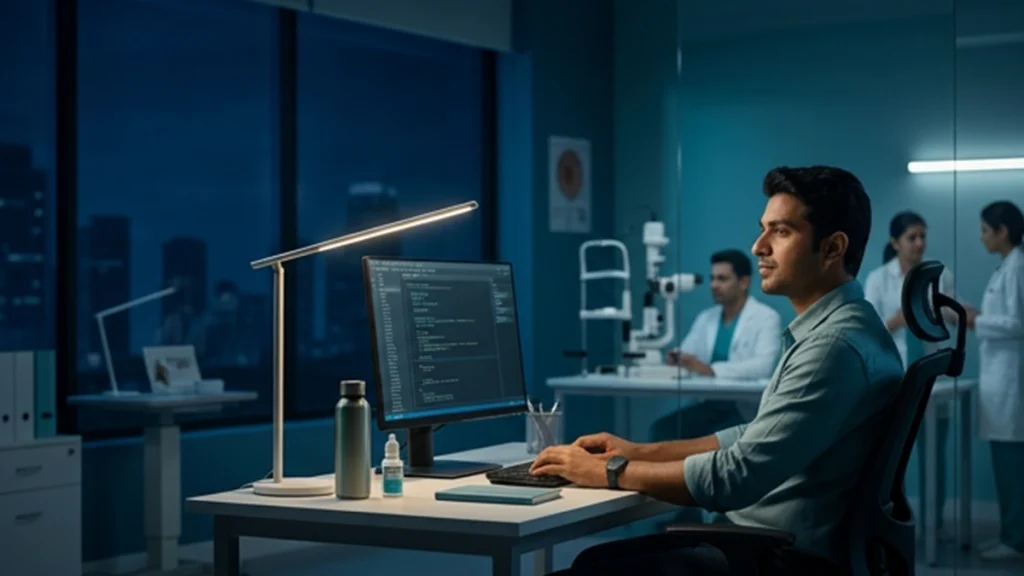
Working the nightshift places an additional strain on our bodies and can be particularly hard on our eyes. Eye care for night-shift workers isn’t simply to avoid having tired eyes when they head into the office the next day. Proper eye health care should focus on maintaining your eyesight while working against your own body’s natural cycle and under artificial lighting – and sometimes staring at a computer screen all night long.
It is unfortunate for people who need to punch a timecard after darkness falls as they know how rough it can get on the eyes. That roughness has a name, and understanding it is the first step toward real eye care for night-shift workers rather than just powering through the fatigue.
Why Night Shift Work Is Hard on Your Eyes
Your eyes as with the rest of your body follow a natural light and dark rhythm. With the night shift work your eyes are asked to be awake and present during times when your body is meant to be at rest, which shows up as night shift eye strain more often then people would expect. Also in play are the artificial lights. We see this in fluorescent lighting overhead, hard screen glare and the contrast between a very bright monitor and a dark room is extra work for the eyes. Disrupted circadian rhythms from working nights and rotating shifts also see to it that we have less alertness and more fatigue, also tired eyes are right in the middle of this.
To that we can add the fact that many night shift jobs have you at a computer screen for long periods from watching dashboards to medical records’ input to going over data. That kind of continuous close focus is a large factor in the issue of screen eye strain which in turn multiplies the problems of already impaired sleep cycles.
| Sign | What It Often Means |
| Dry, gritty, or burning eyes | Reduced blink rate during screen focused work, common with eye fatigue |
| Blurred or fluctuating vision | Eye muscles working overtime to maintain focus over long shifts |
| Headaches by the end of a shift | A frequent companion to screen eye strain and poor lighting conditions |
| Sensitivity to light | Eyes adjusting poorly between bright screens and dim work areas |
| Difficulty refocusing between near and far objects | A hallmark of night shift eye strain after extended screen use |
| Watery eyes despite feeling dry | The eye’s response to irritation, often mistaken for allergies |
The good news is that most night work issues are very much within your control. Outlined here are 7 practices which have been found to be very useful for eye care for night-shift workers which includes the person who is at the computer all night long or that is constantly moving from one task to another under artificial lights.
1. Take Regular Breaks From Your Screen.
The primary habit which reduces screen eye strain and is a base of eye care for night-shift workers is to take breaks from your computer at regular intervals. It is advisable to follow the 20-20-20 method which means every 20 minutes you look at something at a distance of about 20 feet for 20 seconds. This break allows your eye muscles to relax which in turn reduces the near focus which builds up during long periods of computer use.
2. Blink consciously and keep your eyes lubricated.
People when they are intently focused on a screen tend to blink less which in turn is a big cause of the night shift eye strain which presents as dryness and irritation at night. To help with this conscious effort to fully and often blink is recommended which in turn helps to even out your natural tear film. If dryness persists artificial tears may bring relief but anyone that is using them frequently should see an eye doctor to rule out an issue.
3. Adjust Your Lighting to Reduce Glare.
Harsh overhead lighting and bright screens are a cause of eye fatigue during night shifts which is very easy to remedy. It has been seen that using soft lighting as opposed to that which is very bright is helpful for eye care for night-shift workers. Also try to make your screen’s brightness to match that of the room which you are in. A large difference between a bright screen and a dark room only serves to exhaust the eyes out over the length of a full shift.
4. Improve your screen settings.
Small changes to your display can greatly reduce screen eye strain over the duration of a long shift. Increase text size which in turn decreases the need to squint, adjust contrast for better readability, and use any available night or warm mode features your device has to offer. We are after a screen that is comfortable to look at for hours, not one which requires constant squinting or refocusing. Also note the position of your screen and posture.
5. Pay Attention to Screen Position and Posture
Where your monitor is placed is as important as what is displayed on it. A screen at arm’s length which is a little below eye level reduces strain on your eyes and neck. Poor posture towards the screen or stretching your neck to see better tends to increase eye fatigue which in turn is associated with hunched postures and close up focus. Also pay attention to your sleep and light exposure outside work.
6. Protect Your Sleep and Light Exposure Outside Work
Eye care for night-shift workers doesn’t end at the end of your shift. For best results get consistent high quality sleep during the day which allows your eyes to recover as they would after a full night’s rest. Also wear sunglasses on your ride home which will reduce exposure to early morning light and in turn support better sleep which in turn means less eye fatigue on the next shift. We see that there is a great connection between poor sleep and eye strain in night shift workers which is supported by research.
7. Schedule Regular Eye Exams
Because night shift eye strain might mask or mimic other eye conditions that need treatment, getting regular eye exams has never been more important than it is for eye care for night-shift workers. And yet this aspect of eye health may be one of the most overlooked parts of maintaining good ocular wellness for people who work at night. A thorough eye exam will help uncover things like uncorrected refractive errors (such as farsightedness) or early-stage dry eye disease, these two problems which can make screen eye strain much worse. It’s also helpful to mention your work schedule to your eye doctor, allowing them to better customize their advice to your specific needs.
Since knowing what to do matters less if you are not sure how often to do it, here is a quick reference for building these habits into an actual routine.
| Habit | How Often to Do It |
| Screen breaks using the twenty twenty twenty approach | Every twenty minutes during any stretch of screen work |
| Conscious blinking | Continuously, with extra attention during focused or repetitive tasks |
| Lighting and glare check | Once when you set up your workspace, and again if conditions change |
| Screen settings review | Once at the start of a shift, adjusted further if your eyes still feel tired |
| Posture and screen position check | Roughly every hour, especially during long uninterrupted tasks |
| Sleep and light protection routine | Daily, particularly right after a night shift on your commute home |
| Comprehensive eye exam | At least once a year, or on whatever schedule your eye doctor recommends |
When Eye Fatigue Signals Something More
Occasionally tired eyes after a long shift are an issue, but some signs indicate it is time to see an eye doctor instead of waiting it out, and what that is, which line is hard to see is a part of practical eye care for night-shift workers. Persistent blurry vision that doesn’t improve with rest, eye pain which extends past mild discomfort, sudden changes in vision, or eye fatigue which seems to be getting worse over weeks instead of improving are all reasons to get in for an exam. Night shift eye strain should improve with better practices and enough rest. When it does not improve that is a signal which is worth taking very seriously rather than working through.
Conclusion
Eye care for night shift workers is a part of a few simple rituals you perform every night and into the day. Do frequent breaks, do purposeful blinking, play with your light and screen settings, pay attention to your posture, guard your sleep, and get regular eye exams which in total cover most issues related to night shift eye strain and screen eye strain. All of these practices do not require special tools or great chunks of time but they do require you to commit to them. If you are still experiencing eye fatigue despite making these changes your shift may have identified a different issue which an eye doctor can help to diagnose and which they will in turn put you on a plan for which is tailored to your specific schedule and health.
Frequently Asked Questions
1. Why do my eyes feel worse on night shifts than during the day?
Night shift work has you doing a lot of screen time while at the same time you are not getting natural sleep and you are in unnatural lighting which in turn causes eye fatigue. Also the body’s natural clock is out of sync with work hours which in turn makes the usual screen eye strain feel worse which is why advice for eye care for night-shift workers is a bit different from what we give for the general public.
2. Can blue light glasses help with night shift eye strain?
Some night shift workers report that blue light filtering glasses are comfortable to use, although it has mixed effects on how much they reduce eye fatigue.
3. Is it normal to have dry eyes every night shift?
While occasional dryness from reduced blinking during screen work is common, eyes that are dry every shift is an issue to bring to an eye doctor. Persistent dryness may be a sign of an underlying condition that benefits from proper treatment rather than just the use of artificial tears.
4. How often should night shift workers get an eye exam?
There is no set schedule but anyone that does regular night shift work which is screen heavy may do better with more frequent eye exams than the average day time person. An eye doctor can give you the best interval based on your symptoms, your prescription and how much your job plays on your eyes.
Reference Link
- National Eye Institute — Keep Your Eyes Healthy
https://www.nei.nih.gov/eye-health-information/healthy-vision/how-eyes-work/keep-your-eyes-healthy