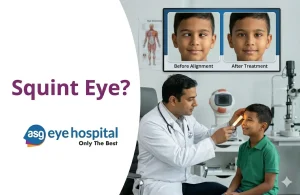
Ever talked with someone whose eyes weren’t looking at you simultaneously? That’s squint eye, scientifically known as strabismus. One eye points straight while the other drifts inward, outward, upward, or downward. Here’s what catches people off guard: this isn’t merely about appearance. Your brain struggles to merge two mismatched images into one coherent picture.
Understanding Squint Eye: Causes and Muscle Imbalance
Six delicate muscles attach to each eyeball. Picture them as ropes on opposite sides of a tug-of-war. When balanced perfectly, the eyes move together smoothly. When one rope pulls harder, or another goes slack, misalignment develops.
Some infants arrive with this condition. Others develop it during toddler years while visual systems mature. Adults develop squints differently: diabetes damages the nerves controlling eye muscles, thyroid problems weaken muscles directly, strokes interrupt brain signals coordinating movement, or head trauma disrupts everything.
Here’s something interesting: exhaustion unmasks squint. Eyes might align fine after breakfast, but following eight hours staring at screens, one drifts sideways. That timing tells specialists exactly which muscles are faltering.
Squint Eye Symptoms: Warning Signs in Children and Adults
Parents typically notice their child’s eye wandering in family snapshots. Kids close one eye outdoors or tilt their heads oddly while watching television. These aren’t harmless habits—they’re compensating for mismatched input.
Adults describe different experiences. Double vision strikes first, two computer monitors instead of one, two cars ahead at the intersection. Headaches follow, persistent ones that painkillers barely touch. Depth perception vanishes, you misjudge steps on staircases, reach for objects, and miss completely.
The frightening aspect of children: brains adapt remarkably well. When one eye continuously sends misaligned images, the brain eventually ignores that eye’s input completely. Ophthalmologists call this amblyopia or lazy eye. Once established, you’re fighting to preserve vision, being actively shut down.
Regular checkups matter enormously. Whether you’re in Delhi, Hyderabad, or smaller towns across India, pediatric eye screenings catch problems while interventions still work.
Squint Treatment Without Surgery: Non-Invasive Options
Many patients correct squint without entering the operating rooms. These strategies work exceptionally well when applied appropriately.
Corrective Eyewear
Farsightedness forces eyes to work overtime, focusing nearby. That constant effort pulls eyes inward, creating visible squint. Provide proper prescription lenses, and squint vanishes naturally. Eyes relax back into alignment because they’re no longer straining. Families expecting surgery sometimes just need spectacles.
Vision Therapy Programs
Think physiotherapy for your visual system. Specialized exercises strengthen weak muscles while teaching both eyes to cooperate properly. This squint treatment without surgery requires dedication, weekly professional sessions plus daily home exercises. For certain squint types, particularly convergence insufficiency, outcomes genuinely impress patients.
Prism Correction
Standard glasses sharpen fuzzy vision. Prisms accomplish something different, they bend incoming light so both eyes receive matching images. Your brain processes aligned pictures without muscles twisting unnaturally. For mild misalignment, prisms offer effective squint treatment without surgery while keeping patients away from surgical procedures entirely.
Occlusion Therapy
Covering the dominant eye forces brains using the neglected one again. This won’t mechanically straighten eyes, but rescues vision otherwise lost permanently. Combined with additional methods, patching prevents the devastating outcome, permanent vision loss in young children.
Botulinum Toxin Therapy
Precise injections into overactive eye muscles produce temporary weakening. Opposing muscles then pull the eyes toward improved alignment. Results last roughly four to six months before fading. Some individuals repeat injections indefinitely; others use them while different squint eye treatment approaches take effect.
Squint Eye Surgery: When and How It’s Performed
Sometimes, squint eye surgery simply represents the most practical solution. Severe misalignments frequently require surgical correction initially. Other cases progress through months of conservative treatment before everyone acknowledges that surgery works best.
Contemporary squint eye surgery has advanced considerably. Surgeons access muscles through small incisions in the conjunctiva, that transparent membrane covering the white surface. They never cut into the eyeball itself, despite common fears.
Depending on which muscles malfunction, surgeons might relocate a muscle’s attachment point backward (recession procedure), shorten it (resection procedure), or reposition it completely. Operations typically require 60 to 90 minutes. Most individuals return home that same afternoon.
Leading eye hospitals throughout India, in cities like Mumbai, Pune, Delhi, Jaipur, Ahmedabad, Haryana, Thane, and Bikaner, have specialists performing these procedures regularly with impressive success rates.
Choosing the Right Squint Eye Treatment for Your Condition
Which method suits your particular circumstances? Several factors determine that answer.
Squint variety matters significantly. Accommodative esotropia responds beautifully to eyeglasses alone. Paralytic squint from nerve damage might demand immediate surgery. An intermittent squint appearing only during fatigue may improve through vision exercises.
Age influences outcomes dramatically. Children below eight years have developing visual systems, still establishing neural pathways. Interventions work faster and more completely during this developmental window. Adults absolutely can improve; the process simply requires longer with adjusted expectations.
General health considerations factor in. Diabetic patients need stable blood glucose before surgery. Thyroid disorder patients should achieve hormone stability first. These medical conditions affect healing and can trigger squint recurrence if not controlled adequately.
Begin with a comprehensive examination by strabismus specialists. They’ll conduct unusual tests, measuring each eye’s movement through various positions, assessing whether both eyes can cooperate whatsoever, and determining which muscles are weak compared to overactive ones.
Sometimes specialists employ prism testing, positioning different strength prisms before your eyes until discovering the power that aligns vision properly. These diagnostic procedures clarify which approach possesses the highest success likelihood for your specific situation.
Why Early Squint Eye Treatment Matters: Risks of Delay
Surgery intimidates people. Therapy programmes seem very demanding. Some wonder whether they can simply tolerate squint indefinitely.
For children, untreated squint produces permanent vision loss in the misaligned eye. Their brain literally stops processing that eye’s visual information. By age nine or ten, that vision loss becomes irreversible regardless of subsequent interventions attempted later.
Adults confront different complications. Chronic headaches become your baseline existence. Depth perception fails, stairs, athletic activities, parking vehicles, and anything requiring accurate distance judgment grows increasingly difficult. Reading exhausts you as your eyes fight each other continuously throughout the day.
There’s also the social dimension people avoid discussing, but everyone experiences. Eye contact fundamentally drives human connections. Misaligned eyes impact overall life quality and emotional well-being.
Taking the Next Step: Your Squint Eye Treatment Journey
Current medical treatments for strabismus provide better results than those available to earlier generations. The modern methods of treating strabismus through eyeglasses and prisms, therapy programs, or through surgical procedures achieve excellent results.
Schedule that evaluation you’ve been postponing. Ask questions until treatment options make complete sense. Obtain additional opinions if uncertainty lingers. But recognise squint won’t improve through wishful thinking; it demands professional medical intervention.
FAQs on Squint Eye (Strabismus)
1. What is a squint eye (strabismus)?
A squint eye, medically called strabismus, is a condition where both eyes do not align in the same direction. One eye may turn inward, outward, upward, or downward, making it difficult for the brain to combine images from both eyes into a single clear picture.
2. Is squint eye a serious problem or just cosmetic?
Squint eye is not just a cosmetic issue. If left untreated, it can lead to double vision, headaches, poor depth perception, and in children, permanent vision loss (lazy eye or amblyopia).
3. Can squint eye be treated without surgery?
Yes. Many cases can be managed without surgery using spectacles, prism glasses, vision therapy, eye patching, or botulinum toxin injections. The treatment depends on age, squint type, and severity.
4. At what age should squint eye be treated?
Squint eye should be treated as early as possible, especially in children. Treatment before 7–8 years of age gives the best chance to develop normal vision. However, adults can also benefit from treatment and surgery.
5. When is squint eye surgery required?
Squint eye surgery is recommended when non-surgical treatments do not correct the eye alignment or when the squint is severe. Surgery helps reposition eye muscles to improve alignment and binocular vision.
6. Is squint eye surgery safe and painful?
Squint eye surgery is safe when performed by experienced ophthalmologists. It is done under anesthesia, so there is no pain during the procedure. Mild redness or discomfort after surgery usually resolves within a few days.
7. What happens if squint eye is left untreated?
If untreated, squint eye can cause permanent vision loss in children, persistent double vision, headaches, poor depth perception, and reduced quality of life in adults. Early diagnosis and treatment prevent long-term complications.