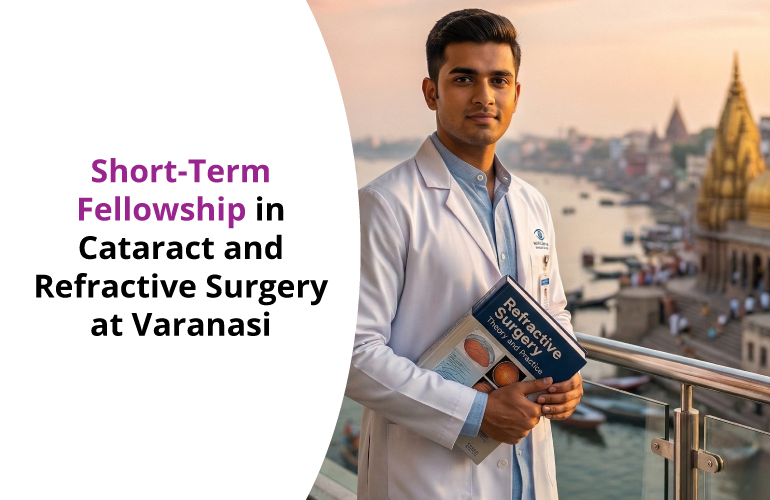
Kashi: The Birthplace of Cataract Surgery
Long before the operating microscope, cataract surgery was born in Kashi. According to tradition, it was here, some three thousand years ago, that the surgeon Sushruta learnt the art of healing from his teacher Divodasa Dhanvantari, King of Kashi, and set down the teaching that became the Sushruta Samhita, one of the founding texts of surgery in human history.
In it, Sushruta gave the world its earliest detailed description of cataract surgery. For Linganasha, the disease that clouds the lens and takes away sight, he described couching. With the patient seated and the eye steadied, a fine, barley-tipped needle, the jabamukhi shalaka, was passed through the side of the eye, and the clouded lens was pushed out of the line of sight so that light could reach the retina once again. He laid down how to prepare the patient, where to enter the eye, how to recognise success and how to care for the eye afterwards.
His range was astonishing. He described 76 diseases of the eye, 51 of them treated by surgery, and more than a hundred surgical instruments. He was a teacher as much as a surgeon, and insisted that students practise on fruits, gourds and models before they operated on a patient: simulation training, three millennia before the word existed.
From Kashi, his knowledge travelled the world. The Sushruta Samhita was translated into Arabic in Baghdad in the eighth century, and couching spread across Asia, the Middle East and Europe, where surgeons practised it for centuries.
When a fellow performs a first capsulorhexis in Varanasi today, the work continues in the city where it began.
About the fellowship
ASG Superspeciality Eye Hospital, Varanasi offers a three-month Short-Term International Fellowship in Cataract and Refractive Surgery for qualified ophthalmologists from outside India. The fellowship is offered only at Varanasi, under the personal mentorship of Dr Pratyush Ranjan.
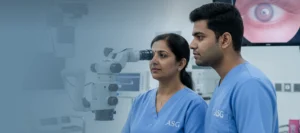
Fellows join the daily work of a busy cataract and refractive service. They observe, assist and then operate under supervision, one graded step at a time, as their skill and the terms of their NMC permission allow.
Programme overview
|
Duration |
3 months (12 weeks), full-time |
|
Venue |
ASG Superspeciality Eye Hospital, Ground Floor, Corporate Plaza, Rathyatra-Mahmoorganj Road, Mahmoorganj, Varanasi 221010, India |
|
Mentor |
Dr Pratyush Ranjan, Consultant, Cataract, Refractive and Glaucoma, and Medical Director of the hospital. More than 40 surgeons from India and abroad have trained with him. (Profile: asgeyehospital.com/doctor/dr-pratyush-ranjan) |
|
Mode |
Supervised training in the outpatient department, operation theatre, wet lab and academic sessions |
|
Course fee |
Nil |
|
Stipend |
Rs 50,000 per month, subject to applicable tax deductions |
What you will learn
-
Phacoemulsification and manual small incision cataract surgery (MSICS), including dense and small-pupil cataracts
-
Biometry and IOL power calculation, and planning for toric and premium IOLs
-
Refractive surgery: patient selection, corneal topography and tomography, LASIK, PRK and ICL
-
Recognition and management of posterior capsule complications and subluxated lenses
-
Preoperative assessment, postoperative care and follow-up clinics
Twelve weeks at a glance
|
Weeks 1–2 |
Orientation, hospital protocols, complete workup and diagnostics, biometry, wet lab |
|
Weeks 3–4 |
Case selection, anaesthesia, supervised surgical steps, MSICS principles |
|
Weeks 5–6 |
Phacoemulsification: fluidics, nucleus management, graded supervised steps |
|
Weeks 7–8 |
IOL implantation including toric and multifocal planning; complication management |
|
Weeks 9–10 |
Refractive module: selection, topography and tomography, laser workflow |
|
Weeks 11–12 |
Consolidation, audit of logged cases, case presentation, exit assessment |
Weekly case presentations, patient rounds and journal clubs run alongside clinical work. Every case is recorded in a log book countersigned by the mentor, and a completion certificate is issued on satisfactory completion.
Please note: this is an institutional training programme. It does not confer a degree or any qualification recognised by the NMC or the National Board of Examinations, and it does not entitle the fellow to independent practice in India.
Eligibility
-
A primary medical qualification equivalent to MBBS, and a postgraduate or specialist qualification in ophthalmology
-
Valid registration or licence to practise in the home country, with a current Certificate of Good Standing
-
Good working English
-
Selection through screening and interview
-
Grant of NMC Temporary Permission before the fellowship begins
NMC Temporary Permission
Foreign doctors need Temporary Permission from the National Medical Commission (NMC) under Section 34 of the NMC Act, 2019, before any hands-on clinical training in India. The selected fellow applies online on the NMC portal; ASG provides the sponsorship letter and programme brochure.
Documents to upload
Any document not in English must be uploaded with a certified English translation.
-
Passport (photo and details page) and a recent photograph
-
All medical degrees, primary and postgraduate (original and certified English translation)
-
Medical registration certificate or licence from the home country (original and certified English translation)
-
Certificate of Good Standing from the licence-granting authority (original and certified English translation)
-
Sponsorship letter from ASG in NMC’s prescribed format (provided by ASG after selection)
-
Programme brochure (provided by ASG)
-
Application fee as notified by NMC, paid online
Good to know
-
Apply well ahead of the planned start date. NMC may ask for clarifications by email, and replies go back on the same email thread.
-
Permission is granted for the stated purpose and dates only. Training takes place only at the sponsoring hospital and ends on or before the permission expires.
-
Apply for the Indian visa only after the NMC permission is granted. Previous international fellows have trained on a Student visa; please confirm the correct category with your Indian mission.
-
Requirements can change. The checklist on the NMC portal at the time of application prevails.
How to apply
Email the following to drpratyushranjan@gmail.com:
-
Updated CV with your surgical experience
-
Copies of your medical degrees and registration
-
A personal statement (500–800 words) on your interest in the fellowship and your goals
-
Contact details of two professional referees
-
A short surgical video (5–10 minutes) of a cataract procedure, if available
Applications are accepted throughout the year. Shortlisted candidates are interviewed online by Dr Pratyush Ranjan, and are usually informed within two to four weeks. Only a small number of fellows are accepted at a time, so that each receives personal attention. Start dates are agreed with the fellow and follow the dates in the NMC permission.
Terms
|
Course fee |
Nil |
|
Stipend |
Rs 50,000 per month, subject to applicable tax deductions |
|
Accommodation |
Arranged by the fellow near the hospital; the hospital guest house is available on request, with Rs 20,000 per month deducted from the stipend |
|
Working hours |
10:00 am to 7:00 pm, with a lunch break |
|
Leave |
One weekly off day as per centre rules; one casual leave per month |
|
Travel |
Fellows arrange their own travel and health insurance |
|
Certificate |
Fellowship completion certificate on satisfactory completion |
Contact
Fellowship enquiries: Dr Pratyush Ranjan, drpratyushranjan@gmail.com, +91 98079 88146
Coordination: Mrs Neha Saraogi, Regional Operations Manager, UP Zone, neha.saraogi@asgeyehospital.com, +91 75700 03481