
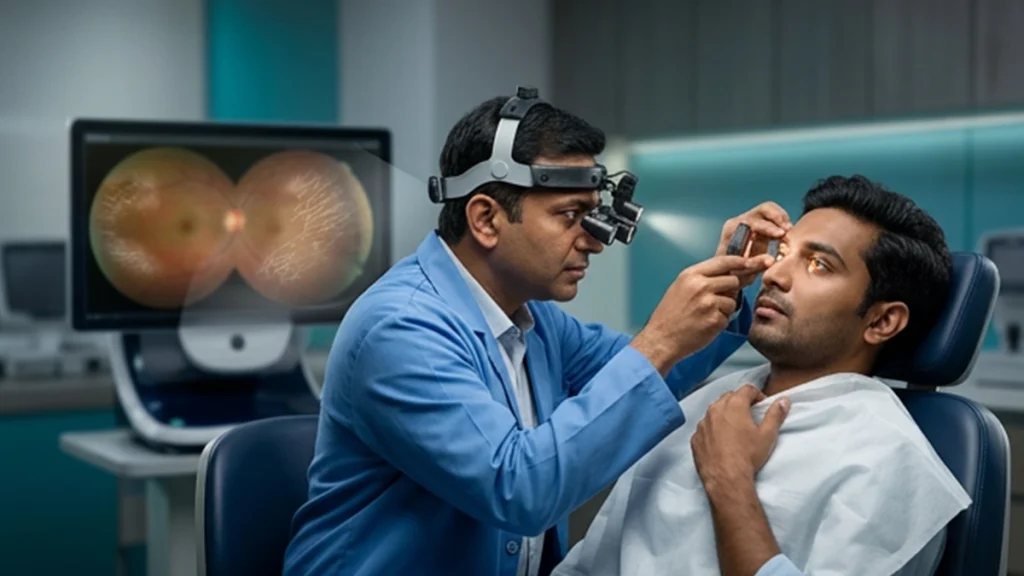
People who have high myopia usually notice that they require stronger glasses or contacts. Also high myopia may cause problems with the retina at the back of the eye. One condition which requires attention is lattice degeneration high myopia which is characterized by areas of the peripheral retina which have become thin and weak.
Lattice degeneration is not a sure thing to cause vision issues. Many people may not at all know they have it until an eye specialist looks at the retina. Also in the case of lattice degeneration high myopia close inspection is required which is because a very high degree of myopia and lattice degeneration together may cause retinal detachment. The National Eye Institute reports that extreme myopia and lattice degeneration are at risk for retinal detachment.
What Is Lattice Degeneration in High Myopia?
Lattice degeneration is a term used for thin out and weak areas in the peripheral retina. These areas present a latticelike structure during a retinal exam. Also in lattice degeneration high myopia which is an elongated eye shape associated with great degrees of myopia, the structure of the eye puts extra stress on retinal tissue.
High myopia also reports onset of vitreous changes at an earlier age. Upon pull of the vitreous which is a gel-like substance within the eye, it may cause retinal holes or tears. It is important to note that not all high myopes which have lattice degeneration high myopia will develop retinal detachment.
| Retinal Finding | What It May Mean |
| Lattice degeneration | An area of thinning in the peripheral retina |
| Retinal holes | Small openings that may occur within weak retinal tissue |
| Retinal tear | A break that may allow fluid to pass beneath the retina |
| Retinal detachment | Separation of the retina that requires urgent medical attention |
Who Needs Regular Monitoring?
Many patients with lattice degeneration and high myopia just require close observation. An ophthalmologist may also suggest a routine dilated retina exam which is to see that the lattice is stable.
Monitoring is especially important in which a person has high myopia, prior retinal holes, signs of vitreous change, or past retinal issues. Also doctors may examine both eyes closely as retinal changes may present in either eye.
Patients that have lattice degeneration high myopia should also be aware of warning signs. Sudden onset of floaters, flashes of light, a dark curtain or shadow in the field of vision, or acute vision loss is a cause for emergency evaluation. These symptoms may indicate a retinal tear or detachment.
When Is Preventive Laser Considered?
Preventive lattice laser treatment does not apply to all patients. It is based on the retinal findings and the individual’s risk profile.
Laser photocoagulation creates small spots of treatment in an at risk retinal area. As these spots heal they form adhesions which in turn secure the retina. Doctors may put in to use lattice laser when there is lattice degeneration which in association with retinal breaks, symptoms or other features which in turn raise the risk of detachment.
The National Eye Institute reports that laser photocoagulation does in fact treat some retinal tears or holes to put a stop to retinal detachment. But it is the ophthalmologist to determine if preventive treatment is required after he has had a look at the retina.
| Situation | Possible Approach |
| Stable lattice without concerning breaks | Regular retinal monitoring may be advised |
| High myopia with lattice degeneration | Closer follow-up may be appropriate |
| Lattice with significant retinal holes | Retina specialist assessment is important |
| Symptomatic or concerning retinal tear | Lattice laser or another treatment may be considered |
Can Laser Prevent Every Retinal Detachment?
No treatment is for sure in retinal tear prevention. Laser is used to fortify the retina at what are known to be weak spots, but new tears may present in other areas.
For which also retinal tear prevention retinal exams and early identification of symptoms are a part. Post procedure of lattice laser patients still must in to the follow up as per ophthalmologist’s recommendation.
In cases of lattice degeneration high myopia treatment should be very much a personal choice. Some eyes do better with just monitoring, while in others we may see benefit from a preventive approach.
Frequently Asked Questions
1. Is lattice degeneration common in people with high myopia?
Lattice degeneration is a more common finding in myopic eyes. Also it has been reported that peripheral retinal changes present in very myopic patients. A dilated retinal exam is recommended for detection of these changes.
2. Does lattice degeneration always cause retinal detachment?
No. Many of those with lattice degeneration high myopia do not go on to develop retinal detachment. Risk is a factor of retinal holes, tears, symptoms, changes in the vitreous, and past retinal issues.
3. Does everyone with lattice degeneration need laser?
No. Lattice laser is a treatment which is tailored to the individual retinal findings and risk factors. Stable areas may only require close monitoring.
4. How can I improve retinal tear prevention?
Regular annual eye exams and timely assessment of any new flashes, floaters, shadows, or sudden vision changes is a key to retinal tear prevention.
Conclusion
Lattice degeneration high myopia does not automatically point to a need for laser intervention. Many of these patients can be kept on routine observation as their retina is stable at present. But in cases of retinal holes, tears, new signs and other risk factors the treatment approach changes. In depth retinal evaluation by an ophthalmologist will determine whether a patient should be monitored or if he is a candidate for lattice laser. Also timely evaluation is key in the prevention of retinal tear prevention and in protecting long term vision.
This article is for educational use only and does not supplant a visit or a recommendation for treatment to an ophthalmologist..
References Link
- The U.S. National Eye Institute
https://www.nei.nih.gov/eye-health-information/eye-conditions-and-diseases/retinal-detachment?