
Changes in eyesight which may be easy to write off, at least when they are slow in coming. We may attribute it to bad lighting, tired eyes, a pair of old glasses, or just the natural process of aging. Also some of that gradual vision change may be a sign of cataract. By recognizing cataract symptoms early you may better understand what is going on and at what point you should put in for an eye exam.
A cataract which is a disordered health issue in the eye causes the usually transparent natural lens within the eye to become opaque. As the opaqueness increases so does the issue of light not focusing properly on the retina. This can lead to blurry vision, glare out at night, faded colors, and difficulty seeing in the dark. Also according to the National Eye Institute (NEI) under the U.S. National Institutes of Health cataracts may cause vision to appear blurry, hazy, or less colorful.
The issue is that at the start of a signs of cataracts you may not notice pain or a sudden change in vision. What you do see may be different from what you expect which is why it is a good idea to get a professional opinion before your eyesight starts to really affect your day to day life.
What Is a Cataract?
The natural lens is behind the colored part of your eye. It helps out with the focusing of which light comes in for you to see that which is crystal clear. A cataract develops a cloudy patch within the lens. As that cloudy area gets bigger or more dense vision will become more hazy.
Ageing is a large cause of cataracts which is natural but there are other causes also. Eye injury, diabetes, certain drugs, former eye surgeries and long term ultraviolet exposure may put some people at greater risk. As per what the cause is, cataract symptoms may present differently in each individual.
A person may first notice that there is a little blurry vision while reading or driving. Another may have issues with glare before they notice the more obvious cloudiness. This variation which we see in how people present with symptoms makes a professional cataract diagnosis very important at the point persistent visual changes appear.
Common Cataract Symptoms at a Glance
The following table explains some common changes associated with cataracts and how they may affect everyday activities.
| Vision Change | What You May Notice | Possible Daily Impact |
| Cloudy or blurry vision | Objects look hazy or slightly out of focus | Reading and recognising distant objects become harder |
| Increased glare | Headlights or sunlight feel unusually bright | Driving may become uncomfortable |
| Halos around lights | Rings appear around lamps or headlights | Night driving becomes more difficult |
| Poor night vision | Vision becomes noticeably weaker in dim surroundings | Walking or driving after dark becomes challenging |
| Faded colours | Colours appear dull, washed out or yellowish | Colour differences become harder to recognise |
| Prescription changes | Glasses stop providing the expected clarity | More frequent spectacle updates may be needed |
| Double vision | One eye may see overlapping images | Reading and focusing become uncomfortable |
These cataract symptoms do not prove that you have one. Other eye issues present with the same signs. An ophthalmologist may run the proper tests to determine the cause.
1. Gradually Blurry or Cloudy Vision
Persistent blurry vision is a very common signs of cataracts. At first you may think that your glasses are dirty. Words may not stand out clearly, distant faces may appear to fade, or the TV may seem a bit hazy.
Early cataract symptoms can be very subtle which in turn people may not notice. You may move closer to what you are looking at or increase font size on your phone. Also you may opt for brighter lighting while reading.
The key is persistence. If you have persistent blurry vision which doesn’t improve with adequate rest or a new pair of glasses don’t assume it is a normal part of the aging process get it checked out by an eye care professional.
2. Increasing Sensitivity to Bright Light
Has the sun suddenly become more intense? Do you find that headlights bother you more than before? Vision may be affected if a cloudy lens scatters light instead of allowing it to focus properly.
These cataract symptoms may in particular present themselves while you are driving at night. Oncoming head lights may appear very blinding, also bright indoor lights may cause discomfort. Flare up by itself is not a diagnosis of cataract. But when it is associated with blurry vision or other signs of cataracts an eye exam is warranted.
3. Halos Around Lights
Some report that they see a glare which surrounds light sources. Streetlamps, bulbs, and car headlights may have what seems like a halo around them. What we are describing here is a cataract symptoms that takes place when the lens changes which in turn effects how light is perceived by the eye. Halos can become more troublesome in dark surroundings because bright lights create greater visual contrast.
If you find that halos are a problem at night while driving report it at your cataract diagnosis evaluation. Your ophthalmologist can determine if indeed you have cataracts or if the issue is another eye health problem.
4. Difficulty Seeing at Night
Cataracts cause vision to deteriorate in low light. You will require brighter light to read by or have trouble recognizing objects in dimly lit rooms.
Poor night vision also plays a role in making driving stressful. Road marks may fade into the dark while oncoming cars head lights can cause even more trouble. As these cataract symptoms start to play out and affect confidence and safety, they should not be ignored. Progressive night vision difficulty which goes along with blurry vision is a signs of cataracts that should be brought to the attention of an ophthalmologist.
5. Colours Look Faded or Yellowish
Cataracts not only play with sharpness of vision but also with color perception. Colors may fade out, so whites may appear duller and blues and other colors may gradually lose their vibrancy.
As the change is a slow process it may go by unnoticed. Some people notice it only when they compare the colours seen by each eye.
Changes in color perception may be due to a number of causes which is why they should be properly evaluated. If faded colors are reported with other cataract symptoms an eye exam can help determine the cause.
6. Frequent Changes in Your Glasses Prescription
Need at times to get a new spectacle prescription is normal. But to have changes in them within a short time may be a signs of cataracts. As the lens changes so too does the eye’s focusing power. New glasses may improve the issue of blurry vision for a while but as the cataract progresses clarity will fade again.
This doesn’t automatically mean that which is why we have the professional cataract diagnosis which is performed by your ophthalmologist to assess the lens and determine if in fact the cataract is in the process of progressing which is what is behind changes in your prescription.
7. Double Vision in One Eye
Some people with cataracts report seeing double or multiple images out of one eye. This may also happen when the other eye is closed. While it is not as well known as blurry vision, monocular double vision is a cataract symptoms. The changes in the lens may split or scatter incoming light which in turn may produce overlapping images. Double vision is a variable symptom which may also be caused by other things. Do not diagnose it as a cataract yourself. See an eye specialist to have any new or persistent double vision checked.
How Cataract Symptoms May Progress
Cataracts develop slowly over time which is not a sudden onset. The experience is different for each person but the following table shows how the progression of lens clouding may affect daily vision.
| Stage | Possible Vision Changes | Effect on Daily Activities |
| Early | Mild blurry vision, slight glare or reduced contrast | Daily activities may remain largely unaffected |
| Developing | More obvious signs of cataracts, halos and poor night vision | Reading and night driving may become harder |
| Moderate | Persistent haze, glare and faded colours | Work, driving and detailed tasks may become difficult |
| Advanced | Significant cloudiness and reduced visual clarity | Independent daily activities may become challenging |
The issue is the degree of cataract symptoms which varies from person to person rather than the fact that one has a cataract. Some may have early stage cataracts for a number of years with no great issue. Others may experience symptomatic changes which affect their daily activities much sooner.
How Is a Cataract Diagnosis Made?
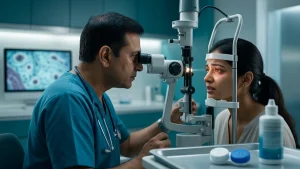
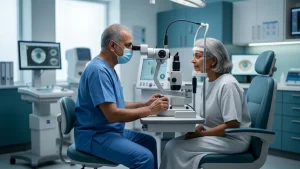
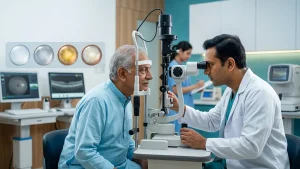
A proper cataract diagnosis is from an eye exam. An ophthalmologist doesn’t base it on what you report as your symptoms. The doctor will test your vision and examine the structures inside your eyes.
The assessment will include a visual acuity test which measures how well you see. Also we do a slit-lamp exam which allows the ophthalmologist to look at the lens in detail. Also we will look at the retina and other structures after we dilate your pupils. We do refraction testing which will tell us if a change in your glasses will improve your vision.
This process helps distinguish cataract symptoms from refractive errors, glaucoma, retinal diseases or other eye issues. In a full cataract diagnosis also noted is the extent of lens change and if it is affecting functional vision.
ASG Eye Hospital reports that they perform visual acuity testing, slit-lamp examination, retinal exam and refraction which we use in the evaluation of cataract and lens disorders.
When Should You See an Eye Doctor?
Do not delay till your vision has severely diminished before you see an ophthalmologist. Persistent blurry vision, increased glare, halos, poor night vision, washed out colors and frequent change of glasses should be brought to the doctor’s notice.
An early cataract diagnosis does not mean right away that you will have a surgical procedure. In mild cases a cataract which is in the early stages may be treated with updated glasses, better lighting or a routine of close follow up. What we do for treatment is based on how much the cataract is affecting your vision and your daily activities.
You should also put that out of your mind that every visual change is a signs of cataracts. Sudden vision loss, flashes, a sudden increase in floaters, severe eye pain or other acute changes may have different causes which require prompt medical attention.
Cataract Care at ASG Eye Care
Understanding cataract symptoms is the first step in making informed decisions about your eye health. At ASG Eye Care we perform eye exams which include evaluation of the natural lens, assessment of your vision and determination of what may be the cause of your vision problems which may or may not be a cataract.
If a cataract diagnosis which in turn causes early lens clouding your ophthalmologist will go over the stage of the disease and what options you have for watchful waiting. As the cataract starts to really impact on your reading, driving, work or other regular activities in which you engage the doctor can go over the treatment options available to you.
The aim is to catch issues early. Watch for signs of cataracts and to seek out professional advice at the right time which in turn will help you manage your vision changes with more confidence.
Final Thoughts
Cataracts present early before really having an impact on daily life. Slowly progressive blurry vision, glare, halos, trouble seeing at night, color desaturation and frequent need for changing prescriptions are some issues to watch out for.
If you see these cataract symptoms, don’t wait for it to get better or go to a different eye care professional without getting an accurate diagnosis. A full eye exam is the only way to properly cataract diagnosis and also to eliminate other eye issues.
Most of all remember that changes in eyesight do not have to be a given as you age. Look out for early signs of cataracts which will give you a chance to talk to an ophthalmologist about your vision and to make informed decisions regarding your eye care.
Frequently Asked Questions
1. What are the first cataract symptoms?
Early cataract symptoms may present as mild cloudiness in vision, reduced visual sharpness, light sensitivity, trouble with night time vision and colors appearing more dim. They tend to develop gradually over time instead of suddenly.
2. Is blurry vision always caused by cataracts?
No. Blurry vision is a symptom of refractive errors, dry eyes and a number of other eye issues. A full exam is required to determine the cause.
3. What are the most common signs of cataracts?
Common signs of cataracts are cloudy vision, glare, halos around lights, poor night vision, faded colors and frequent changes in spectacle prescription.
4. How does a doctor confirm a cataract?
A cataract diagnosis is usually done by testing visual acuity and looking at the eye’s lens. Also your ophthalmologist may do refraction, slit-lamp and dilated eye exams.
5. Can cataracts affect only one eye?
Yes. Cataracts in which the eye is present at any given time and may progress at different rates between the two eyes. This can make the cataract symptoms more apparent in whichever eye is affected more.
6. When should I get my eyes checked for cataracts?
Schedule a visit for an eye exam when you notice visual changes that affect your reading, driving, work or daily activities. An ophthalmologist can identify if you require a close follow up or treatment.