A cataract gradually changes how you see. Text may become blurred, head lights at night may appear to have halos, colors may become dull, and once familiar faces may not be recognized even after changing glasses. As these issues begin to impact your reading, your driving, your work, or your independent life an evaluation for cataract surgery in Indore may help determine if the clouding of the natural lens is the cause.
During cataract surgery in Indore, the cloudy lens in the eye is taken out and we put in a clear artificial intra ocular lens which is also known as an IOL. The National Eye Institute reports that surgery is the only way to remove a cataract, also the timing of the surgery should be based on how the condition is affecting a person’s daily activities.
A consultation for cataract treatment in Indore is not limited to checking the cataract. The ophthalmologist also looks at the cornea, retina, optic nerve, eye pressure, spectacle power and full medical history. A qualified cataract doctor in Indore can then explain whether surgery is right for you and what visual improvement you may see from it.
What Is a Cataract?
In the normal course the eye’s lens is clear which in turn helps in the focus of light on the retina. A cataract which is the lens becoming opaque develops when this happens. As the cloudiness increases it may cause blurred vision, glare, halos around lights, poor night vision, reduced color contrast, faded colors or frequent changes in spectacle power. Age is the most common cause of cataract development. Also at risk are diabetics, those with eye injuries, which may have had previous eye surgery, radiation exposure and long term use of steroids and other medications. Cataracts do not spread from one eye to the other.
In the normal course the eye’s lens is clear which in turn helps in the focus of light on the retina. A cataract which is the lens becoming opaque develops when this happens. As the cloudiness increases it may cause blurred vision, glare, halos around lights, poor night vision, reduced color contrast, faded colors or frequent changes in spectacle power. Age is the most common cause of cataract development. Also at risk are diabetics, those with eye injuries, which may have had previous eye surgery, radiation exposure and long term use of steroids and other medications. Cataracts do not spread from one eye to the other.
Common Cataract Symptoms
| Symptom noticed | Possible effect on daily life | Why an examination matters |
| Cloudy or blurred vision | Reading, television viewing and recognising faces become difficult | The doctor checks whether a cataract or another condition is reducing vision |
| Glare and halos | Headlights, sunlight and bright indoor lights feel uncomfortable | Cataract density, corneal health and pupil response are evaluated |
| Poor night vision | Driving or walking in dim light becomes difficult | Contrast sensitivity and retinal health may need assessment |
| Faded colours | Clothes and surroundings appear dull or yellowish | Progressive lens clouding may affect colour perception |
| Frequent spectacle changes | New glasses provide only temporary improvement | The cataract or refractive error may be progressing |
| Double vision in one eye | A single object appears as two images | The lens, cornea and retina must be examined |
These symptoms do not in all cases require that a cataract operation in Indore be done right away. The ophthalmologist looks at how the symptoms play into the patient’s daily life, the health of the other eye as well as the patient’s particular visual needs.
When Should Cataract Surgery Be Considered?
There is no set stage of cataract at which we see to do surgeries. National Eye Institute reports that we usually recommend for the op to take place when vision impairment affects performance in tasks such as reading, driving, watching TV or other key activities. Also we may consider doing the op when the cataract is causing issues with the evaluation or treatment of the retina.
The decision about cataract surgery in Indore should be looked at from a practical stand point. Does glare make evening travel a problem? Is reading becoming a struggle? Do you have trouble judging stairs? Has blurred vision affected work or home life? In Indore a cataract specialist will also look into if another eye condition is a factor. While cataract removal will clear up the clouded optical pathway it does not reverse that which is permanent as a result of advanced glaucoma, retinal scarring or optic nerve disease. The chosen cataract hospital in Indore should give realistic counsel instead of pushing surgery which may be based only on age or a promotional package.
Tests Before a Cataract Operation
Before a cataract operation in Indore, patients usually go in for visual acuity test, spectacle power assessment, slit lamp exam, eye pressure measurement and retinal evaluation which includes pupil dilation. Biometry determines the eye’s length and its optical features which in turn allows for the right IOL power to be determined. Keratometry measures corneal curvature and also helps to identify astigmatism. Also we may do other tests when we see diabetes, glaucoma, retinal disease, previous surgery or corneal irregularity present.
The purpose of these tests is not simply to confirm a cataract. The results help the cataract doctor in Indore select an appropriate lens, plan the surgical technique and to discuss with them if glasses will still be required post surgery. Patients should report to us any diabetes, high blood pressure, allergies, past eye procedures and also what medications they are on. Blood thinners and other prescribed drugs should not be discontinued without first talking to the that care for you.
Cataract Treatment Methods Available in Indore
Different techniques may be used for cataract treatment in Indore, depending on the cataract’s density, the state of the eye, what technology is available and the assessment by the surgeon. At ASG Eye Hospital’s official Indore page we see that they describe phacoemulsification, micro-incision cataract surgery, small incision cataract surgery, laser assisted cataract surgery and extracapsular cataract extraction for some patients. That said, what is available and which is suitable for you must be confirmed at your consultation.
Phacoemulsification which is the term for the use of ultrasound energy to break up the cloudy lens into tiny fragments which are removed through a small incision. We put in a foldable IOL at the same time. Also we see the principle of micro-incision which is a very small surgical entry. What we may do in some cases is perform a small incision cataract surgery which may be used for hard or mature cataracts. In some more advanced cases we may advise on extracapsular extraction which is a non minimal invasive method for certain patients. Also we have laser assisted procedures which we use for specific steps in the surgery.
The most appropriate cataract treatment in Indore is not automatically the most expensive option. What works best for a patient’s situation which in turn includes the type of cataract, state of the cornea and pupil, health of the lens supporting structures, medical history and the patient’s visual expectations will determine the proper method. A responsible cataract surgeon in Indore should explain go over with the patient why a certain procedure is being put forth, what other options there are and if any extra technology is truly clinicaly necessary.
How Is Cataract Surgery Performed?
During cataract surgery in Indore, the eye is generally numbed with local anaesthesia or anaesthetic drops. The surgeon then makes a small opening, removes the cloudy natural lens, and places the selected IOL inside the eye.
The patient may notice light, colour or movement during the cataract operation in Indore, but they should not see the surgery in detail. Also most patients go home the same day after being observed. The actual procedure may be short but the full hospital stay which includes registration, preparation, pupil dilation, surgery, post op checks and discharge counseling is what is spent in the hospital. It is advised that a family member or responsible adult see the patient home. In Indore a cataract surgeon may change the procedure if the cataract is very dense, the pupil does not dilate well, the lens supporting fibers are weak or there is a preexisting eye condition.
Lens Options for Cataract Surgery
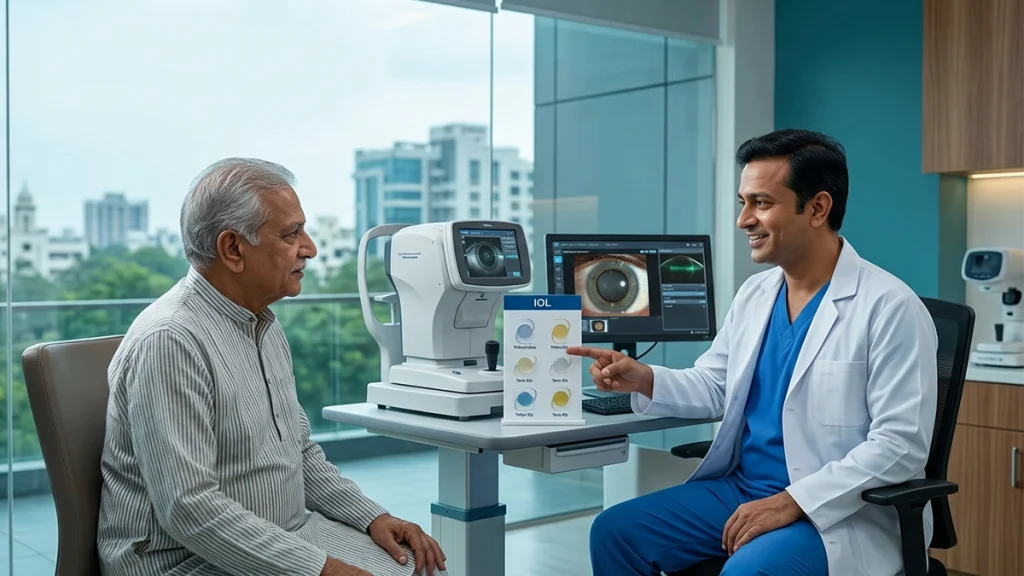
The artificial lens implanted during cataract surgery in Indore remains inside the eye after the natural cloudy lens has been removed. Lens selection influences the expected range of vision and possible dependence on spectacles.
| IOL option | Main purpose | Important points to discuss |
| Monofocal IOL | Usually provides clear vision at one main distance | Reading or distance glasses may still be required |
| Toric IOL | Corrects selected amounts of corneal astigmatism | Accurate measurements and correct lens positioning are important |
| Multifocal or trifocal IOL | Provides vision at more than one distance | Some patients may notice glare, halos or reduced contrast |
| Extended-depth-of-focus IOL | Extends useful distance and intermediate vision | Fine near work may still require reading glasses |
| Monovision arrangement | One eye is planned more for distance and the other for near | Not every patient adapts comfortably to the difference |
FDA has recognized monofocal, multifocal, extended range of focus, accommodating and toric intra ocular lens designs. Pre op evaluation should go over benefits, risks, and possible outcomes before implantation. A monofocal lens is usually set for one primary distance. In the case of corneal astigmatism that is significant a toric IOL may be used. Multifocal, trifocal and extended range lenses may reduce but not eliminate the need for glasses in proper candidates.
The cataract doctor in Indore should consider the patient’s occupation, reading habits, night-driving needs, retinal health, glaucoma status, corneal measurements and budget. Also before getting cataract treatment in Indore patients should ask which distance is being targeted, what activities may still require glasses and if the chosen lens will cause glare or halos.
Cataract Surgery Cost in Indore
The cataract surgery cost in Indore is not the same for every patient. It varies by the type of surgery, IOL type, diagnostic tests, hospital facilities, medicines, health complexity and post op package. At ASG Eye Hospital’s national cataract info page we see an average range of about ₹20,000 to ₹1,50,000 per eye. In their Indore page it is reported that the cost depends on the IOL, surgical approach and hospital facilities. The put forth national range is to be taken as a broad guide rather than a set price for an individual patient in Indore.
When comparing the cataract surgery cost in Indore, patients should ask what is included in the estimate. A written quote should detail consultation charges, biometry, retinal and corneal tests, IOL cost, surgeon fees, operating-theatre charges, medication, and also any scheduled follow ups. The cataract surgery cost in Indore may be lower with a standard monofocal IOL and see a higher price with toric, multifocal, trifocal, extended range or laser assisted options. Also a more expensive lens does not mean the right one for each individual patient.
Insurance which includes cashless options is at the discretion of the insurance company, policy terms, waiting period, hospital network, procedure limits and lens related caps. Before scheduling a cataract operation in Indore, patients should confirm coverage directly with the hospital and insurance provider. A transparent cataract hospital in Indore should explain every charge before admission. The final cataract surgery cost in Indore should be confirmed only after examination because additional eye conditions may change the surgical plan.
Choosing a Cataract Doctor and Surgeon in Indore
Selecting a cataract doctor in Indore is not just by which they price their consultation. The ophthalmologist should do a through evaluation, bring forward other options, talk on lens pros and cons and also report on what may play a role in post op vision.
A cataract surgeon in Indore should present the surgical approach we will take, what the visual results will be like, what complications may come up, the recovery time and that it is likely your will need to use glasses. Also caution patients against perfect vision guarantees, permanent freedom from glasses or zero risk.
ASG Eye Hospital’s present Indore cataract page features Dr Lalit Gupta, Dr Wafi Ansari, Dr Mahesh Birla and Dr Vineet Mutha as the doctors associated with cataract, phaco, glaucoma, retina and laser services. We advise that you verify doctor availability, consultation timings and the operating surgeon when booking as these are subject to change.A consultation with a cataract doctor in Indore should help the patient understand what will be done and why. The final choice of cataract surgeon in Indore should be based on relevant qualifications, clinical communication, surgical planning and access to postoperative care.
Choosing a Cataract Hospital in Indore
A cataract hospital in Indore should provide for in depth evaluation, biometry, sterile surgery and postoperative assessment. Also to which is the patient to look for written out medication instructions, emergency contact info, consent forms and scheduled follow ups should be made available. ASG Eye Hospital’s official city page reports that their Indore center is at Embassy Tower, Plot No. 9/1/3, First Floor, Mahatma Gandhi Road, near Treasure Island Mall. The hospital is at large from Palasia, Vijay Nagar, South Tukoganj, Geeta Bhawan, Bengali Square, Annapurna Road, Rajendra Nagar, Bhanwarkuan, Rau and nearby areas. Patients should check for current hours of operation, which doctors are on staff, insurance issues and if the put forth surgical technology is what is offered at that center.
Recovery and Postoperative Care
Recovery from cataract surgery in Indore is a gradual process. Early in the healing process patients may notice mild watering, temporary blurriness, light sensitivity or a gritty sensation. We ask that you follow the prescribed eye drop regimens as advised, do not rub the eye and to keep all your follow up appointments. As to which activities like bathing, exercise, lifting, driving and returning to work are to be avoided varies from patient to patient and procedure to procedure. What the official NHS reports is that although many people recover very quickly after cataract surgery, it is still important that postoperative precautions be followed very carefully.
After a cataract operation in Indore, vision may continue to improve over a few weeks. A full spectacle prescription is usually given after the healing process is enough. In case of diabetes, glaucoma, corneal disease or retinal conditions patients may require more attention.
Severe or increasing pain, sudden change in vision, redness, discharge, new flashes, many new floaters or a curtain like shadow require prompt assessment. The patient should reach out to the cataract hospital in Indore instead of waiting for the next scheduled visit.
Benefits and Possible Risks
In Indore the purpose of cataract surgery is to improve vision which is impaired by the cloudy lens. Better sight may put an end to difficulty in reading, recognizing faces, walking, cooking, work and travel. Also results do depend on the health of the cornea, retina, optic nerve and other eye elements. It is true that we cannot go back vision which is lost from some other eye disease. As with any surgery there are risks associated with a cataract operation in Indore. They may include infection, inflammation, changes in eye pressure, retinal swelling, corneal swelling, bleeding, retinal detachment or IOL positioning issues.
A layer of the artificial lens may develop cloudiness which may present months to years post surgery. This is what we call posterior capsule opacification which we can treat with a laser at the time of the visit for evaluation. Counselling before cataract treatment in Indore allows the patient to understand expected benefits, possible limitations and warning signs that require urgent care.
Why Consider ASG Eye Hospital for Cataract Care?
Patients exploring cataract surgery in Indore can consult ASG Eye Hospital for cataract evaluation, biometry, lens counseling, surgical planning and post op follow up. Also the official Indore page reports we perform phacoemulsification, micro-incision surgery, small incision surgery, laser assisted surgery and extracapsular extraction for chosen cases. When you are to see a cataract doctor in Indore the first visit will determine if the visual issue is indeed from cataract. And for those that are to choose a cataract surgeon in Indore we discuss the IOL recommendation, visual target, what to expect in terms of recovery and also go over the risks.
Before choosing a cataract hospital in Indore, patients may call the MG Road center to check on appointment slots, which doctors are available at present, insurance options, and to get out a personal cost estimate. Also this is a good step to clarify issues related to cataract surgery cost in Indore before proceeding with treatment.
Conclusion
Choosing cataract surgery in Indore is an individual medical choice based on the impact of cataract on daily life, health of the full eye and the which which you will benefit from the surgery. We can do an in depth evaluation to determine if treatment is needed at present or if we should go with a watch and wait approach. Also in Indore for cataract issues it is important to research cataract surgery cost in Indore, ask the cataract doctor in Indore the right questions and to discuss the plan with your cataract surgeon in Indore which will in turn make the treatment process much easier to navigate.
The chosen cataract hospital in Indore should provide open communication, a written up estimate and a structured follow up before and after cataract operation in Indore. In Indore patients which are a part of our practice may get in to ASG Eye Hospital for an exam to discuss their symptoms, lens choices and personal surgical plan.
Frequently Asked Questions
1. Is cataract surgery painful?
Most cataract surgery in Indore procedures are performed after applying local anesthetic or anesthetic drops to the eye for cataract surgery. Patients may notice light, pressure or movement but what we don’t see is a great deal of pain.
2. How long does a cataract operation take?
The surgical stage of a cataract operation in Indore may be relatively brief. That said preparation, dilating the pupil, post op checks and discharge counseling lengthen the total hospital stay.
3. What is the average cataract surgery cost?
The cataract surgery cost in Indore depends on IOL, technology, investigations and what is included in the package. ASG reports out a wide national range of approximately ₹20,000 to ₹1,50,000 per eye but for a specific quote in Indore get what is published after the eye exam.
4. Which lens is suitable for cataract treatment?
The correct lens for cataract treatment in Indore depends on corneal astigmatism, retinal health, lifestyle, night driving requirements and what type of spectacle use you prefer. There is no one size fits all lens.
5. Will glasses be required after surgery?
The cataract doctor in Indore will explain the planned visual target. Monofocal distance lenses often leave patients with a need for reading glasses. Premium lenses may reduce the use of glasses in right patients but we cannot promise total freedom from them.
6. How should a surgeon be selected?
Choose a cataract surgeon in Indore who does detailed measurements, talks of realistic results, goes over the risks and alternatives and provides organized postoperative support.
7. Can both eyes be operated on at the same time?
The in which the second cataract operation in Indore takes place is based on the state of both eyes, recovery from the first procedure and the surgeon’s clinical protocol.
8. Is cataract surgery covered by insurance?
Insurance coverage for cataract surgery in Indore depends on the policy, waiting period, network hospital status, procedure limit and IOL cap. Written confirmation should be obtained before admission.
9. What should a cataract hospital provide?
A cataract hospital in Indore which supports diagnosis, biometry, sterile surgery, recovery monitoring, postoperative follow up and emergency guidance.
10. When should the patient contact the hospital urgently?
Urgent contact is required for severe pain, sudden vision loss, increase in redness, discharge, flashes, new floaters or a curtain like shadow.
Reference Links
- NPCBVI – Ophthalmology Division
https://dghs.mohfw.gov.in/opthalmology-division.php - Standard Treatment Guidelines – National Blindness Programme
https://clinicalestablishments.mohfw.gov.in/en/standard-treatment-guidelines - The National Eye Institute,
https://www.nei.nih.gov/eye-health-information/eye-conditions-and-diseases/cataracts/cataract-surgery