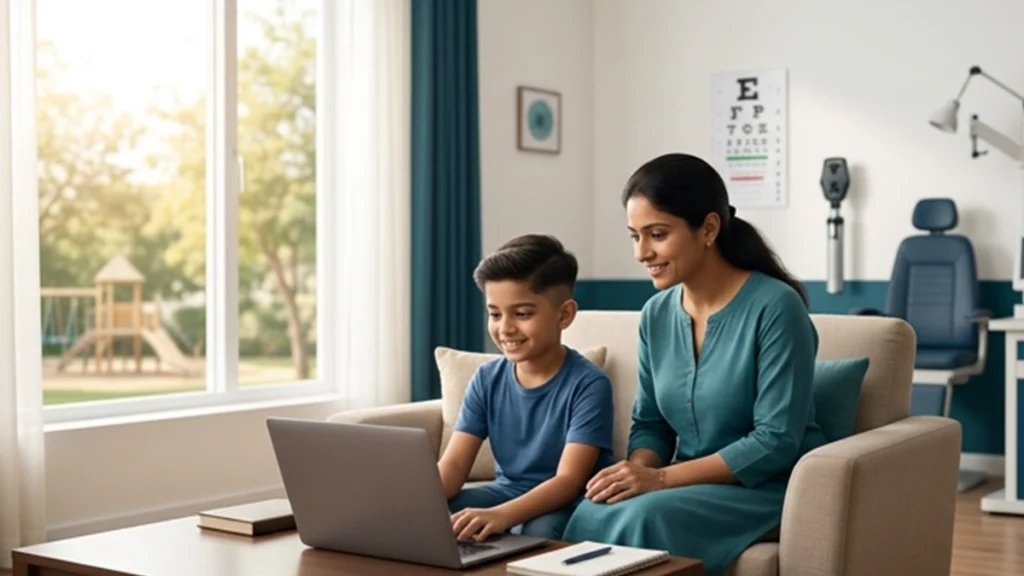
In today’s world phones, tablets, televisions, and computers are a part of what is normal for kids. They use screens for school, entertainment, games and communication. Although digital devices bring many benefits, extended time in close proximity to them can lead to tired, dry, or uncomfortable eyes.
Parents do not have to eliminate tech use completely. Instead we see value in instilling healthy screen habits for children which in turn may help to achieve a better balance between digital input, outdoor activity, sleep and eye health.
Research also reports that which may go along with increased myopia in kids we see with greater digital screen use, although screens are only one of many factors which play a role. z
Why Healthy Screen Habits Matter for Children
Long term at kids screen time often means they are focused up close for great lengths of time. Also while on a device kids may not blink as much. This may cause dryness, temporary blurred vision, headaches, or eye strain.
One report which looked at school age kids noted that smart phone use reduced blinking and produced more eye discomfort at the end of an hour of continuous use. Also in the children’s eye care we do well to teach how to use these devices in a way that is comfortable for them rather than just looking at total time spent.
| Screen-Related Habit | Possible Concern |
| Long periods without breaks | Eye fatigue and discomfort |
| Holding screens very close | Increased near-focus demand |
| Reduced blinking | Dry or irritated eyes |
| Excessive indoor screen use | Less time available for outdoor activity |
1. Introduce Regular Screen Breaks
One of the healthy screen habits for children is to take lots of visual breaks. Tell your child to step away from the device at regular intervals and instead look at far off objects.
Breaks give your eyes a chance to rest which in turn help out during extended periods of break from continuous screen time. Also they play a role in breaking up long stretches of uninterrupted kids screen time.
2. Create Screen-Free Parts of the Day
Not at all does screen use have to fill every free moment. Parents may also set which times for devices are off, like during meals and at the park, during family talks, and in the evening at home.
This approach is a part of the daily routine in which parents and also children play a role in the development of healthy screen practices. Also, electronic devices are used as a reward or punishment. Also it may present to kids that screens are but one of many available activities.
3. Encourage More Outdoor Time
Outdoor play gives out a natural respite from close work. We see that as the more time spent in outdoor activity the risk of myopia in kids goes down.
For improved children’s eye care, we must put forth an effort to have them balance out study, play station, and media use with more time spent in the great outdoors. Also we may see that by instilling healthy routines we do in fact improve the eye health issue related to screen time and eyesight which in no way means we should scare kids away from technology.
4. Keep Screens at a Comfortable Distance
Children often bring their smartphones and tablets right up to face, especially during game play or video. Get them in the habit of holding the devices at a better viewing distance.
Larger screens play a role in extended educational activities. This simple switch also supports healthy screen habits for children and which in turn reduces that which is unnecessary close up focus.
5. Adjust Screen Brightness and Room Lighting
A very bright screen in a dark room is uncomfortable. Also glare and reflections which do.
Match your screen’s brightness to that of your surroundings and when possible reduce distracting glare. Also the American Academy of Ophthalmology reports that you can ease digital eye strain by adjusting screen brightness, contrast, and nearby lighting.
6. Remind Children to Blink
Children report to be less aware of their blinking when they are into a game, video, or homework. This may cause the eye to feel dry.
Regular blinks help refresh the tear film. Also parents can gently encourage kids to take breaks and blink out during that long kids screen time. This simple routine may in fact become a very large component of daily children’s eye care.
| What Parents Can Encourage | Why It Helps |
| Frequent visual breaks | Gives the eyes time away from near focusing |
| Comfortable viewing distance | Reduces prolonged close viewing |
| Regular blinking | Helps maintain the tear film |
| Outdoor activities | Balances near work and indoor screen use |
| Appropriate room lighting | Helps improve viewing comfort |
7. Set Age-Appropriate Screen Rules
For each child what is right in terms of screen use varies by age and daily requirements. Also for many families school work makes a daily set limit out of the question.
For young children public health advice is given to parents which sets out boundaries. The World Health Organization reports on sedentary screen time for pre 5 year old kids as part of which also they give advice on physical activity and sleep.
The goal is for healthy screen habits for children to develop which is not to say that we should count every second they are on a device.
8. Pay Attention to Eye-Related Symptoms
Children may not give clear reports of their vision issues. Parents should look out for complaints like repeated headaches, eye discomfort, blurred vision, frequent eye rubbing, or difficulty with seeing.
If issues persist after you reduce kids screen time and improve their screen habits, get in for an eye exam. Professional children’s eye care is to detect refractive errors and other eye problems which may need treatment.
Conclusion
Technology is a part of what kids do today, which means total avoidance is almost out of the question. Instead we should work on instilling healthy screen habits for children in them from a young age.
Regular intervals, outdoor play, proper viewing distance, good lighting, and moderate kids screen time is what we see as a way out for better digital experience. Also parents must report on persistent visual issues and take into the fold professional children’s eye care when required. With a steady routine, families may put in place a better balance between tech, daily doings and eye health.
Frequently Asked Questions
1. Can too much screen time affect a child’s eyesight?
Long term computer use may cause digital eye strain which in turn may present as dry eyes or temporary blurred vision. Also we see that there is a connection between high screen exposure and myopia but that many environmental and genetic factors play a role. We put forth that which practices parents adopt screen time and eyesight may in fact promote healthier routines.
2. What are healthy screen habits for children?
Healthy screen habits for children include taking breaks often, which distance from the screen is proper, that we have good lighting in the room, also getting lots of play time outside, we encourage regular eye blinking, and that we set time limits which are appropriate to age and day’s activities.
3. How can parents reduce kids screen time?
Parents can have screen free meals, encourage outdoor play, create device free family activities and put in place consistent home rules. Gradual reduction of kids screen time will make the routine easier to maintain.
4. When should a child have an eye examination?
Parents should take in professional children’s eye care when a child reports persistent blurry vision, headaches, eye discomfort, difficulty in seeing, or other atypical visual symptoms.
5. Is there a connection between screen time and eyesight?
Research is into screen time and eyesight. We see that long term screen use causes eye strain also which in some studies we note is associated with an increase in myopia.
Reference Links
- World Health Organization – Guidelines on Physical Activity, Sedentary Behaviour and Sleep for Children Under 5 Years of Age
https://www.who.int/publications/i/item/9789241550536 - U.S. National Library of Medicine / NIH – Digital Screen Time and Myopia: A Systematic Review and Dose-Response Meta-Analysis
https://pmc.ncbi.nlm.nih.gov/articles/PMC11846013/ - U.S. National Library of Medicine / NIH – Screen Time Exposure and Myopia in Children and Adolescents
https://pmc.ncbi.nlm.nih.gov/articles/PMC11186094/ - American Academy of Ophthalmology – Digital Devices and Your Eyes
https://aao.org/eye-health/tips-prevention/blue-light-digital-eye-strain