Reception of your glaucoma test report may be confusing which is when it includes foreign numbers, charts, and shaded areas. What I have found to help is in explaining glaucoma visual field results which in turn helps patients see how the disease will play out for their sight.
Glaucoma attacks the optic nerve which in time leads to loss of peripheral vision. We use visual field testing to determine and report these changes. Although glaucoma visual field results are very useful they must be put in the context of other eye exams by an ophthalmologist.
What Is a Glaucoma Visual Field Test?
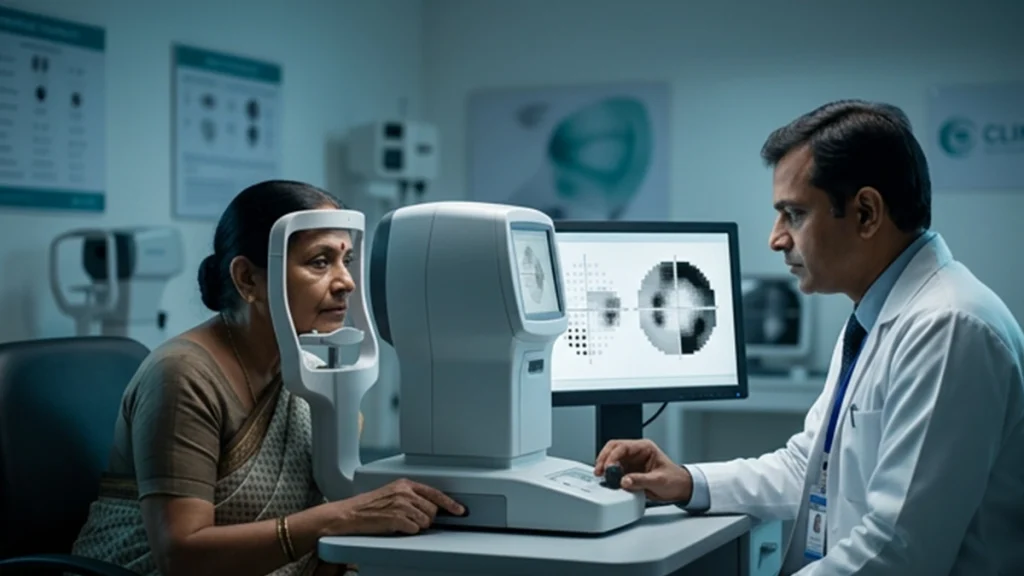
A visual field test is a study of what you see out of the corner of your eye. The most common is the Humphrey field test which is a computerized exam for light sensitivity.
During the exam you will look at a set point and press a button when the lights come on. This procedure which is known as perimetry also identifies areas of vision loss.
The Humphrey field test is to identify early peripheral vision loss which may occur before any symptoms present. Your doctor will compare glaucoma visual field results to previous reports to track changes.
Understanding the Numbers in Your Glaucoma Visual Field Report
Your report includes a number of different tests. Each one gives out varying information on visual function. By going over these tests we make it easier to discuss glaucoma visual field results with your ophthalmologist.
| Report Parameter | What It Means |
| Mean Deviation (MD) | Measures overall visual field sensitivity compared with age-adjusted normal values. More negative values may indicate greater loss. |
| Pattern Standard Deviation (PSD) | Identifies irregularities or localised changes in visual field sensitivity. |
| Visual Field Index (VFI) | Estimates visual field function as a percentage, giving greater weight to central vision. |
| Glaucoma Hemifield Test (GHT) | Compares patterns in the upper and lower visual fields to identify possible abnormalities. |
| Reliability Indices | Help doctors judge whether the responses during testing were consistent and dependable. |
These doctors use these measurements to interpret glaucoma visual field results in glaucoma patients, also no single value is a definite indicator of glaucoma progression.
What Do Common Changes in Glaucoma Visual Field Results Mean?
Glaucoma tends to attack side vision first before central vision. In perimetry we see to identify telltale patterns of reduced sensitivity.
| Visual Field Change | Possible Interpretation |
| Nasal Step | Reduced sensitivity along the nasal side of the visual field, following the horizontal midline. |
| Arcuate Scotoma | A curved area of reduced vision that may reflect glaucoma-related optic nerve damage. |
| Paracentral Scotoma | A small area of vision loss close to the central point of vision. |
| Generalised Depression | Widespread reduced sensitivity that may result from cataracts, glaucoma, or other factors. |
| Advanced Field Constriction | Extensive peripheral vision loss, sometimes leaving a smaller area of useful central vision. |
These patterns also account for what is seen in glaucoma visual field results. Also in other eye diseases you may see the same abnormalities.
Why Can Glaucoma Visual Field Results Change Between Tests?
Changes in glaucoma visual field results are not to indicate progression of glaucoma. Fatigue, dry eyes, poor concentration, incorrect lens placement, and cataracts play a role in this.
The Humphrey field test also includes what we call reliability measures. These tools allow doctors to identify which atypical results require confirmation.
Repeated perimetry is used to tell apart temporary changes from what is really present of peripheral vision loss. Doctors also look at eye pressure, the study of the optic nerve and results of optical coherence tomography (OCT).
How Do Doctors Monitor Glaucoma Progression?
Regular eye examinations allow ophthalmologists to compare glaucoma visual field results over time, looking for consistent trends rather than relying on a single abnormal report.
When a patient has glaucoma visual field results that point to progression of the disease doctors may review eye pressure control and also look at the patient’s treatment adherence. As per the results of the review, they may put forward a case for adjustment in medication, or suggest laser treatment or even surgery.
At ASG Eye Care we perform a visual function assessment along with relevant clinical studies to inform each patient’s treatment plan.
Conclusion
Understanding glaucoma visual fields is key to patient participation in eye care. We use regular perimetry and the Humphrey field test for early detection and monitoring of peripheral vision loss.
If you see changes in your report, get in touch with an ophthalmologist for analysis. Go to ASG Eye Care to know more on full scale eye exams and glaucoma care.
Frequently Asked Questions
1. What do abnormal glaucoma visual field results mean?
Abnormal results on glaucoma visual field tests report reduced sensitivity in some areas. They may point to glaucoma related damage which is confirmed by other tests.
2. Is the Humphrey field test painful?
No. The Humphrey field test is also free of invasiveness and in general is painless. You respond to flash lights while at the same time maintaining your gaze.
3. Can peripheral vision loss from glaucoma be reversed?
Existing glaucomatous peripheral vision loss is usually permanent. What we can do is to diagnose and treat at an early stage which may in turn slow or prevent progression of the damage.
4. How often should perimetry be performed?
The frequency of perimetry is determined by the stage of glaucoma, associated risk factors, and prior test results. Your ophthalmologist will determine the testing schedule.
5. Can glaucoma visual field results improve?
Sometimes what we see is an improvement in glaucoma visual field results which may be due to better performance on the test or a reduction in interference from other eye conditions. This does not mean that function of the damaged optic nerve has returned.
References Links
1. National Eye Institute (NIH) – Glaucoma: Symptoms, Diagnosis and Treatment
https://www.nei.nih.gov/eye-health-information/eye-conditions-and-diseases/glaucoma
2. Guy’s and St Thomas’ NHS Foundation Trust – Visual Field Eye Test
https://www.guysandstthomas.nhs.uk/health-information/visual-field-eye-test
3. American Academy of Ophthalmology EyeWiki – Standard Automated Perimetry
https://eyewiki.aao.org/Standard_Automated_Perimetry