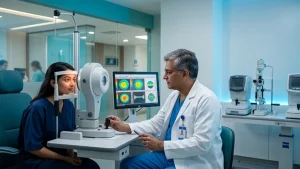
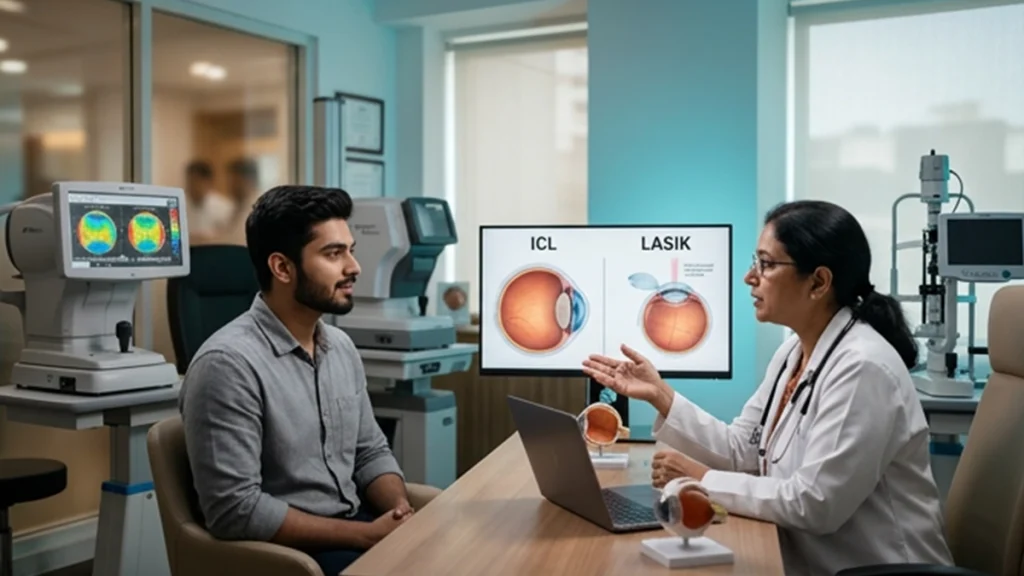
Choosing out of ICL vs LASIK may be a difficult decision which you have to take when both procedures are put out to reduce your dependence on glasses or contact lenses. But they do it in different ways. Your prescription, corneal health, eye anatomy, age and lifestyle play a role in which one is best for you.
ICL surgery and LASIK surgery Assisted In Situ Keratomileusis are both forms of vision correction surgery, the former places a lens inside the eye and the later reshapes the cornea. By understanding these differences you may get more out of your pre op discussion with an ophthalmologist.
What Is the Difference Between ICL and LASIK?
When it comes to ICL vs LASIK the main difference is in what the procedure does to correct vision. In a LASIK surgery an ophthalmologist uses a laser to reshape the cornea which in turn changes how light focuses on the retina.
As for ICL surgery, we are looking at the insertion of an implantable lens inside the eye which is done without removing the natural lens. The FDA describes these collamer lenses as artificial lenses which are put in the eye to correct refractive errors like myopia.
That is a key point to note when looking at ICL vs LASIK for high myopia cases or for people that may not be good candidates for corneal laser eye surgery.
| Factor | ICL | LASIK |
| Treatment method | Lens implanted inside the eye | Cornea reshaped using laser |
| Corneal tissue removal | No | Yes |
| Common consideration | Moderate to high myopia | Suitable refractive errors with adequate corneal thickness |
| Implant involved | Yes | No |
| Recovery | Usually quick but requires intraocular healing | Often rapid visual recovery |
Who May Be Eligible for ICL or LASIK?
Eligibility is a major issue in ICL vs LASIK. We see that a detailed eye exam is required before either procedure.
For someone looking at LASIK surgery a stable prescription and healthy corneas is a must. Also we look at corneal thickness, tear-film health and over all eye health. The FDA reports that changes in prescriptions, pregnancy, breastfeeding and some health issues play a role in LASIK suitability.
ICL surgery may be an option for people with very high myopia which in some cases rules out laser eye surgery. Also we look at the anterior chamber depth and other variables before putting in the implantable lens.
Thus the ICL vs LASIK choice should not be based only on spectacle power.
ICL vs LASIK Benefits
The differences between ICL vs LASIK are in what each procedure does. With LASIK surgery we do not put in a permanent lens and also see a very quick visual recovery which is a great benefit.
Many times we see patients back to their routine within a short while post op as the ophthalmologist says it is ok.
ICL surgery on the other hand does not reshape or remove corneal tissue. This is a pro for certain patients which have refractive errors that the traditional laser eye surgery can’t correct either because of the prescription or the cornea dimensions.
| Comparison | ICL Surgery | LASIK Surgery |
| Corneal reshaping | Not required | Required |
| Internal lens | Yes | No |
| High myopia | May suit selected patients | Suitability depends on eye measurements |
| Dry-eye consideration | Does not involve a corneal flap | Dry-eye symptoms may occur |
| Follow-up | Regular eye monitoring required | Post-operative follow-up required |
Neither procedure is automatically “better.” The answer to ICL vs LASIK depends on the individual eye.
Risks of ICL vs LASIK
Every way of looking at it, vision correction surgery presents risks. In terms of results from LASIK surgery we see that dry eye issues, glare, halos, issues with night vision, under or over correction are all possibilities. Also the FDA reports that some patients do in fact have visual issues or other complications after these types of refractive procedures.
As for ICL surgery which takes place within the eye, issues like infection, inflammation, raised eye pressure, cataract growth or problems with the position of the lens are what we see. That is why it is very important for patients to have detailed measures taken and to have a good follow up.
Also in the ICL vs LASIK debate we see that it is very much a case by case issue based on personal health factors and history which is why it is so important to talk this over with your doctor not just to look at ads or what another patient may have had to say.
Recovery After ICL and LASIK
Recovery is a common issue in the discussion of ICL vs LASIK.
With LASIK surgery, vision tends to improve right away although at times may be accompanied by temporary dryness, glare or fluctuating vision. We tell patients to avoid rubbing their eyes and to stick to the prescribed medication schedule.
As forICL surgery recovery which also may be quick, because it is an intraocular vision correction surgery regular follow up is very important. We may check eye pressure, vision and the position of the lens at follow up.
Also recovery time for ICL vs LASIK may vary, so it is best to follow your surgeon’s individual instructions.
Conclusion
ICL vs LASIK decisions should be based on what is best for your eye health, not just convenience. Both procedures do what is to reduce dependence on glasses in patients that are appropriate for them.
ICL surgery which is a type of surgery that puts in an artificial lens leaves the cornea alone, whereas LASIK surgery uses a laser to reshape the cornea. An ophthalmologist can determine which vision correction surgery. best fits your prescription and eye make up.
If you are thinking about ICL vs LASIK we recommend you come in for a full evaluation at ASG Eye Hospital to go over your options and make a known decision.
FAQs About ICL vs LASIK
1. Is ICL better than LASIK?
There is no universal winner between ICL vs LASIK. ICL surgery does better in the case of high prescription or certain corneal issues. For LASIK surgery we see better results in patients that have adequate corneal thickness and which also have stable refractive errors.
2. Is ICL safer than LASIK?
Both of these procedures are used commonly but present different risks. In ICL surgery we go into the eye and in LASIK surgery we reshape the corneal tissue. Your ophthalmologist will go over which is the best risk profile for your eyes.
3. Can people with thin corneas undergo ICL?
Some patients that are not candidates for corneal laser eye surgery do in fact have the option of ICL surgery. We still require a full exam.
4. Which procedure has faster recovery?
In many reports it is noted that both do well. For many patients who have had LASIK the recovery of vision is very quick, also with ICL vs LASIK we see improvement in vision right after the procedure.
5. How do I choose between ICL and LASIK?
The best approach to ICL vs LASIK is to have a full eye exam. What we look at is prescription, corneal thickness, eye pressure, anterior chamber dimensions and total eye health which will determine the choice.