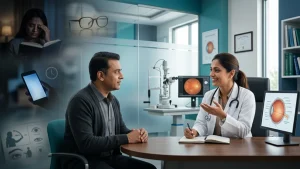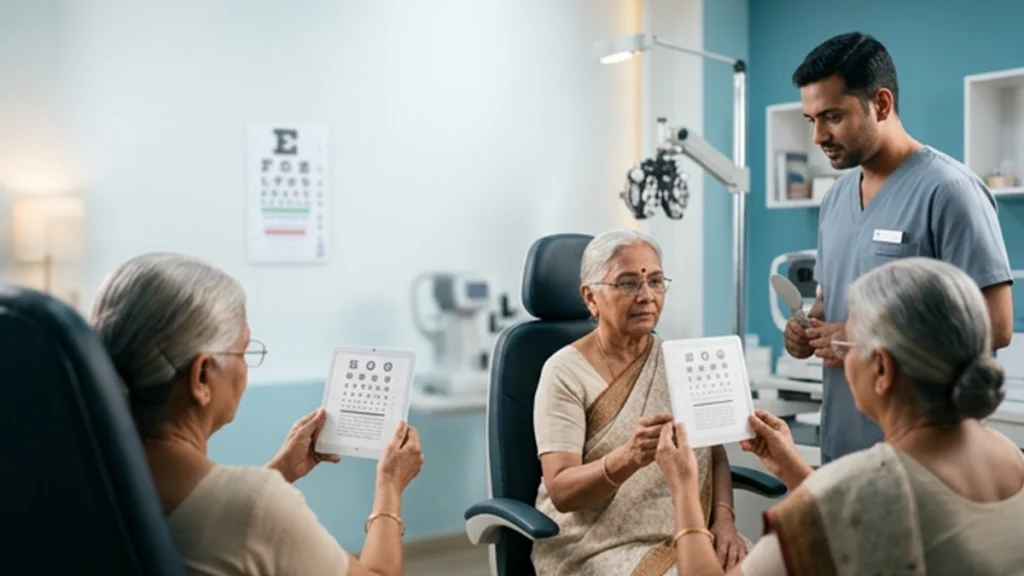
Have you ever noticed the lines of letters on an eye chart which a doctor uses to test you? That is a visual acuity test, and also a very basic method of measuring how well you see.
Eye care professionals usually check vision at both close and far distances. A near vision chart which is used for reading distance helps to see how well you can out make out words and symbols. At a distance vision test how well you see more distant objects. Together these tests give you information on the health of your eyes and if we think there is an issue we may do more in depth evaluation.
What Is a Visual Acuity Test?
A visual acuity test which measures the sharpness of your vision is what you do during which you will identify letters, numbers, or symbols that get progressively smaller.
The National Eye Institute reports that during a full eye exam which may also include reading text at a distance as well as up close which in turn helps the eye doctor to assess different aspects of vision.
For distance testing, the Snellen chart is a standard tool. As for near vision, an ophthalmologist may use a near vision chart which has progressively smaller print.
These tests don’t diagnose all eye conditions. What they do eye check result is give your health care provider info about your ability to see clearly.
What Is a Near Vision Chart?
A normal reading distance near vision chart is what we use to determine how well you see at a close range. During a near vision test we in most cases will have that chart at a certain distance which is set and will test each eye
The chart has letters, words, numbers, and symbols in various sizes. You read the smallest line which is clear to you. This near eye test is also a way to identify issues with close up tasks.
People usually look for the common name of the near vision chart name which they expect to be a universal chart. But we see that different clinical charts and notation systems are used. A Snellen near vision chart or any other standardized near reading chart may be included in the exam.
| Test | What It Checks | Typical Task |
| Near vision test | Clarity of near vision | Reading small print |
| Distance vision test | Clarity at a distance | Reading letters on a wall chart |
| Visual acuity test | Overall visual sharpness | Identifying progressively smaller characters |
How Is a Near Vision Test Performed?
During a refraction exam you will hold the near vision test at the distance your eye care professional instructs. Good lighting is key to getting an accurate result.
The doctor will have you cover one eye at a time and read out the small print you see. We will then do the same with the other eye. For the near eye test we may ask you to remove your glasses or wear your usual ones whichever is the case for your assessment.
Your performance on the near vision test chart which in turn gives the doctor info on your functional near vision. You may have difficulty with this if you have refractive errors or age related changes like presbyopia.
A near vision chart for up close reading is not enough to determine the exact cause of blurry vision. Further evaluation may be required.
How Does a Distance Vision Test Work?
The near version of the distance vision test which also uses a Snellen style chart that displays large letters at the top and as you go down the chart the letters get progressively smaller.
The National Eye Institute reports on visual acuity which includes measurements like 20/20 or 6/6. What they mean by 6/6 is that you are able to see at six meters what a person with normal visual acuity can see at that same distance.
An eye test distance should be the same for all tests as results are affected by change in viewing distance.
| Result Example | General Meaning |
| 6/6 | Standard distance visual acuity |
| 6/12 | Reduced distance clarity compared with 6/6 |
| Near chart result | Indicates clarity at the specified reading distance |
Near Vision Chart vs Distance Vision Chart
A far vision chart and near vision chart present information which is of different use. The near vision test determines how well you read up close, while the distance vision test measures what you see at a distance.
Some may have great distance vision yet see poorly at near vision. This is very true of presbyopia as we age. Also some may do well on the eye test distance but have issues reading up close.
For that which is, doctors perform eye check result from both tests which is also true for the fact that they do not base their diagnosis on a single measurement.
Why Are Regular Vision Tests Important?
Changes in vision can be gradual. You may begin to hold your phone at arm’s length or to stand closer to the sign without realizing you’re doing it.
A visual acuity test will identify changes in visual clarity. For a near vision chart which brings out issues with close work, at distance testing we look at far vision.
However we see that clear vision in the charts is not the same as a full health of the eyes. In fact we find that full eye exams will bring to light eye issues which a basic near eye test may not.
Conclusion
The near vision chart is a basic yet very useful component of a routine eye exam. When put with a visual acuity test for distance they present to the eye care professional a more complete picture of how well you see at various distances.
If you are having trouble with reading or notice that distant objects are less clear do not rely on a home near vision test chart. At ASG Eye Care we do full eye exams which include assessment of your near vision and distance vision, we will determine your prescription needs and check the health of your eyes.
Frequently Asked Questions
1. What is a near vision chart used for?
A near vision chart measures the clarity of your ability to see letters, words, or symbols at a given close distance.
2. What is the near vision chart name?
The name of the near vision chart name may vary depending on the type of chart used. For the Snellen near vision chart which is one option, also there are other standardized near reading charts which are available.
3. Is a near vision test different from a distance test?
Yes. A near vision test for close up clarity. distance vision test which measures how well you see at a distance.
4. Can I perform a near eye test at home?
A home based near eye test may help you notice changes, but it should not take the place of a professional exam. Screen size, print quality, lighting, and testing distance play a role in results.
5. What should I do if my eye check result has changed?
If you experience any changes in your eye health, note that your vision is still blurry, are dealing with eye strain, or problems with reading, see an eye specialist. Also if you see sudden changes in your vision don’t delay in getting in to see a medical professional.
Reference Links
- National Eye Institute – Get a Dilated Eye Exam — The NEI explains that visual acuity testing includes reading letters up close and far away as part of an eye examination. (National Eye Institute)
- National Eye Institute – History of the National Eye Institute — Includes an explanation of visual acuity measurement, testing distance, and 20/20 or 6/6 notation. (National Eye Institute)