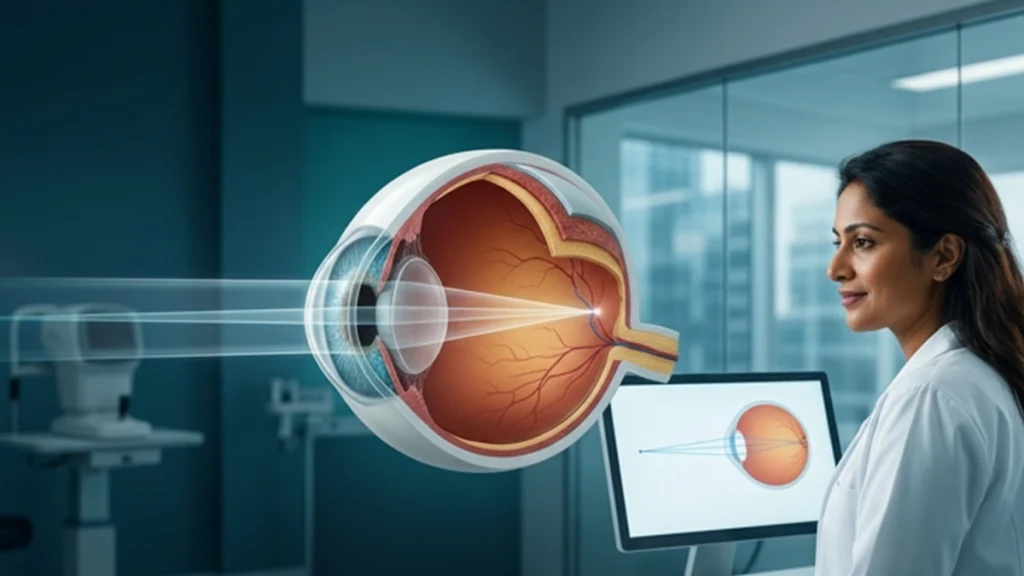
The human eye has a complex architecture which works in unison to produce clear vision. Within the eye we have the uvea, the well developed vascular layer which forms the middle structure. Although these may not be the parts that come to mind first when thinking of the eye, the uvea is very much a key player in the health of the eye.
Understanding the what is uvea meaning, its structure, and the issues which affect it may help in the recognition of eye symptoms.uveal tissue issues may cause redness, pain in the eye, light sensitivity, blurred vision or changes in vision. Some of these conditions require immediate evaluation to reduce the risk of complications.
What Is Uvea?
If you are curious what is uvea it is the middle layer of the eye’s anatomy. The National Eye Institute also reports that the uvea is the layer which sits between the sclera, the white outer layer of the eye, and the retina which lines the back of the eye.
The iris, ciliary body, and choroid out which together what they do is control incoming light, assist with focus, produce aqueous humour and support important intra ocular tissues.
Understanding Uvea Anatomy
The uvea anatomy is best looked at by dividing it into its three primary sections. While each area of the uveal tract of eye has a unique function the three also work as a unit.
| Part of the Uvea | Main Function |
| Iris | Controls pupil size and regulates how much light enters the eye |
| Ciliary body | Helps the lens focus and contributes to aqueous humour production |
| Choroid | Contains a rich blood supply that helps nourish the outer retina |
The iris which is the visible colored part at the front of the eye also changes pupil size in response to light. Behind the iris is the ciliary body which has muscles that play a role in changing the shape of the lens for focus.
The choroid is that which makes up for the rear section of the uvea. It has many blood vessels which in turn supply the outer retina with oxygen and nutrients. This vascular character is also a reason which is why healthy uveal tissue is of import for proper visual function.
What Does the Uvea Do?
The uvea which is also a group of connected structures does many things at once instead of a single function. Its blood vessels play a role in supplying nutrition to key eye elements. Also the iris’ job is to control the amount of light that comes in through the pupil and the ciliary body which also supports the focus of the eye produces aqueous humour.
The choroid which is also a site of pigment plays a role in absorption of extra light within the eye. This in turn reduces internal light reflectance. Also in uveal tract anatomy this helps to see how the eye performs its functions of light management, focus, circulation and nutrition.
Diseases That Can Affect the Uvea
In many eye issues the uveal tissue is affected. A very known issue is uveitis which is a term for inflammation of the uveal tract and its adjacent structures. Uveitis may affect one or both eyes and different sections.
| Condition | Area Commonly Involved | Possible Symptoms |
| Anterior uveitis | Iris | Redness, pain, blurred vision, light sensitivity |
| Intermediate uveitis | Ciliary body/vitreous region | Floaters and blurred vision |
| Posterior uveitis | Choroid/retinal region | Floaters or reduced vision |
| Panuveitis | Multiple parts of the uvea | Combination of symptoms affecting vision |
| Uveal melanoma | Uveal tissue | May cause visual changes or sometimes few early symptoms |
In the case of uvea we see that it may be a result of infection, immune based issues, or other causes. In some patients we may not at first determine a definite cause.
Uveal melanoma, which is different from uveitis, is a cancer that has its origin in cells within the uveal tract, which at most times is the choroid. Any that may be a tumor requires specialist evaluation as opposed to self diagnosis based on symptoms.
When Should You See an Eye Doctor?
Symptoms of uvea at times may present like other eye issues. Persistent redness, severe eye pain, light sensitivity, new floaters, or blurred or reduced vision should not be ignored.
An ophthalmologist is able to look at the inner structure of the eye and determine which tissues the uveal tissue retina, or other structures are affected. Also it is very much at the early stage that we must pay attention because if left untreated uveitis may cause severe damage to the eye.
Conclusion
The uvea which is a more unknown structure when compared to the retina or cornea plays a large role in healthy vision. The iris, ciliary body, and choroid which together form the uveal tract also support light regulation, focusing, production of fluid, pigmentation, and nutrition of the retina.
Because there is a risk that some uveal tissue will affect your vision, persistent symptoms like eye pain, redness, light sensitivity, floaters, or vision changes should be evaluated by a professional. At ASG Eye Care we perform full eye exams which are very helpful in identifying the issue at hand and in giving the best treatment options.
Frequently Asked Questions
1. What is the uvea in the eye?
The uvea is the blood supplied middle layer of the eye between the sclera and retina. It includes the iris, ciliary body, and choroid.
2. What is another name for the uvea?
The term uvea is used interchangeably with the uveal tract. Both refer to the middle vascular layer of the eye.
3. What are the three parts of uvea anatomy?
The three primary elements of uvea anatomy are the iris, ciliary body, and choroid. Together which make up the uveal tract of eye.
4. What is uveal tissue responsible for?
Uveal tissue is responsible for light entry control, focus, production of aqueous humour, pigmentation, and supply of nutrients to key eye structures.
5. Is uveitis a disease of the uvea?
Yes. Uveitis is a term for eye inflammation which may affect various elements of the uvea and at times adjacent structures.
6. Can uvea problems affect eyesight?
Yes. Diseases of the uvea may present with symptoms of blurred vision, floaters, pain, redness, or light sensitivity. The results may range from case to case based on the affected area and the severity.
Reference Links
- National Eye Institute (NIH) — Uveitis
https://www.nei.nih.gov/eye-health-information/eye-conditions-and-diseases/uveitis - National Library of Medicine / NCBI — Anatomy, Head and Neck, Eye
https://www.ncbi.nlm.nih.gov/books/NBK482428/ - National Library of Medicine / NCBI — Anatomy of the Eye
https://www.ncbi.nlm.nih.gov/books/NBK11120/ - National Cancer Institute / NCBI — Anatomy of the Eye – Intraocular (Uveal) Melanoma
https://www.ncbi.nlm.nih.gov/books/NBK65836/figure/CDR0000258015__144/