
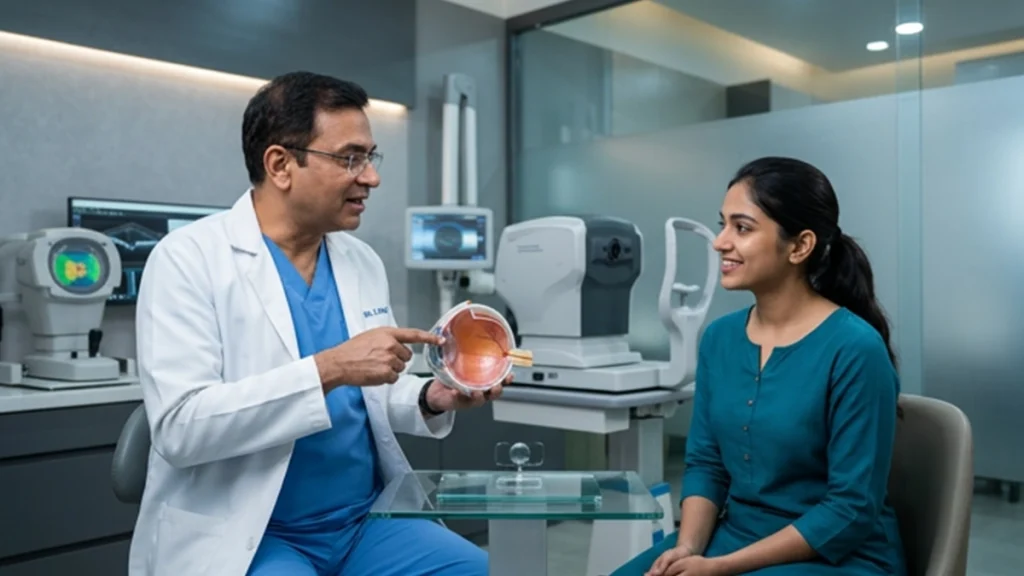
Instead of reshaping the cornea what ophthalmologists do is to put in a custom fit lens within the eye which leaves the natural lens alone. This is a choice which presents itself when laser procedures are not for the patient or when they are looking for an alternative to traditional methods of vision correction.
The process is very much different than that of a routine contact lens. An implantable collamer lens is left in the eye. It is important to have an in depth ICL vs LASIK discussion which they do because the procedures affect different eye elements and also present different risks.
What Are Implantable Contact Lenses?
Implantable contact lenses are also a type of intraocular lens which we term phakic. “Phakic” indicates the eye’s natural lens stays in place. The FDA reports that a phakic lens is put in through a tiny incision and is put in front of or behind the iris as is device dependent. It changes how light is focused which in turn causes the image to hit the retina more accurately.
The present which is a very common type of implantable collamer lens which is a soft and foldable material. It is placed behind the iris and in front of the natural lens. We use it primarily for myopia, also we have toric versions which may correct for astigmatism although that is at the discretion of local doctors and what we see in the individual patient. It provides vision correction without the removal of corneal tissue.
Although implantable contact lenses are designed to remain in place long term, “removable” should not be taken to mean “risk-free” or “fully reversible.” The FDA states that a phakic lens can be removed surgically, but it cannot guarantee a return to the exact preoperative condition or to the patient’s previous quality of sight.
How Does ICL Surgery Work?
In a short sighted eye light does what is in front of the retina instead of on it. The implanted lens adds more optical power which in turn allows light to focus more exactly on the retina. As opposed to LASIK the cornea is not reworked with a laser. This is a key point in the ICL vs LASIK evaluation.
Before we put in implantable contact lenses we do an in depth exam. We check refraction, cornea, pupil size, anterior chamber depth, eye pressure, retina and also count the corneal endothelial cells.The FDA reports that anterior chamber depth and endothelial cell count are key measures before phakic lens surgery.
Accurate measurement is key for an implantable collamer lens which requires that we have an ideal space or “vault” between the device and the natural lens. In reviews of the material from the US National Library of Medicine which reports this info out extensively they stress on meticulous pre op planning and sizing in to get the best results also in terms of reducing issues that may arise from a poor fit of that vault.
Who May Be a Suitable Candidate?
A typical candidate is an adult with a stable diagnosis, health of the eyes and which has enough internal space for safe insertion. People with moderate to high myopia or thinner corneas may be evaluated for implantable contact lenses, but spectacle power alone does not confirm candidacy.
The surgeon looks at age, pupil size, corneal endothelial health, anterior chamber depth, eye pressure, past inflammation and retinal condition. FDA reports that in people with unstable refraction, shallow anterior chambers, abnormal iris anatomy, history of uveitis, glaucoma issues or retinal problems caution is advised. Also that device indications and age limits which do change by country make an individual consultation a must.
Presbyopia also should be brought up. We see that Implantable contact lenses may improve distance clarity which in turn does not stop the age related loss of near focus, hence reading glasses may still be required. The aim of vision correction is for a greater degree of freedom from refractive blur not a promise of lifelong spectacle free sight.
Benefits of Implantable Contact Lenses
A key benefit is that we do not remove corneal tissue. This may make implantable contact lenses a good option to consider when corneal thickness, shape or prescription do not allow for laser treatment. The natural lens stays in the eye and the implanted lens provides the extra focus.
For some patients with high myopia we present that an implantable collamer lens is a solution which produces consistent results when for other patients the option of laser which requires extensive remodeling of the cornea is chosen. Also in the case of recent central-port models which are of a more advanced design we see very good visual and refractive results but also it is stressed that which patients are selected for the procedure and that long term follow up is to be performed.
Residual vision issues like glare, halos, or the need for glasses may still present for certain tasks. What we see as the best vision correction approach will fit the eye’s anatomy, prescription, lifestyle and degree of risk the patient is willing to take.
ICL vs LASIK: Main Differences
The table below shows broad differences but does not replace an eye examination.
| Factor | ICL Surgery | LASIK Surgery |
| Basic method | A prescription lens is implanted while the natural lens remains | A laser reshapes corneal tissue |
| Corneal tissue | No tissue is removed for the refractive effect | Corneal tissue is reshaped |
| Why it may be considered | Higher myopia, a thin cornea or preference for a lens-based approach | Suitable corneal shape and thickness with a treatable prescription |
| Dry-eye context | No corneal flap is created, although temporary surface discomfort may occur | Dry-eye symptoms may occur or worsen in some patients |
| Future intervention | The lens may be repositioned, exchanged or removed through another operation if required | Corneal reshaping is permanent; enhancement may be possible in selected cases |
| Long-term care | Monitoring of pressure, lens position, natural lens and corneal cells | Postoperative reviews followed by routine eye care |
The issue with ICL vs LASIK is that there is no one size fits all better option. What we see is which procedure presents the best risk benefit profile for a given eye. For one patient a implantable collamer lens may be the way to go, for another it may be LASIK, PRK, specs or routine contact lenses.
What Happens During the Procedure?
For certain patients implantable contact lenses which do not reshape the cornea via laser provide a vision correction option.
On the day of the procedure the eye is anesthetized and prepared in sterile conditions. The surgeon makes a small incision, inserts the folded lens and puts it in place within the eye. FDA info notes that phakic lens implantation usually takes 30 minutes which is about the time it takes for the anesthesia to wear off and the surgery to be completed though time, anesthetic used and surgical approach varies by device, surgeon and patient.
Central in design allows for fluid flow through the lens. In some older designs a separate iris opening is used to help reduce pressure build up; preparation varies by device.
After surgery the implantable contact lenses are left in the eye and are not noticed as is an IOL placed on the eye surface. The surgeon will check the position and eye pressure, prescribe post op drops and set follow up. As this is an intraocular procedure, pay close attention to the medicine, hygiene and activity instructions.
Recovery After ICL Surgery
Vision may at first be hazy and of fluctuating quality. Mild sensitivity to light, glare, redness or the sense that there is a body out of place may occur. The FDA reports that vision usually begins to improve within the first few days, however it also can do so in fits over a period of weeks. At times when the eye has recovered enough to feel comfortable, that does not mean all is fully healed; scheduled follow up exams are still very important.
After having an implantable collamer lens put in patients are usually advised against eye rubbing and to use as directed the prescribed antibiotics and anti-inflammatory drops. As for water exposure, exercise, heavy lifting, eye make up, driving and going back to work — that should follow what the operating surgeon says which may differ from what you may read online.
Follow-up visits may evaluate pressure, inflammation, lens position, vault, corneal clarity, and the natural lens. Such monitoring is essential for safe vision correction.
Risks and Limitations
Like with any surgical procedure, implantable contact lenses do present with complications. The FDA reports that which may include glare or halos, undercorrection or overcorrection, increased eye pressure, loss of endothelial cells, clouding of the cornea, cataract, retinal detachment, infection, bleeding, inflammation and the need for more in depth surgery. Severe results are rare but some may cause permanent damage to vision.
If the implant is placed too near the natural lens cataract risk may go up; also improper sizing or position may cause pressure related issues. In reports of the more recent central-port lenses it is noted that the adverse event rate is low in eyes which are properly selected, but they do not do away with the need for informed consent and long term care.
Night time vision issues to bring up in your ICL vs LASIK consult. Glare, halos and night time performance drop off can follow refractive procedures. Pupillary response, degree of correction required, eye surface health and personal healing process play a role. A good consultation will go over what will be better, what will stay the same and what new issues may present.
| Symptom After Surgery | Recommended Response |
| Mild blur, sensitivity or irritation that is improving | Follow the prescribed drop schedule and attend the planned review |
| Increasing pain, redness or discharge | Contact the treating eye hospital urgently |
| Sudden fall in vision | Seek immediate ophthalmic assessment |
| New flashes, many floaters or a curtain-like shadow | Obtain an urgent retinal evaluation |
| Persistent halos or unsafe night driving | Discuss the symptoms during review and avoid driving when vision is unreliable |
| Headache, nausea, coloured rings or marked discomfort | Seek urgent assessment for possible pressure elevation |
Long-Term Care
Choosing implantable contact lenses means you will have to agree to regular check ups. The FDA reports that you should have ongoing eye exams which may have developed at early and non obvious stages. Also brought up is the issue of corneal endothelial cell monitoring and prompt assessment of flashes, floaters or blank spots in your field of vision.
An implant is not a solution for eye aging. We still see cataracts, presbyopia, glaucoma, retinal disease and prescription changes in patients. Also in the future cataract surgery may require removal of the implant. It is important that patients keep their device records.
The quality of an implantable collamer lens over time is a result of pre op screening, proper sizing, surgical planning, adherence to post op medication and regular follow up. These elements are as important as the procedure itself in responsible vision correction.
How to Choose Between ICL vs LASIK Options
A base which is a sound ICL vs LASIK choice is set by diagnostic evaluation not advertising or someone else’s experience. Corneal thickness and shape, prescription, anterior chamber depth, endothelial cell count, pupil size, tear film health, retinal health, age and visual expectations all play a role.
With a proper cornea and prescription, LASIK is a choice. For high myopia or a cornea which should not be greatly altered,implantable contact lenses are an option. PRK, glasses or routine contact lenses may be safer for the rest
During a discussion forICL vs LASIK options ask what brings in the recommendation, what results to expect, how night vision and dry eye issues may change, what the follow up will be, what happens if the results do not turn out as expected. The FDA also gives out a patient question list.
Consult ASG Eye Hospital About Your Options
Implantable contact lenses may be an option for some individuals as a choice that has less of a dependency on heavy glasses or normal contact lenses at which point corneal laser surgery is not a choice. Also these do present real intraocular risks and a long term follow up commitment.
At ASG Eye Hospital we provide a full range of implantable contact lenses evaluation which will determine what option is best for you out of ICL, LASIK, PRK etc. The final decision between ICL and LASIK is based on your eye measurements, medical health and what you as a patient can expect. With care and attention to detail we are able to responsible and custom plan your vision correction
Frequently Asked Questions
1. Are Implantable Contact Lenses the Same as Ordinary Contact Lenses?
No.Implantable contact lenses are put in during a surgical procedure in the eye, in contrast to normal contact lenses which go on the cornea and are replaced as required. An implant requires intraocular surgery and long term follow up.
2. Can an ICL Be Removed Later?
An implantable collamer lens in most cases may be removed or replaced at a later surgical procedure if it is for a medical reason. Also we cannot say for sure that the eye will return to the exact same state or that visual quality will be the same as what it was before.
3. Is ICL Safer Than LASIK?
There is no universal answer for ICL vs LASIK safety as the risks vary. ICL includes surgery within the eye that may affect intraocular pressure, the natural lens, or corneal cells. LASIK changes the cornea and may bring on dry eye, flap issues or vision correction. Which issues are most pertinent to the individual is determined by test results.
4. Will I Have Perfect Vision?
No process can guarantee perfect vision. Implantable contact lenses are what we have for the most part to reduce your dependence on glasses, but they may still leave you with some residual degree of correction issues, problems with reading when not wearing glasses, glare or halos. The aim of vision correction is to achieve a practical and real level of improvement which is what is reasonable.
5. Is ICL Suitable for Very High Power?
An implantable collamer lens is used for moderate to high myopia but suitability is determined by what is in the approved device range and the health and anatomy of the eye. High powered spectacles do not in and of themselves determine eligibility.
6. Can ICL Cause Cataract?
An implantable collamer lens is used for moderate to high myopia but suitability is determined by what is in the approved device range and the health and anatomy of the eye. High powered spectacles do not in and of themselves determine eligibility.
7. How Long Does Recovery Take?
Many of our patients see an improvement in a few days’ time but at times the degree of that improvement may come and go for weeks. The care team will determine when it is safe for a patient to return to driving, work and normal activities.
8. Are Lifelong Check-Ups Needed?
Regular routine eye exams are advised post intraocular implant. During these we check in on eye pressure, corneal cells, natural lens, retina and implant position which may not be obvious when your vision seems fine.