You see your child at the dinner table and notice one eye turn out of place for a moment. Then after a while that eye goes back to normal and the other eye turns out of place. Doctors refer to this as an intermittent squint in children. This guide goes over the signs, causes and at what point your child should be put into treatment.
What Is Intermittent Squint?
A squint is when the eyes are not aligned. Also known as strabismus. Six small muscles control each eye, and they are meant to work as a team. When they don’t they may see one eye go straight while the other turns in, out, up or down.
In some intermittent squint in children. The most common is intermittent exotropia in which the eye turns outward sometimes. Your child may have a drift out of which at times a child’s eye will go out. At other times the squint will be present some of the day, for example when your child is tired, ill or daydreaming. For the rest of the day the child squint sometimes may not be present at all.
According to the Florida HealthFinder’s medical encyclopedia strabismus symptoms “may present all the time or may come and go.” Also reported that children may never notice double vision.
Common Signs to Watch For
A child squint sometimes shows up only at certain times of day.
| Sign | What You May See | When It Often Shows |
| Eye drifts outward | One eye looks away from the target | When tired or daydreaming |
| Closing one eye | Child shuts one eye in bright light | Outdoors in sunlight |
| Rubbing the eyes | Frequent rubbing or blinking | After reading or screen time |
| Head tilt | Child tilts or turns the head | While watching TV or reading |
| Poor depth judgement | Trouble catching a ball or using stairs | During play and sports |
If you see your eye turns outward sometimes, take a video or photo. It helps the doctor to see what goes on at home. A child squint sometimes during a clinic visit which is why we rely on your records.
What Causes It?
In most cases we are not able to determine one single cause. The Florida HealthFinder encyclopedia reports that family history and farsightedness play a role. Also they note that over half of strabismus cases present at birth or very soon after. Also we see that in the case of conditions like cerebral palsy or Down syndrome the risk is higher.
Sometimes a squint is a sign of another eye issue. From birth some have a cloudy lens from a congenital cataract which in turn can cause vision loss and one eye to turn in. In very rare cases a tumor inside the eye causes a squint. Our guide into Is Retinoblastoma Curable? Causes, Stages & Treatment we go in depth into this serious but treatable cancer. That is why we insist on a full check up for every squint eye in kids and not a quick look over
Why Early Diagnosis Matters
When the eyes are pointed in different directions the brain gets 2 different images. To avoid confusion the brain may ignore the picture from the lazy eye. Over time that eye weakens. This is what doctors term amblyopia or lazy eye.
In the Florida HealthFinder encyclopedia it is reported that one third of children with strabismus develop amblyopia. Also they note that delay in treatment may cause permanent vision loss in one eye. Early care for strabismus in children is key to protecting sight and depth perception. If your child’s eye turns outward sometimes,at all, get in to see an eye care professional as soon as you can.
How Doctors Check Your Child
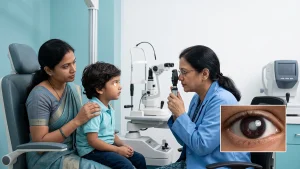
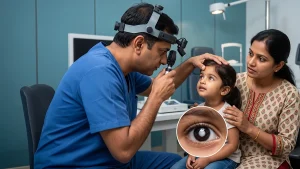
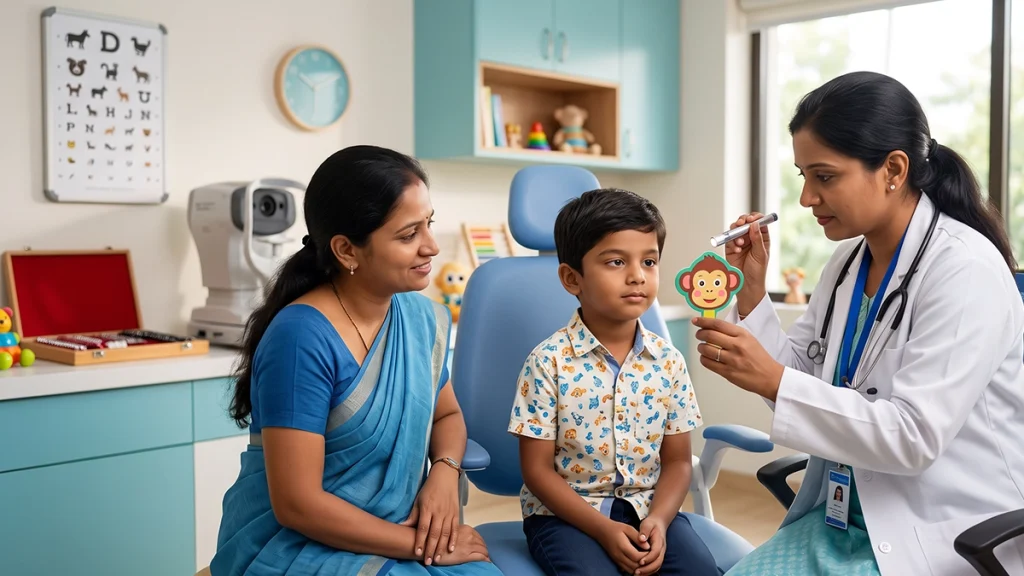
An eye doctor will perform tests of each eye’s vision. In the cover test we have the doctor cover one eye at a time and we watch the other move. These quick painless tests confirm intermittent exotropia. Also we have the retina at the back of the eye checked. This is done to rule out issues like retinal degeneration.
When Is Treatment Needed?
Not all cases of intermittent squint in children require surgery at the onset. A study reported on PubMed followed 97 toddlers with untreated intermittent exotropia for 3 years. We found that 28% did in fact get worse or required treatment. Only 10% had a clear case of worsening of the eye turn. What we see is that many children do very well for a long time.
So in many cases doctors will watch a mild case of squint eye in kids at first. They will look at how often the eye turns outward sometimes of alignment and if vision is being affected. Treatment becomes an option when the eye turns out more frequently or when the development of a lazy eye begins
| Treatment | How It Helps | When Doctors Use It |
| Regular check-ups | Tracks changes over time | Mild, well-controlled squint |
| Glasses | Corrects refractive error and eases strain | When the child needs a power |
| Eye patching | Strengthens the weaker eye | When lazy eye develops |
| Eye exercises | Improves eye teamwork | Some older children |
| Eye muscle surgery | Straightens the eye | Frequent or worsening turn |
In the Florida HealthFinder encyclopedia we see that for many kids the first step is to get glasses. Patching is a treatment which covers the strong eye which in turn causes the weak eye to work harder. We do surgery which affects the eye muscles if other methods are not sufficient. Keep in mind that while surgery straightens the eye it does not in fact fix lazy eye by itself
Other Childhood Eye Problems to Keep in Mind
A squint is one of many eye problems in children. Some kids have trouble seeing the board at school. At annual eye exams we catch these at early stage along with any strabismus in children.
Conclusion
Spot out that which is intermittent squint in children’s vision early which is a game changer. See if one eye turns outward sometimes in a pattern, in particular when your child is tired. Also know that intermittent squint in children may not change much over time but still requires a regular check up. Any squint eye in kids calls for a proper eye exam. Strabismus in children does best with early care. At ASG Eye Hospital we have pediatric eye doctors at your service. They are able to do the right check up for a child with intermittent squint in children. Book a visit today if you see signs of intermittent squint in children at home.
Frequently Asked Questions
1. Is intermittent squint in children serious?
A squint is one of many intermittent squint in children. Some kids have trouble seeing the board at school.
2. Will my child outgrow a squint eye in kids?
Some cases are stable, but don’t wait and see. All kids’ eye issues require an ophthalmologist’s input.
3. What is intermittent exotropia?
Intermittent exotropia is a condition in which one eye turns out some of the time. It is the most common form of squint that comes and goes.
4. Why does my child squint sometimes only when tired?
A child squint sometimes at times when his eye muscles are tired. Fatigue causes the eyes to not work in alignment.
5. When does strabismus in children start?
Strabismus in children usually appears at birth or very soon after. Best results are achieved with early treatment.
References
- MedlinePlus, U.S. National Library of Medicine) https://quality.healthfinder.fl.gov/health-encyclopedia/HIE/1/001004
- (PubMed, U.S. National Library of Medicine) https://pubmed.ncbi.nlm.nih.gov/32202318/