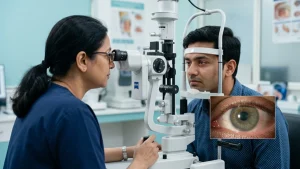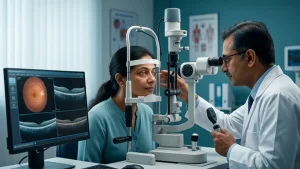
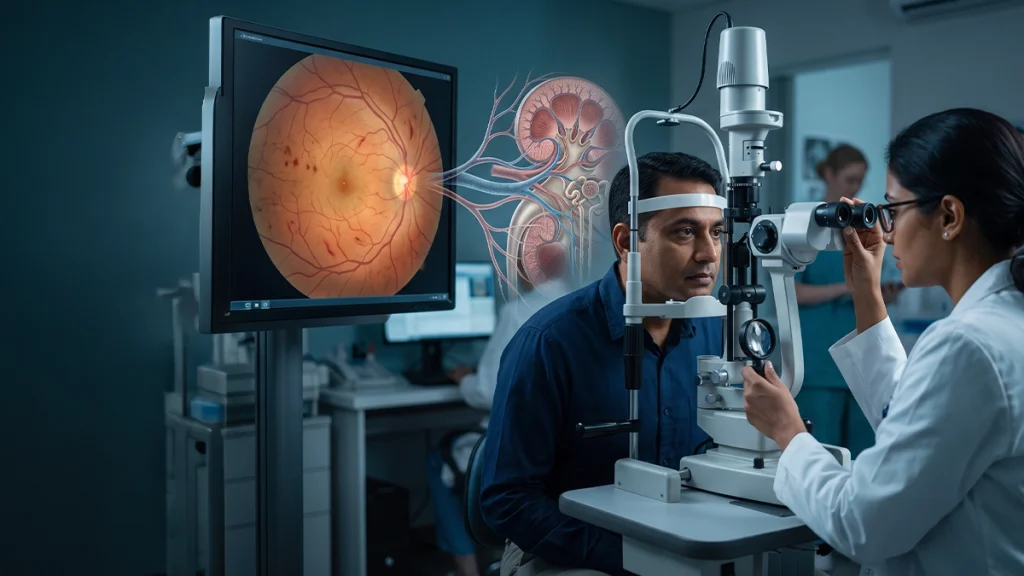
When your kidneys are in poor health, your eyes will feel the effects too. Many patients don’t pay enough attention to their eye health. The link between kidney disease and eyes is strong, but we still don’t talk about it much. In this guide on kidney disease and eyes, we present five signs you should not ignore.
Why Kidney Disease and Eyes Are Connected
The kidneys and the retina both rely on very small blood vessels. These are diabetes and high blood pressure. These are also the same issues that damage the blood vessels in your eyes.
That is why kidney disease and eyes often go hand in hand. Doctors refer to this as a systemic disease and eyes connection. A study listed in they looked at 349 patients to study renal failure and vision. It found that 45.6% of them had hypertensive retinopathy, which was the most common eye issue.
5 Eye Symptoms Most Patients Miss
The early signs of kidney disease and eyes trouble are usually mild.
The first sign is blurred vision. High blood pressure damages the retina slowly and without pain. This is hypertensive retinopathy, and it tends to go unnoticed until vision drops. A lot of kidney disease eye symptoms show up just as quietly.
The second sign is puffy eyelids. Damaged kidneys may leak protein and hold on to extra fluid. You may see swelling around the eyes, which is usually worse in the morning. People often put it down to poor sleep.
The third sign is dry, gritty or red eyes. These are very common dialysis eye problems. A 2025 review on WHO IMSEAR reported that dialysis affects tear quality. It also pointed to dry eye as a key issue to manage.
The fourth sign is vision that changes daily. Fluid shifts during dialysis can change eye pressure and focus. This is most noticeable in people who already have glaucoma. Such dialysis eye problems need regular pressure checks.
The fifth sign is sudden dark spots or vision loss. This may be a sign of bleeding in the retina or damage to the optic nerve. With renal failure and vision issues, sudden changes need urgent care.
| Symptom | What It May Mean | What to Do |
| Slow, painless blur | Blood pressure damage to the retina | Book a retina check |
| Puffy eyelids | Fluid buildup or protein loss | Tell your kidney doctor |
| Dry, red, gritty eyes | Dialysis-related dry eye | Use lubricating drops, see an eye doctor |
| Vision that changes daily | Eye pressure or fluid shifts | Get your eye pressure checked |
| Sudden dark spots or vision loss | Retinal bleeding or nerve damage | Seek urgent eye care |
Diabetes Makes the Risk Higher
Diabetes strengthens the link between kidney disease and eyes. It increases the risk of diabetic eye disease. High sugar and high blood pressure together harm the retina at a faster rate. That is why kidney disease eye symptoms in diabetic patients need extra attention.
A Simple Eye Check Plan for Kidney Disease and Eyes
Regular checkups identify hypertensive retinopathy and other issues at an early stage. Your doctor may adjust this guide.
| Patient Group | Suggested Eye Check | Key Tests |
| Kidney disease with high blood pressure | Once a year | Retina exam, blood pressure review |
| Kidney disease with diabetes | Once a year or more | Dilated retina exam, retina scan |
| On dialysis | Every 6 to 12 months | Eye pressure, dry eye tests |
| After a kidney transplant | As your doctor advises | Cataract and eye pressure checks |
The review also notes that eye exams give better results when booked a few hours after a dialysis session. This gives a more accurate reading. Our team checks for all retina diseases related to kidney health.
Conclusion
The connection between kidney disease and eyes is real, and the early signs are often hard to spot. Watch for blur, swelling, dryness and sudden spots. These kidney disease eye symptoms need prompt attention. Dialysis eye problems and renal failure and vision changes do best with early care. Book an eye check-up at ASG Eye Hospital, where our doctors have a great deal of experience with kidney disease and eyes.
Frequently Asked Questions
1. What are the most common kidney disease eye symptoms?
Blurry vision, puffy eyelids and dry eyes are what we see most often among kidney disease eye symptoms.
2. Can dialysis eye problems be treated?
Yes. Most dialysis eye problems, like dry eye, get better with drops and proper care.
3. Does renal failure and vision loss always go together?
No. Early care is what protects sight. Still, renal failure and vision changes require close attention.
4. Can hypertensive retinopathy be reversed?
Early hypertensive retinopathy can improve once blood pressure is brought under control.
5. How can I protect my eyes with kidney disease?
Get your blood pressure and sugar under control. Have yearly eye exams, as kidney disease and eyes share the same risk factors.
References
- Causes of Chronic Kidney Disease, National Institute of Diabetes and Digestive and Kidney Diseases, U.S. National Institutes of Health
https://www.niddk.nih.gov/health-information/kidney-disease/chronic-kidney-disease-ckd/causes - Ocular Manifestations in Patients with Chronic Renal Failure, Journal of the Korean Ophthalmological Society, 1997 (WHO Global Index Medicus)
https://search.bvsalud.org/gim/resource/en/wpr-10031 - Protsyk O, Lacorzana J. The effects of hemodialysis on the eye. Indian Journal of Ophthalmology, 2025 (WHO IMSEAR)
https://imsear.searo.who.int/items/838451ef-d21d-497b-b69e-48c09d3d9d23/full