ASG Eye Hospital

Baby’s Eyes Always Watery? 6 Causes of Blocked Tear Ducts and When to Treat

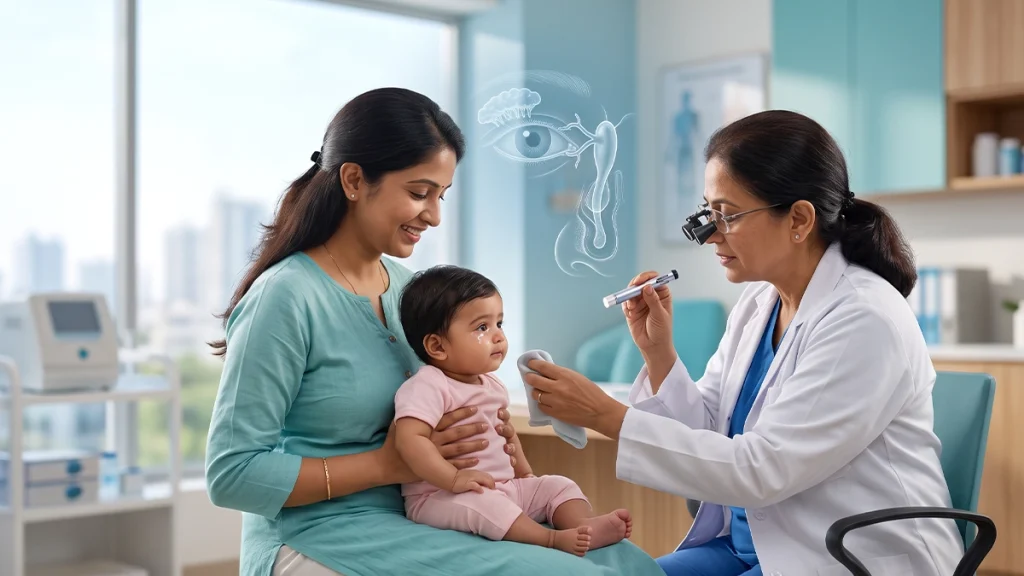
You clean your baby’s eyes out in the morning, and by the hour they are wet again. Tearing in babies is a common issue and it is usually harmless. That said it is very worrying for new parents, also when the sticky crusted eyes show up. This guide explains why tearing in babies happens and when you should see an eye doctor.

Why Does Tearing in Babies Happen?

Tears drain through tiny openings in the inner corner of the eyelids. They then flow down a narrow tube into the nose. When these tubes are closed off, we see tears at the corners of the eyes. This is a condition known as congenital nasolacrimal duct obstruction which affects up to 1 in 5 of newborns. Constant tearing in babies is a sign of this blockage although other causes do exist.

6 Causes of Blocked Tear Ducts and Watery Eyes

1. A Membrane That Did Not Open

A thin membrane often sits at the lower end of the duct. Normally, it opens around birth. In some babies, it stays shut for months. This explains most cases of tearing in babies.

2. A Narrow Duct

Some infants have a duct that is simply too narrow. Tears move slowly, and tearing in babies often worsens during colds. A blocked tear duct in infants of this type often improves as the face grows.

3. Missing Tear Openings

Rarely, the small openings on the eyelid edge are absent. Tears have no way out, so tearing in babies starts right from birth. An eye specialist needs to examine these babies.

4. Bony or Nasal Differences

The duct which transverses bone before it gets to the nose. We see that the bone canal varies which in turn causes tearing. In babies which have certain facial conditions tearing in babies is an issue which persists for a longer time. 

5. Infection

Trapped tears provide a warm environment for bacteria to grow. This results in yellow or green baby eye discharge and crusty lashes. A red, swollen lump by the nose may be a sign of a tear sac infection. Tearing in babies with fever or swelling should be seen the same day. 

6. Other Eye Conditions

Not at every turn do we see watery eyes in babies as a result of a blocked duct. Congenital glaucoma, an in turned eyelash or conjunctivitis also cause tearing in babies. Light sensitivity and a cloudy cornea are warning signs.

CauseWhat Parents NoticeUsual Outlook
Unopened membraneConstant tears, mild crustingOften clears by 12 months
Narrow ductTears pooling on the lidImproves with growth
Missing openingsWatering from birthNeeds a specialist check
Bony differencesLong-lasting wateringMay need surgery
InfectionYellow-green dischargeNeeds medical treatment
GlaucomaLight sensitivity, cloudy eyeNeeds urgent care

Home Care for Tearing in Babies

Most blocked ducts open up on their own, so tearing in babies often goes away within the first year. Your doctor may show you a gentle way to massage the tear sac. Wash your hands first then stroke from the inner eye corner towards the nose. Clean out any baby eye discharge with cooled boiled water and a clean cotton pad. These steps will help with tearing in babies as the duct grows.

When to Treat a Blocked Tear Duct

If tearing in babies continues past 9 to 12 months, a specialist may suggest probing. The doctor passes a fine probe through the duct to open it. It works well in most young children. A few need silicone tubes or a bypass surgery called DCR. A team experienced in lacrimal disorders can guide you.

Baby’s AgeUsual ApproachGoal
0–6 monthsMassage and cleaningHelp the duct open
6–12 monthsClose monitoringAllow natural recovery
12–24 monthsProbingOpen the blocked duct
Over 2 yearsTubes or DCR surgeryCreate lasting drainage

Why Choose ASG Eye Hospital?

Our Paediatric ophthalmology team treats watery eyes in babies with patience. We screen for Paediatric eye diseases like glaucoma first. That way, we treat the real cause of tearing in babies, not just the symptom.

Conclusion

Tearing in babies can look alarming, yet it usually has a simple cause. A blocked tear duct in infants often opens by itself within a year. If tearing in babies persists, book awatery eyes assessment at ASG Eye Hospital for clear answers.

Frequently Asked Questions

1. Is it normal for babies to tear?

Yes. In babies mild tearing is common and usually clears by the first birthday.

2. How do I spot a blocked tear duct?

Look for weeping which may cause wet lashes and also crusting of the eyes after sleep. A blocked tear duct in infants usually affects one eye.

3. Can a watery eye harm vision? 

A simple blockage rarely does. That said, a doctor should check on going watery eyes in babies to rule out glaucoma.

4. When should I see an eye doctor?

Take in a visit if the tearing in babies lasts beyond six months. Go in sooner if the eye looks red or cloudy.

5. Does a blocked duct always need surgery? 

No. In most cases of congenital nasolacrimal duct obstruction resolution is had with massage and time.

References (Government / Public Health Sources)

Overview

Job Title: Consultant Ophthalmologist

Location: Pan India
Job Category: Medical Healthcare

Work Employment:  Full time

What you work:

  • Diagnose and treat patients with a focus on Ophthalmologist.
  • Collaborate with senior doctors and multidisciplinary teams.
  • Ensure patient-centric care and follow clinical protocols.
  • Contribute to research, training, or hospital initiatives (if applicable).

Mandatory skills:

  • Relevant medical degree / certification.
  • Strong knowledge of ophthalmology practices / healthcare protocols.
  • Excellent communication and patient-handling skills.
  • Ability to work in fast-paced healthcare environments.

Preferred Qualifications:

  • Experience: 3 to 6 years of experience
  • Prior experience in eye care / multi-speciality hospitals.
  • Fellowship or advanced training in Ophthalmologist.
  • Familiarity with advanced diagnostic tools and surgical techniques.
  • Passion for innovation, patient care, and continuous learning.

Apply For This Positions

This will close in 0 seconds

Overview

Job Title: Optometrist

Location: Amritsar, Punjab 

Job Category: Optometry

Work Employment:  Full time

What you work:

  • Conduct comprehensive eye examinations and vision assessments for patients of all ages.
  • Prescribe and fit spectacles, contact lenses, and low-vision aids.
  • Perform diagnostic tests including refraction, tonometry, perimetry, and OCT imaging.
  • Support consultant ophthalmologists in pre-operative and post-operative patient workups.
  • Counsel patients on eye care, lens hygiene, and follow-up schedules.
  • Maintain accurate clinical records and adhere to hospital protocols.

Mandatory skills:

  • Bachelor’s or Master’s degree in Optometry (B.Optom / M.Optom) from a recognised institution.
  • Valid registration with the relevant state or national optometry council.
  • Proficiency in refraction, slit-lamp examination, and contact lens fitting.
  • Working knowledge of autorefractors, tonometers, fundus cameras, and OCT equipment.
  • Strong communication skills in English, Hindi, and Punjabi.
  • Ability to manage high patient volumes in a fast-paced clinical setting.

Preferred Qualifications:

  • Experience: 1 to 5 years of clinical optometry experience.
  • Prior experience in an eye care or multi-speciality hospital in Punjab.
  • Exposure to paediatric optometry, binocular vision, or low-vision rehabilitation.
  • Familiarity with advanced diagnostic imaging and dry-eye management.
  • Passion for patient care, community eye-health camps, and continuous learning.

Apply For This Positions

This will close in 0 seconds

Overview

Job Title: Optical In-charge 

Location: Panjim, Goa / Mumbai-Worli (Lower Parel) 

Job Category: Optical

Work Employment:  Full time

What you work:

  • Manage day-to-day operations of the optical outlet, including sales, dispensing, and inventory.
  • Guide customers on frame selection, lens options, and coatings based on their prescription and lifestyle.
  • Take accurate frame measurements and ensure precise fitting, adjustments, and after-sales service.
  • Drive optical sales targets and monitor daily, weekly, and monthly business performance.
  • Maintain optimum stock levels, coordinate with vendors, and control shrinkage through periodic audits.
  • Supervise and train optical staff on product knowledge, dispensing standards, and customer service.
  • Coordinate with optometrists and consultants to ensure smooth prescription-to-delivery flow.
  • Ensure visual merchandising, display hygiene, and adherence to brand and hospital standards.

Mandatory skills:

  • Diploma or Bachelor’s degree in Optometry (D.Optom / B.Optom) or equivalent optical dispensing qualification.
  • Minimum 3 years of experience in optical supervisory or in-charge role.
  • Sound knowledge of lens types, coatings, frame materials, and dispensing principles.
  • Hands-on experience with edging, fitting, and basic optical workshop equipment.
  • Proven ability to achieve sales targets and manage inventory and billing systems.
  • Strong communication and interpersonal skills in English, Hindi, and Konkani or Marathi.
  • Working knowledge of POS / retail software and MS Office.

Preferred Qualifications:

  • Experience: 3 to 7 years in optical retail or an eye care hospital optical division.
  • Prior experience managing an optical outlet in Goa or the western region.
  • Exposure to premium and progressive lens brands and specialty eyewear.
  • Familiarity with contact lens dispensing and after-care support.
  • Team leadership, customer relationship management, and continuous learning mindset.

Apply For This Positions

This will close in 0 seconds

Overview

Job Title: Optometrist

Location: Pan India 


Job Category: Optometry

Work Employment:  Full time

What you work:

  • Conduct comprehensive eye examinations and vision assessments for patients of all ages.
  • Prescribe and fit spectacles, contact lenses, and low-vision aids.
  • Perform diagnostic tests including refraction, tonometry, perimetry, and OCT imaging.
  • Support consultant ophthalmologists in pre-operative and post-operative patient workups.
  • Counsel patients on eye care, lens hygiene, and follow-up schedules.
  • Maintain accurate clinical records and adhere to hospital protocols.

Mandatory skills:

  • Diploma / Bachelor’s or Master’s degree in Optometry (D.Optom / B.Optom / M.Optom) from a recognised institution.
  • Valid registration with the relevant state or national optometry council.
  • Proficiency in refraction, slit-lamp examination, and contact lens fitting.
  • Working knowledge of autorefractors, tonometers, fundus cameras, and OCT equipment.
  • Ability to manage high patient volumes in a fast-paced clinical setting.

Preferred Qualifications:

  • Experience: 1 to 5 years of clinical optometry experience.
  • Exposure to paediatric optometry, binocular vision, or low-vision rehabilitation.
  • Passion for patient care, community eye-health camps, and continuous learning.

Apply For This Positions

This will close in 20 seconds