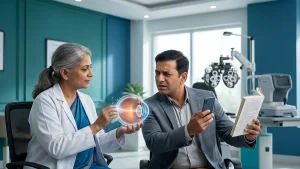
Finding that it is a struggle to read a message, restaurant menu, medicine label, or book after 40 is very common. You may begin to hold your phone at arm’s length or turn on the lights. At this stage many think they have developed long sightedness. But what you experience in the close up range may not be from the same issue. Presbyopia vs hypermetropia are different reasons for close vision changes which is also why a proper eye exam is important before getting reading glasses.
Why Does Near Vision Change After 40?
Presbyopia is a condition which comes with age that affects how the eye focuses. The natural lens loses its flexibility as we age. This in turn causes the eye to have a harder time in focus on nearby objects. The National Eye Institute reports that presbyopia is a type of refractive error which affects near vision in adults of middle age and beyond. It usually begins in the 40’s. This is what causes near vision to suddenly present problems for people at age 40 and beyond even when distance vision is still clear.
Hypermetropia which is also known as hyperopia or farsightedness is a different condition. In this case the eye’s shape causes light to focus behind the retina instead of directly on it. This difference is key in the presbyopia vs hypermetropia comparison.
Presbyopia vs Hypermetropia: What Is the Difference?
Although both conditions may cause blurred near vision, they develop for different reasons.
| Feature | Presbyopia | Hypermetropia |
| Main cause | Age-related loss of lens flexibility | Eye shape or focusing power causes light to focus behind the retina |
| Typical onset | Usually becomes noticeable in the 40s | Can exist from childhood |
| Main difficulty | Focusing on close objects | Near vision, and sometimes distance vision |
| Common correction | Reading glasses, bifocals or progressive lenses | Prescription glasses or contact lenses |
Another issue in the presbyopia vs hypermetropia discussion is which of the conditions may present at the same time. People with a history of farsightedness may notice early and more severe close up problems as presbyopia sets in.
Signs That Presbyopia May Be Developing
Changes in near vision after 40 ut to be a gradual process. What was once fine print may at the normal reading distance become a issue. At this time a person may hold a phone at a greater distance or require more bright lighting. Also eye strain and headaches may present after long close work. If distance vision is still clear but the near tasks are harder, presbyopia may be the cause.
However in many cases symptoms are not enough to determine between presbyopia vs hypermetropia. An eye exam is the way to go for diagnosis of refractive error and also to rule out other causes of blurred vision.
Do You Need Reading Glasses?
Reading glasses which supply additional focusing power for close up tasks. They may make books, phones, labels, and any nearby objects easier to see. Also which is convenient for some people with uncomplex presbyopia ready made reading glasses are a solution. That said, the same lens power in each eye may not suit all. Astigmatism, different prescriptions, present farsightedness or other eye issues can play a role in what is required.
| Vision situation | Correction that may be considered |
| Clear distance vision with difficulty reading | Reading glasses |
| Near and distance prescription needed | Bifocal or progressive glasses |
| Existing hypermetropia with presbyopia | Individualised prescription lenses |
| Unequal power or astigmatism | Prescription spectacles after an eye examination |
The National Eye Institute reports that which is also true for contact lenses which are a great and safe solution for refractive errors. Also it is very much the case that annual eye exams are a good idea still at which point over the counter readers may bring relief temporarily.
Why an Eye Examination Matters After 40
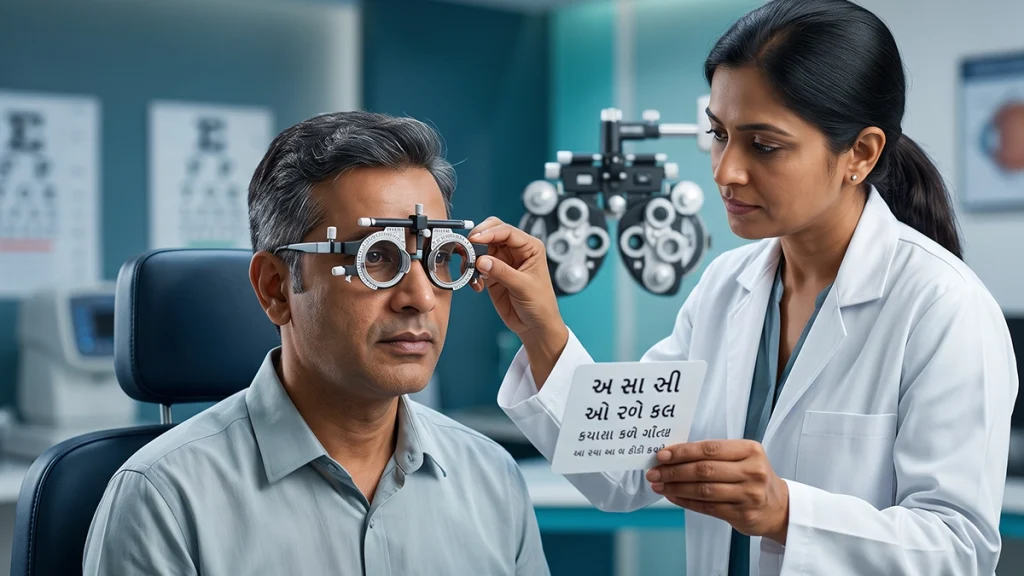
It is a simple fact that we tend to put any vision change after the age of 40 down to ageing. Also it is true that blurry vision may also result from an out of date prescription or other eye issues. A full eye exam will look at distance and near vision, refractive power, and over all eye health. Also it reports on presbyopia as against hypermetropia and out whether in fact both are present.
This is very helpful when you are dealing with headaches, eye strain, changing specs, or persistent blurred vision which in turn interferes with your daily routine.
Conclusion
Difficulty at reading after the age of 40 is not a sure sign of farsightedness. Presbyopia and hypermetropia both affect near vision but they have different causes.
Understanding the difference between presbyopia vs hypermetropia will help patients see the value in personalized vision care. If you are having trouble with small print try reading glasses which may help, but a full eye exam is the way to get the right prescription and also check the overall health of your eyes.
Frequently Asked Questions
1. Is presbyopia the same as farsightedness?
No. Presbyopia is a result of age related loss of near focus. Hypermetropia which is also known as farsightedness affects mainly the eye’s optical shape and focus. A person can have both.
2. At what age does presbyopia usually begin?
Presbyopia typically becomes noticeable in the 40s. At this stage people often first notice it when they see that reading small print is becoming uncomfortable or they are holding material at a greater distance.
3. Will reading glasses make my eyes weaker?
No. Reading glasses improve the reduced near focus which is a part of the natural aging process of the eye. They don’t bring on this age-related change faster.
4. Can someone have presbyopia and hypermetropia together?
Yes. The conditions go hand in hand. An eye exam will tell the difference between presbyopia vs hypermetropia and also determine your prescription.
5. Should I get an eye test if my near vision changes after 40?
Yes. An exam can identify what is causing the change in your near vision at age 40 and also check out other eye issues that may need treatment.
Government Medical References
National Eye Institute, U.S. National Institutes of Health — Presbyopia:
https://www.nei.nih.gov/eye-health-information/eye-conditions-and-diseases/presbyopia?
National Eye Institute, U.S. National Institutes of Health — Farsightedness (Hyperopia):
https://www.nei.nih.gov/eye-health-information/eye-conditions-and-diseases/farsightedness-hyperopia?
National Institutes of Health — Refractive Errors:
https://health.nih.gov/health-topics-a-z/refractive-errors?