What Is Cataract Biometry?
Cataract biometry is a key test done prior to cataract surgery. It allows the ophthalmologist to determine the power of the artificial lens which will take the place of the opaque natural lens. This measurement also supports personalized surgical planning and better vision post op.
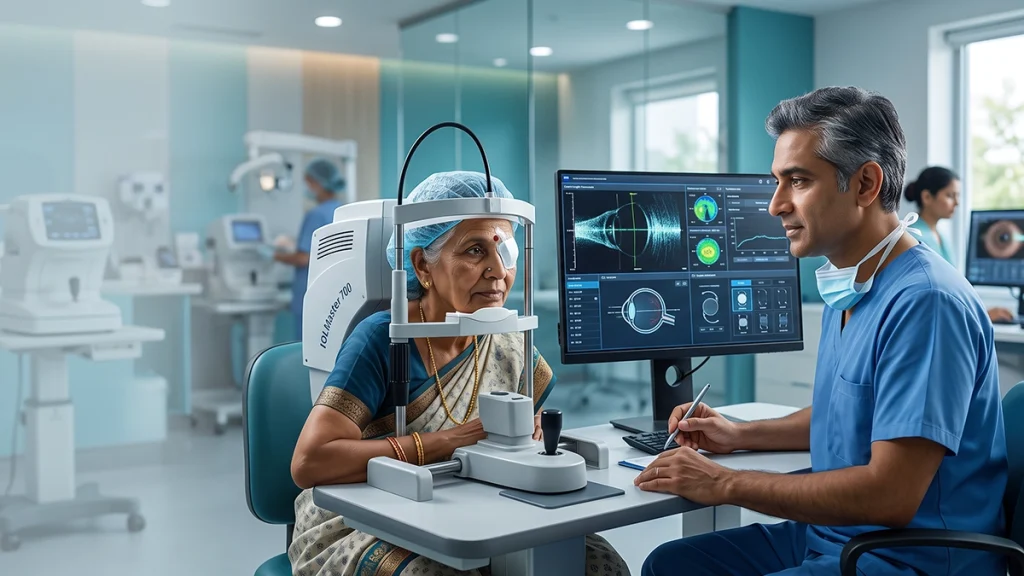
During the course of cataract biometry special equipment is used to measure eye length and the curvature of the cornea. From these measurements we determine the appropriate intraocular lens (IOL). Though the process is quick and painless it is very much so in terms of accuracy which is key to good surgical planning.
Why Is Cataract Biometry Important Before Surgery?
Every individual has a different eye shape and focus which is why there is no single lens power that will work for all patients. Cataract biometry provides the surgeon with the data required to choose the right implant.
Accurate IOL power calculation does in fact reduce the chance of an unexpected need for glasses post op. But we must note that no calculation is a guarantee of total independence from glasses. Also play a role in the final results are pre existing eye conditions, healing process and individual anatomy.
How Does Cataract Biometry Work?
During ophthalmic cataract biometry patients’ chin and forehead are usually supported by a device. The machine which at large does not make contact with the eye takes the measurements. The test is usually very comfortable and but a short while.
Modern which is the field of optical biometry that which uses light based technology to measure the eye. We are able to determine axial length and other details which in turn are used in lens planning. Should a dense cataract which puts into question the reliability of optical measurements present itself the doctor will put forth ultrasound biometry as a recommendation.
The surgeon combines these measurements with a suitable formula to estimate the required lens strength. This process is known as IOL power calculation. The result helps guide lens selection rather than providing a guaranteed visual outcome.
Which Factors Determine Cataract Lens Power?
For accurate cataract biometry we use many factors. Each of these helps the surgeon see how light travels through the eye.
| Measurement | Why it matters |
| Axial length | Measures the distance from the front of the eye to the retina. |
| Corneal curvature | Helps estimate how strongly the cornea focuses light. |
| Anterior chamber depth | Helps formulas estimate where the implanted lens may sit. |
| Desired visual outcome | Helps guide lens selection based on the patient’s needs. |
These measures are used in the calculation of cataract lens power. Also the eye’s past health issues and the patient’s expectations are taken into account before we finalize the plan.
What is the difference between Optical and Ultrasound Biometry?
For cataract biometry both methods are used but they are based in different technologies. Which one the doctor will use is determined by the condition of the eye and the quality of the results we are looking for
| Feature | Optical biometry | Ultrasound biometry |
| Technology | Uses light | Uses sound waves |
| Eye contact | Usually non-contact | Depends on the technique |
| Common use | Routine pre-surgery measurements | Useful when optical readings are difficult |
| Main consideration | Dense cataracts may limit readings | Technique can affect measurement accuracy |
For in many cases of our patients we use optical biometry as a first choice. That said ultrasound is a good alternative when the machine does not produce reliable results. It is at the ophthalmologist’s discretion to order in more tests
How do doctors determine the proper IOL power?
We take the cataract biometry measurements of the eye and input them into specialized formulas. The formulas that we use to do this are based on a number of variables which we put in to get the best estimate of the IOL power required. Also we look at the results of these formulas in relation to the full picture which includes the results of the eye exam.
In the choice of cataract lens power we discuss lifestyle and visual preferences. Some patients prefer clear distance vision which they are fine to correct with reading glasses for near tasks. Also some may wish to look at other lens options which may be suited to their eye health and which they are a good candidate for.
Patients should report past LASIK or any other corneal refractive surgery. Those procedures may alter corneal measures which in turn makes IOL power calculation difficult. The surgeon may order up extra tests or use specialized formulas to improve the estimate.
Can Cataract Biometry Guarantee Perfect Vision?
No. Cataract biometry improves surgical planning but we cannot promise a certain visual outcome. Measurement variability, healing time and other ophthalmic issues may play a role in post op results.
Attend all recommended exams and bring your health history to the ophthalomologist. Put in to question what your lens choices are, what results you should expect and if glasses will still be a thing. Careful planning which in turn sets real expectations.
Conclusion
Cataract biometry is key in the plan of cataract surgery and choice of artificial lens. Precise measurements, right formulas and a detailed eye exam help doctors determine the cataract lens power.
Frequently Asked Questions
1. Is cataract biometry painful?
No. In general we do not associate cataract biometry with pain. Most optical measurements done in this procedure do not include contact with the eye. Your doctor will go over the process with you and will put forth another method if required.
2. How long do cataract biometry sessions last?
Generally the measurements take only a few minutes, but the full preop appointment may drag out longer. Also if results are unclear or the eye in question needs more assessment, that will add to the time.
3. Is optical biometry better than ultrasound?
In most cases ophthalmologists report that optical biometry is the preferred method which is when it gives accurate results. Ultrasound is useful in patients which have dense cataracts which interfere with optical measurements. The choice of which method to use is based on what is best for each patient.
4. Will the correct IOL power eliminate glasses?
Not always. We can use IOL power calculation to determine the best focus but some patients still require glasses for reading or distance. The result is a function of the lens used, eye health and individual healing.
Reference Links
1. National Eye Institute’s cataract surgery guide –
https://www.nei.nih.gov/eye-health-information/eye-conditions-and-diseases/cataracts/cataract-surgery