
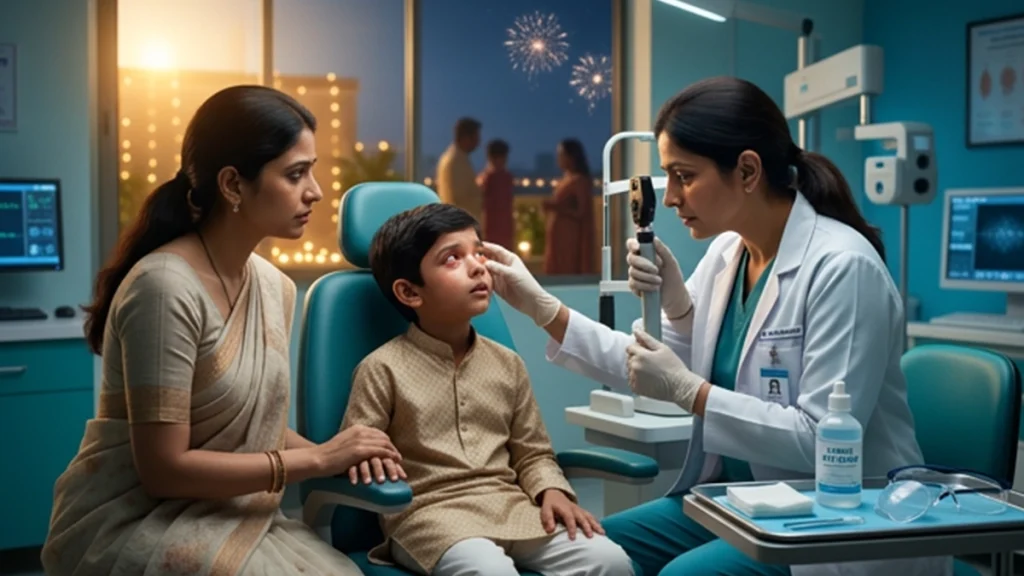
During the Dussehra and Diwali festivals we see a great many fireworks, sparklers and firecrackers used in celebration. Though these are fun there is also the very real issue of serious eye injuries which can happen in a second from them. Sparkles, hot particles of material, debris, and the force of the blast can injure the eyelid, cornea or more internal eye elements. Knowing firecracker eye injury first aid can help you respond safely while arranging urgent medical care.
A Diwali eye injury is a problem which also affects the person lighting the firework. At the same time people standing by can also get injured. Research in India has reported firework related eye injuries of bystanders as well as those handling the fireworks.
How Can Firecrackers Injure the Eyes?
A firecracker may put out intense sparks, smoke, chemical materials, ash, or small pieces at high speed. These elements may cause first degree burns, corneal injuries, breaks in skin, bleeding or damage in the eye. Very serious blast injuries may cause blindness. That is why proper firecracker eye injury first aid is very important during holidays.
Following the basics of Dussehra eye safety may reduce your risk. The Petroleum and Explosives Safety Organization (PESO) says do not hold fireworks while you light them, bend over them, or go up to misfired crackers.
| Type of Exposure | Possible Eye Problem |
| Sparks or hot particles | Eye-surface burn, irritation or corneal injury |
| Flying debris | Scratch, cut or foreign-body injury |
| Blast force | Internal or external eye trauma |
| Direct firecracker impact | Potentially severe eye emergency |
Firecracker Eye Injury First Aid: What Should You Do?
The response which is correct is based on the type of injury. For cases of mild burns or foreign particles, as per Indian fire work safety report we should use running or tap water to rinse the eye. PESO reports that it is recommended to wash the eye which has had a burn from a firecracker with tap water for 10 minutes’ and then go to the eye hospital.
However, firecracker eye injury first aid is different when there may be an open or penetrating wound. Do not wash or clean an obviously open eye wound. Don’t wash out or clean an obviously open eye wound. Also don’t remove any embedded objects. As per Delhi Traffic Police report cover an open eye injury without applying pressure and get medical care. Also do not put in home remedies, creams, oils or un-prescribed eye drops in the injured eye.
| Situation | Appropriate Immediate Response |
| Suspected superficial burn or loose particles | Gently rinse with clean running water and seek medical assessment |
| Object appears embedded | Do not remove it or press the eye |
| Open or penetrating injury suspected | Do not wash; protect the eye without pressure |
| Vision changes or severe pain | Treat it as an eye emergency and seek urgent care |
Warning Signs That Need Emergency Eye Care
After a Diwali eye injury, do not think that everything is fine based on the outer appearance of the eye some damage may be internal. Severe pain, sudden blur in vision, reduced vision, bleeding, acute light sensitivity, an irregular pupil, inability to open or move the eye, or a foreign body visible in the eye these are signs of a serious eye issue. At first sign of these symptoms get in to see a medical professional right away.
Fireworks are reported to cause a range of injuries from corneal damage to severe open-globe trauma. Also in terms of firework related eye injuries some reports note that in some cases we had to go to surgery.
Dussehra Eye Safety and Diwali Prevention
Good Dussehra eye safety is a priority which we pay attention to right from the time a firework is to be set off. Use fireworks in open areas and keep a large distance which is safe. Children should not play with fireworks without an adult’s supervision. Do not point fireworks at people and do not look at a firecracker while it is lighting.
Protective eyewear may also be worn which in turn adds to the safety for those handling fireworks. Also have clean water at the ready and do not go back to a dud firecracker that didn’t go off. While these measures may lower the chance of a Diwali eye injury, we have to accept that some level of risk will remain. In case an accident does occur, safe firecracker eye injury first aid followed by timely medical evaluation is important.
Conclusion
Festivals should be about happy memories, not eye damage which is preventable. We can do better in terms of firecracker eye injury first aid which in turn will make our response to an accident at home better. Do not rub or press the injured eye and leave out the idea of removing an embedded object. In case of serious Diwali eye injury or a put forward eye emergency get in touch with an ophthalmologist or emergency medical team right away. By following simple Dussehra eye safety measures we may also see a reduced risk before the parties begin.
Frequently Asked Questions
1. What is the first thing to do after a firecracker injures the eye?
For first degree burns or when there is loose debris in the eye, run clean cool water over it. Do not rub out the eye. If you think there is a cut, a puncture wound or a foreign object which is embedded do not wash or remove anything and get to the emergency room right away.
2. Can I use eye drops after a Diwali eye injury?
Avoid the use of over the counter eye drops for Diwali eye injury unless they are prescribed by an eye care professional. Treatment will depend on the exact type and severity of the injury.
3. When does a firecracker injury become an eye emergency?
Vision loss, severe pain, bleeding, light sensitivity which is very noticeable, an abnormal pupil, an embedded object, or difficulty with movement or opening of the eye are signs to be treated as an eye emergency.
4. Should I rub the eye if a firecracker particle enters it?
No. Rubbing may increase damage to the eye surface. Safe firecracker eye injury first aid involves avoiding rubbing and getting appropriate medical assessment.
5. Can bystanders also suffer firecracker eye injuries?
Yes. People during Dussehra and Diwali when they watch fireworks run a risk of injury from sparks, fragments, or unexpected firework action. Maintaining distance is an important part of Dussehra eye safety and Diwali safety.
Reference Links
- Petroleum & Explosives Safety Organisation (PESO), Government of India – Do’s and Don’ts: Fireworks
https://www.peso.gov.in/web/en/node/299? - PubMed – Spectrum of Ocular Injuries and Visual Outcome Following Firework Injury
https://pubmed.ncbi.nlm.nih.gov/32395048/?