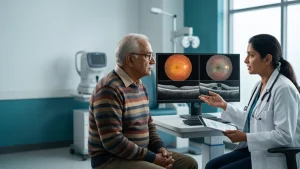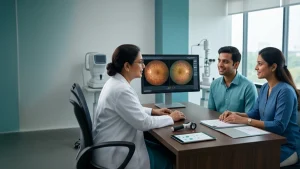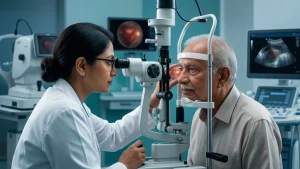
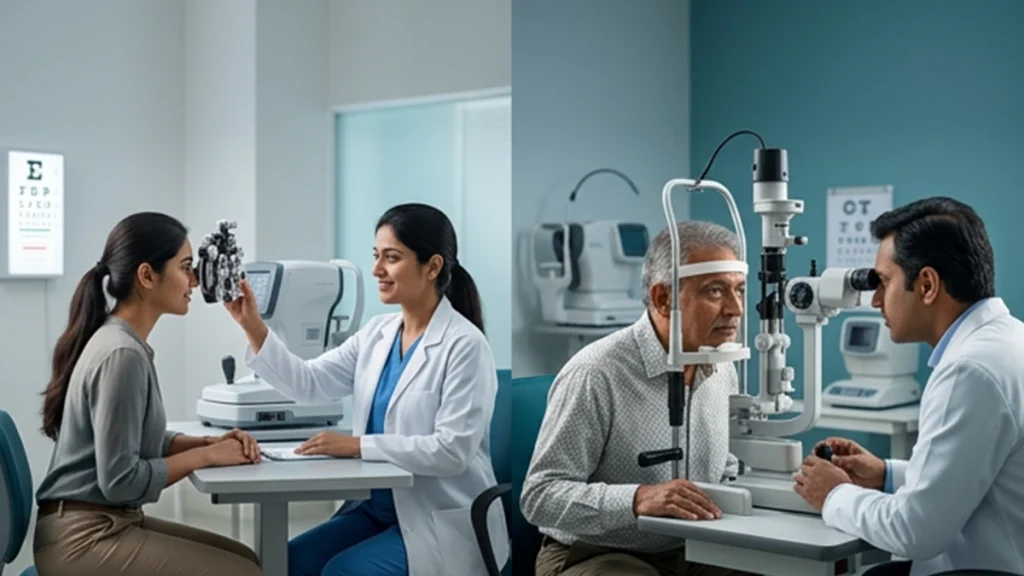
Your sight may be great, still in reality there is a lot of change going on in your eyes. In young adults we see that eye exams are for checking visual acuity and changing prescriptions. At 40 the focus does indeed begin to change. An eye checkup after 40 becomes very important as natural aging affects your focusing ability. At the same time your risk of certain eye issues also increases with age.
In regular check ups your eye care provider is able to see past what is present in an eye chart. What we do in a routine eye exam is evaluate vision, prescription needs and many other aspects of eye health. Based on your age, symptoms and risk factors we may suggest extra tests for you.
How Eye Care Changes Before and After 40
Before age 40 most adults go to the eye doctor for blurred vision, headaches, eye strain or a change in their glasses. These also present in later years. At 40 and beyond though it is the focus of an eye checkup after 40 to note age related focusing changes and to identify early signs of eye disease
| Area Checked | Before 40 | After 40 |
| Vision assessment | Distance and near vision | Distance and near vision, including age-related changes |
| Prescription | Myopia, hyperopia and astigmatism | Existing refractive errors plus presbyopia |
| Eye pressure | Checked when clinically appropriate | May receive greater attention based on glaucoma risk |
| Near focusing | Usually stable in younger adults | Presbyopia check becomes increasingly relevant |
| Eye health | Based on examination and risk | Greater focus on age-related changes and individual risk |
An eye checkup after 40 many do not find out they have an eye disease from a check up. What it does signal is the start of changes which in turn require more attention.
Why Near Vision Often Changes After 40
One of the primary changes is that you notice difficulty with near vision. You may find yourself holding your phone at an arm’s length or using more brightness while you read. Also, small print may not be as easy to make out.
As we age what we see is the eye’s natural lens which in time loses some of its near focus ability. Also from MedlinePlus which reports that at age 45 people usually begin to notice signs of presbyopia.
An eye checkup after 40 you should get a presbyopia check during your eye exam which will identify this change also at this time to determine what type of reading aid which may be reading glasses or progressive lenses you may require. Presbyopia is a natural part of the aging process but it is still recommended that any new vision issues get a full evaluation.
Why Glaucoma Screening Matters
Glaucoma affects the optic nerve and at times may present no symptoms in the early stage of the disease. The National Eye Institute reports that a comprehensive dilated eye exam is the way to find glaucoma and other eye problems before noticeable vision loss occurs.
For this in which it is to be reported we may see glaucoma screening to be a key element in eye checkup after 40 also for people which have additional risk factors. Your doctor may look at eye pressure, the optic nerve and peripheral vision when relevant.
Importantly, intraocular pressure alone is a poor indicator of glaucoma. The National Eye Institute reports that tonometry by itself is not reliable for accurate glaucoma diagnosis. A full scale evaluation is what gives us the big picture.
What Can an Eye Check-Up Assess?
A routine eye exam which in turn may help your ophthalmologist determine your present vision and total eye health. What we do in the exam is based on your symptoms, medical history and also individual risks.
| Assessment | What It Helps Evaluate |
| Visual acuity | Clarity of vision |
| Refraction | Glasses or contact lens prescription |
| Presbyopia check | Near-focusing ability |
| Eye pressure | Pressure inside the eye |
| Dilated examination | Retina, optic nerve and other internal structures |
| Glaucoma screening | Signs or risk factors associated with glaucoma |
At age 40, it is also true that a comprehensive eye checkup after 40 may bring to light changes that may not be noticed in day-to-day life.
How Often Should You Get Your Eyes Checked?
There isn’t a uniform eye exam schedule for all adults. What works best for you will depend on your age, eye health, family history and medical conditions.
The National Eye Institute says that certain at risk groups should have comprehensive dilated eye exams every one to two years. People with diabetes or high blood pressure should ask their doctor how often they should get a dilated exam.
Your doctor will create a routine eye exam schedule for you which will take into account your personal risk factors.
Conclusion
At age 40 you may not see an acute drop in your eyesight, but it is at this time that you should pay more attention to your eye health. ASG recommends you get an eye checkup after 40 to go over changes in near vision, your prescription needs and also to look at signs of eye disease. By including a routine eye exam, proper glaucoma screening and a presbyopia check you give your ophthalmologist a full picture of your vision.
If you are having problems with reading we may have determined that your prescription has out of date and also that it has been a while since your last eye exam which is recommended to bring in at ASG Eye Care for a full exam.
FAQs
1. Is an eye checkup after 40 necessary if my vision is clear?
Clarity of vision does not in fact guarantee eye health. Some ophthalmic conditions including glaucoma may present with no early warning signs at all.An eye checkup after 40 is a good idea to screen for problems which may as of yet be unnoticeable.
2. What is checked during a routine eye exam?
During the routine eye exam we may have our visual acuity tested, we may do a refraction test, have our eye pressure checked and an assessment of our eye structures. Your doctor may recommend dilation or other tests based on your needs.
3. What is a presbyopia check?
A presbyopia check determines how well your eyes focus on close objects. As we age we see a natural change in near focus which is what this is related to.
4. Does everyone need glaucoma screening after 40?
Not all the same at glaucoma risk. But glaucoma screening may be especially useful for people which have known risk factors. We recommend you see your ophthalmologist to determine which tests and which exam schedule is right for you.
5. Should I wait for symptoms before booking an eye exam?
No. Some eye diseases may present no early signs. Getting in for a check up is key to early detection.
Government & Medical References
National Eye Institute – Get a Dilated Eye Exam
https://www.nei.nih.gov/eye-health-information/healthy-vision/finding-eye-doctor/get-dilated-eye-exam
National Eye Institute – Glaucoma
https://www.nei.nih.gov/eye-health-information/eye-conditions-and-diseases/glaucoma