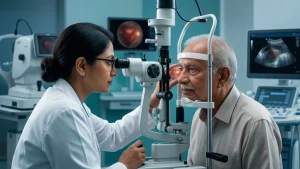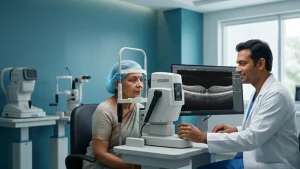

Vision does change as we age, also some changes require more than a new pair of glasses. At age 50 and beyond you may develop Macular degeneration that affects sharp central vision for reading, driving, recognizing faces, and seeing fine details. The condition which affects the macula is a small but very important part of the retina.
Age related macular degeneration (AMD) presents in 2 main forms:dry AMD and wet AMD. Although both of them affect central vision, what is different is how they present. Also their management is very much a different approach. Out of this understanding which signs to look out for and when to seek out eye care is important.
What Is Macular Degeneration After 50?
Macular degeneration after 50 which is involved in producing that clear detailed central vision as it breaks down from age. As it does a person may see blurring of central vision, distortion, and trouble with dim light.
Age is a very large risk factor. Also in play may be smoking, family history, cardiac health, and other variables. By age Macular degeneration after 50 usually does not cause full blindness which may in fact leave peripheral vision intact. That said, advanced stages of the disease can really do in day to day activities.
As we age, regular in depth eye exams become very important. In early stages many symptoms may not be noticed.
Dry AMD vs Wet AMD
Most of what we see in age related macular degeneration is dry AMD which is a result of macula thinning out from the wear and tear of years. It usually develops slowly.
Wet AMD is a less common type but it tends to progress much faster. In this type abnormal blood vessels grow by or around the retina. They may break and cause bleeding or exude fluid which in turn damages the macula.
| Feature | Dry AMD | Wet AMD |
| Progression | Usually gradual | Often faster |
| Main change | Thinning and degeneration of macular tissue | Growth and leakage of abnormal blood vessels |
| Vision changes | Gradual central blurring or difficulty in low light | Distortion, blurred areas or sudden central vision changes |
| Management | Monitoring, risk reduction and stage-specific care | Often requires anti-VEGF AMD treatment |
Anyone experiencing macular degeneration after 50 should know which type and stage they have. This distinction guides monitoring and treatment decisions.
How Is Dry AMD Managed?
Management of dry AMD is based on the stage of the disease.In early disease we may only see regular eye exams recommended along with attention to changeable risk factorsAlso at this stage patients may go over nutrition, smoking cessation, and general health issues as relevant.
For some people with intermediate AMD certain AREDS2 supplements may reduce the risk of it progressing to late AMD. These supplements do not apply to all cases of macular degeneration past age 50 and should be discussed with an eye care professional.
Advanced in the dry form of dry AMD which may cause geographic atrophy a situation where areas of retina degenerate. Treatment may consist of specialist assessment, visual rehabilitation, and low vision support. What we see of treatment options is constantly expanding which is why it is important to have regular retinal exams.
How Is Wet AMD Managed?
Wet AMD requires as soon as possible referral to a specialist as vision may drop off very fast. A person may report that what had been straight lines has turned into wavy lines or that there is a blurred or blank spot in the center of what they are seeing.
In the case of active wet AMD we see that which medicines used are of the VEGF class. Doctors which inject these into the eye. Anti-VEGF AMD therapy does help to control the abnormal blood vessels which cause leakage and bleeding.
The National Eye Institute reports that anti-VEGF drugs may put a break on the progression of vision loss in the case of wet AMD. Many patients report that they have to return for more injections as the results of anti-VEGF AMD treatment are not permanent.
| Management Approach | Purpose |
| Regular retinal examinations | Monitor macular degeneration after 50 and detect progression |
| OCT and other retinal imaging | Identify structural changes, fluid or abnormal vessels |
| AREDS2 supplements when appropriate | Reduce progression risk in selected AMD stages |
| Anti-VEGF AMD injections | Control abnormal vessel growth and leakage in wet AMD |
| Vision rehabilitation | Help people adapt to significant central vision loss |
Why Early Detection Matters After 50
After age 50 at the onset of macular degeneration before serious vision loss takes place. In dry AMD which is the early form at this stage there may be no noticeable symptoms at all, while wet AMD which is the aggressive form can cause a rapid change in vision.
After the age of 50 if you notice new distortion, central blurring, or blank spots in your vision report it right away. A straight line that suddenly appears wavy is a symptom that requires prompt attention.
Early diagnosis gives an ophthalmologist time to determine the best treatment approach which may include anti-VEGF therapy or some other method.
Conclusion
Macular degeneration after 50 is a very individual condition. Dry AMD usually develops slowly and we see it in stages which require it to be monitored and managed that way. Wet AMD tends to progress much faster and usually requires prompt treatment with anti-VEGF AMD.
Identify vision issues early which is a big step. If you notice that straight lines are wavy, your central vision is blurred, or you see a new dark or blank area, get in to see the eye doc as soon as you can. At ASG Eye Hospital we do regular retinal exams which also help us to detect early change, determine the type of AMD we are dealing with and put in place the best management plan.
Frequently Asked Questions
1. Is macular degeneration common after age 50?
Age related macular degeneration is a condition which presents more as we get older. At macular degeneration after 50 and beyond, anyone should talk to an eye care professional about what your individual risk is and what exam schedule is right for you.
2. Which is more serious, dry AMD or wet AMD?
Both may do so at different paces. In Dry AMD progression is slower, while in wet AMD there may be quicker vision loss due to the growth of abnormal blood vessels.
3. Can dry AMD turn into wet AMD?
Yes. The National Eye Institute reports that at any stage of dry AMD there is a chance of it developing into wet AMD. This is a reason for ongoing monitoring.
4. How does anti-VEGF treatment help wet AMD?
Anti-VEGF AMD which reduces VEGF action. This in turn helps to decrease abnormal blood vessel growth, leakage and bleeding in the retina. Treatment may also require frequent injection.
5. Should I have regular eye checks after 50?
Regular thorough eye exams may identify age related retinal changes. Also they are very important for people with risk factors or a diagnosis of macular degeneration after 50.
References Links
- National Eye Institute (NIH) – Age-Related Macular Degeneration (AMD)
https://www.nei.nih.gov/eye-health-information/eye-conditions-and-diseases/age-related-macular-degeneration - NHS – Age-Related Macular Degeneration Treatments
https://www.nhs.uk/conditions/age-related-macular-degeneration-amd/treatment/