
Losing an eye to injury, disease, surgery, or a condition at birth changes more than what we see. It also affects how we feel about ourselves and our day to day comfort. A prosthetic eye is a solution which improves the look of the eye which is lost. It doesn’t restore sight, but a properly fit artificial eye does improve facial balance and for many people improves that which they feel which in turn improves daily life.
Understanding the prosthetic eye meaning, fitting process, movement, care, and expected cost can make rehabilitation easier to approach.
What Is a Prosthetic Eye?
A prosthetic eye is a made to measure device which looks like a natural eye. In the medical field it is also referred to as an ocular prosthesis. What it does is sit over the eye tissue in the socket instead of being a full in place bio eye replacement.
Modern prosthesis are of medical grade acrylic. We have very skilled techniques to craft and color an artificial eye which we make to look as much as the other eye as we can. It is made out of a prosthetic eye which does not include the retina, optic nerve or any other elements which produce sight.
The spelling artificial eye is also commonly searched online, although “artificial eye” is the correct term.
Why Might Someone Need an Ocular Prosthesis?
A person may get an ocular prosthesis after the natural eye has been removed due to severe trauma, a painful blind eye, certain tumors, or other serious eye issues. Also some people may require an eye prosthesis and a rehabilitation plan because of congenital conditions in which an eye is absent or underdeveloped.
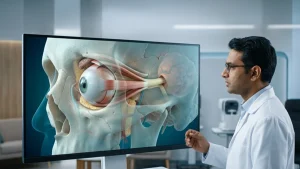
After removal of the natural eye (enucleation or evisceration) an orbital implant is put in at a deeper level in the socket. The prosthetic eye is placed in front of this implant which in turn sits under the eyelids. The exact procedure and approach varies by the case and condition of the socket.
Types of Ocular Prosthesis
The appropriate choice among the types of ocular prosthesis depends on whether the natural eye is absent, damaged, or still present.
| Type | How It Is Used |
| Custom prosthetic eye | Individually shaped and painted to match the other eye and fit the socket |
| Stock artificial eye | A pre-made option that may be used temporarily or in selected cases |
| Cosmetic shell | A thin shell fitted over a damaged, shrunken, or abnormal natural eye |
| Orbital prosthesis | Replaces a larger area when the eye and surrounding orbital tissues are absent |
Customisation often improves comfort, appearance, and fit. The eye doctor and ocularist can determine which of the types of ocular prosthesis suits the individual socket.
How Is a Prosthetic Eye Fitted?
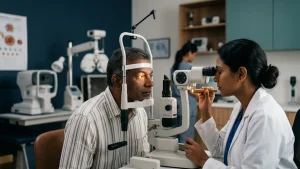
Fitting usually takes place after the socket has healed which varies by patient. At the assessment the ocularist looks at the socket and takes measurements or an impression. We may also adjust a trial prosthesis for comfort, eyelid movement, and alignment. We match the iris and the artificial eye details to the natural eye. Once the ocular prosthesis is finished the specialist will check its placement and comfort. Patients are also taught how to handle their prosthetic eye safely.
Does a Prosthetic Eye Move Naturally?
Some degree of prosthetic eye movement is present which may however not be the same as natural eye movement. The range of motion is a function of the type of surgery, what type of orbital implant is used, socket anatomy, muscle function, and quality of fit.
A properly fitted eye prosthesis and rehabilitation program is put in place to achieve comfortable movement and a natural at rest position. Results which report on prosthetic eye movement still vary so expectations should be gone over on an individual basis.
How to Care for a Prosthetic Eye
Good care is key to a prosthetic eye comfort. Before you handle your artificial eye, wash your hands. Follow the care instructions given by your ocularist as they may differ between patients. Discharge that is persistent, pain, swelling, redness, bleeding, or a sudden change in fit do not ignore these. An ocular prosthesis may also need professional polishing or adjustment over time.
| Care Area | General Guidance |
| Handling | Wash and dry hands before touching the prosthetic eye |
| Cleaning | Follow the cleaning method recommended by the ocularist |
| Comfort | Ask about suitable lubrication if dryness or friction develops |
| Review | Arrange professional assessment when fit or comfort changes |
| Warning signs | Seek medical advice for persistent pain, redness, swelling, or unusual discharge |
Prosthetic Eye Cost in India
In India the cost of a prosthetic eye is not fixed. It is a variable which depends on what type of prosthesis is used, degree of customization, material, socket health, clinical assessment results, and if any additional treatment is required.
A custom made artificial eye may go for more than a stock option because of individual fitting and detailed color matching. When patients look for providers such as Mehra’s ocular prosthetics which offer this service or other ocular prosthesis services they will do well to look into the clinical skill of the provider, the fitting methods and post care rather than just at the price. For an exact estimate in home care which also will provide more information, a visit for an in person examination is important.
Conclusion
A prosthetic eye is a key component in cosmetic as well as emotional recovery from vision loss. Today we see that with advanced fitting methods it is possible to have a very close match of the artificial eye to the living eye, also the fit is very comfortable.
Successful eye prosthesis and rehabilitation is not just about choosing an eye that looks natural. We do in depth socket assessment, precise fitting, we stress on hygiene, follow up care and timely adjustments. It is advised that anyone looking into an ocular prosthesis speak with an ophthalmologist and a trained ocular prosthetic professional to determine the best option for your individual needs.
Frequently Asked Questions
- Can a prosthetic eye restore vision?
No. A prosthetic eye which is fitted properly does improve looks but it does not restore sight. It also is not a substitute for the retina or the optic nerve which are required for sight.
- Is wearing an artificial eye painful?
Once the proper fit is achieved a patient should do fine. If you are a new patient with pain or the issue persists see your eye care professional.
- How long does an ocular prosthesis last?
Also the life span of a prosthetic eye is not permanent. You may see changes in the socket, wear, growth in case of a child patient, or discomfort which may call for a polish, adjustment or replacement.
- Can a prosthetic eye move?
Yes, some prosthetic eye movement may occur. The degree of movement varies between patients and is based on the implant, the surgery, the socket, and the fit.
- Is a prosthetic eye the same as an orbital implant?
Also it is true that the implant which is an orbital one usually sits in a more internal position post surgery. The visible prosthesis fits over the healed tissue and gives the appearance of a natural eye.