Cataracts grow slowly and present with a variety of vision issues. Also not all cataracts progress at the same rate which is why ophthalmologists have developed a cataract grading to determine the severity and what treatment is required. With cataract grading patients are made aware of the stage of their condition and the time frame in which surgery may be required.
At the ASG Eye Hospital we use international standards for cataract grading which we apply to evaluate lens opacity, monitor disease progression and determine the best treatment option. This article goes into the stages of cataracts, the cataract grading scale and what each stage means for your vision.
What Is Cataract Grading?
Cataract grading assessment is the term used by doctors to determine the degree of clouding in the eye’s natural lens. In the course of an eye exam specialists note the place, extent, and effect of the cataract on vision.
The aim of cataract grading is to assess what degree a cataract is affecting daily tasks like reading, driving, and face recognition. Also we use a standardized cataract grading scale which allows doctors to compare notes over time and to track the disease progress.
Why Is Cataract Grading Important?
The grading of cataract which we use to determine disease severity. It is a tool which ophthalmologists use to decide between watchful waiting, prescription changes, or surgery.
Regular cataract grading assessment also puts into notice which changes are taking place at an early stage. As cataract grading scale to progress slowly we do, which is to have periodic eye exams which in turn will catch the issue before it develops into something more serious which causes great vision loss.
Types and Classification of Cataracts
Doctors first determine what type of cataract is present which then allows them to grade it. classification of cataract is based on which areas of the lens are affected.
| Cataract Type | Description |
| Nuclear Cataract | Develops in the center of the lens and commonly occurs with aging |
| Cortical Cataract | Starts at the lens edges and gradually moves inward |
| Posterior Subcapsular Cataract | Forms at the back of the lens and may affect vision quickly |
This cataract classification what we do see is it to help specialists identify how the issue will progress and affect vision.
Common Cataract Grading Scale Used by Doctors
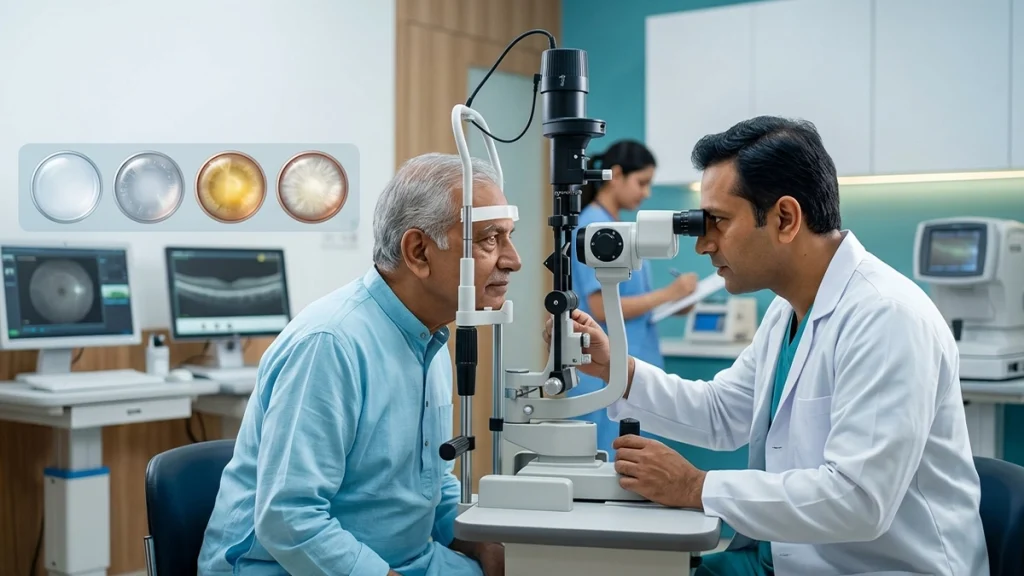
Most ophthalmologists at present use what is in fact the same set of systems like LOCS III (Lens Opacities Classification System III) for cataract grading. These systems put forward a comparison of the lens changes which in turn is against a set of standard images.
The following table shows a simplified cataract grading scale 1 5 often used to explain severity to patients.
| Grade | Severity | Typical Vision Impact |
| Grade 1 | Very Mild | Minimal visual disturbance |
| Grade 2 | Mild | Slight blurring and glare |
| Grade 3 | Moderate | Noticeable vision reduction |
| Grade 4 | Advanced | Significant vision impairment |
| Grade 5 | Severe/Mature | Major vision loss, often requiring surgery |
This cataract grading scale 1 5 helps patients to see where they are in terms of disease progression.
Understanding Cataract Grades
In the early stages of cataract grading we see that Grade 1 and Grade 2 cataracts present with mild symptoms. Patients at this stage may report increased light sensitivity or have trouble with very small print.
A grade 3 cataract is a more advanced stage which presents with more noticeable vision issues. At this stage people may have trouble with night time driving, reading, or identifying faces in low light. It is at this point that we see patients in for a discussion of surgical options which we recommend once the cataract is affecting quality of life.
In advanced cataract grading,stage 4 and stage 5 of cataract development vision may break down greatly. At this point in time surgery usually becomes the most effective treatment.
How Doctors Perform Cataract Grading
During a routine eye exam doctors use a slit lamp microscope to look at the lens. They will note the color, the density and for any opacity which in turn they use to cataract grading.
The grading of cataract also includes visual acuity test, glare assessment, and retinal exam. These tests determine what degree to which the cataract is affecting functional vision.
Modern in vitro imaging tools also improve the accuracy of cataract grading by which we see in great detail the lens changes and in turn this supports treatment planning.
What Cataract Grading Means for Treatment
A patient’s cataract grading does not in itself determine the need for surgery. Instead what we see is which grade the cataract is in and also we note the patient’s visual symptoms.
Someone at a low cataract grading may present for surgery when vision is very impaired by the daily activities. On the other hand a patient with a high score but no major issues may do fine with a watch and wait approach.
Understanding the categories of cataract classification, the stage of the disease, and the visual impact allows ophthalmologists to provide tailored recommendations.
Conclusion
Understanding the stages of cataract grading is key to patient decision making. Through proper cataract classification and use of a cataract grading system eye doctors are able to accurately determine disease progress and put forth the best treatment options. At any stage of cataract development from early to grade 3 cataract it is important for patients to have regular eye exams which are vital in preserving clear vision and in turn quality of life.
FAQs
1. What is cataract grading?
Cataract grading is a standardized practice which doctors use to determine the degree and progress of lens clouding in the eye.
2. What is the cataract grading scale?
A cataract grading scale which puts cataracts into different groups based on their density, location, and vision impact.
3. What does a grade 3 cataract mean?
A grade 3 cataract is a stage of moderate cataract development which presents with visible visual impairment that may in turn affect daily activities.
4. What is the classification of cataract?
The classification of cataract is into types which include nuclear, cortical, and posterior subcapsular cataracts.
5. Is cataract surgery based only on cataract grading?
No. While cataract grading does play a role in determining the severity, also at hand are the patient’s symptoms, lifestyle requirements, and the state of the eye which all play a factor in the decision for surgery.
6. What is the grading of cataract used for?
The grading of cataract stages helps in tracking disease progress, to guide treatment choices also which time surgery.
Reference Links
- National Eye Institute (U.S. Government) – Cataracts Overview
https://www.nei.nih.gov/learn-about-eye-health/eye-conditions-and-diseases/cataracts