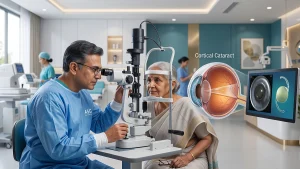
Cataracts cause blurring of vision, color desaturation, and headlight glare issues. Which is a big player in Cataract surgery in Delhi. Also people ask if surgery is really a must, what does the Cataract surgery cost in Delhi include, and which Cataract treatment in Delhi is the best for them. It is before making any decision that a full eye exam should be done which is key to note because similar symptoms may be related to retina, cornea, optic nerve, or eye pressure issues.
A cataract occurs when the eye’s natural lens becomes cloudy. At present, no medicine or eye drop is known to reverse an established cataract. Treatment involves surgery: the cloudy lens is removed and replaced with an artificial intraocular lens, or IOL.A planned Cataract operation in Delhi performed as a day-care procedure after the necessary tests, counseling, and lens calculation have been completed.
When Should Cataract Be Treated?
Surgery is not required till blurred vision, glare, or reduced color definition starts to affect reading, driving, work, or independence. The right time for Cataract surgery in Delhi differs from one patient to another. In the early stages of Cataract treatment in Delhi, updated glasses and regular monitoring may be tried, but these are temporary measures and do not remove the cataract. Prior to referring to a Delhi Cataract hospital a Delhi Cataract doctor will also look out for glaucoma, retinal diseases and corneal issues. In Delhi patients no longer have to wait for the cataract to fully mature if it is by that time affecting daily life.
Common Symptoms of Cataract
Common issues present as painless progressive blurring of vision, halos around lights, night time vision difficulty, color desaturation, and frequent need for changing glasses. By the time these issues start to impact daily life a work up for Cataract surgery in Delhi is a good idea. Cost should not be the main issue when it comes to timing of the procedure; delay in which a Cataract operation in Delhi is indicated only prolongs avoidable difficulty. A Cataract surgeon in Delhi is able to determine if the cataract is the primary issue.
Sudden vision loss, acute eye pain, large amount of redness, new flashes of light, a large increase in floaters, or a curtain like shadow which does not see through do not characterise what we would expect in a typical cataract case. Seek prompt medical attention as these may be signs of another eye issue.
Tests Performed Before Surgery
Testing includes visual acuity, refraction, slit-lamp exam, eye pressure measurement, and a dilated look at the retina. In Delhi for Cataract surgery we use biometry and keratometry to determine the IOL power making Cataract surgery in Delhi a more tailored procedure. Before we go ahead with the Cataract operation in Delhi, the Cataract doctor in Delhi reviews the patient’s health history, present medications, and past eye work as part of the Cataract treatment in Delhi.
Patients must report to the eye care team issues like diabetes, high blood pressure, use of blood thinning medications, past eye injuries, and former surgeries. Also bring up any history of LASIK or any other refractive procedure which will in turn affect IOL calculations at your preop assessment.
Types of Cataract Surgery
Phacoemulsification uses ultrasound which breaks up and removes the cloudy lens through a small incision. In micro-incision surgery an especially fine incision is used and it may be preferred in some cases of very dense cataracts. At certain points a femtosecond laser is used for laser guidance. Advanced technology may raise the Cataract surgery cost in Delhi but a Cataract surgeon in Delhi should recommend it only when you need it. Choose a cataract hospital in Delhi that performs sterile surgery and provides careful follow-up.
| Surgical method | How it works | Key point |
| Phacoemulsification | Ultrasound removes the cloudy lens through a small incision before a foldable IOL is inserted | Often used for routine age-related cataracts |
| Micro-incision cataract surgery | A refined phaco technique uses a very small incision | Incision size is only one measure of suitability |
| Manual small-incision surgery | The lens is removed through a self-sealing tunnel | Useful for selected dense cataracts |
| Femtosecond laser-assisted surgery | A laser performs selected surgical steps | May add precision but is not required for every patient |
Cataract degree, pupil size, and the state of the cornea and natural lens’ supporting structures also play a role. Also of note are glaucoma and retinal disease. While laser assisted surgery is an option for some patients it is not true for all cataract cases.
Understanding Cataract Surgery Cost
The price varies by procedure, lens, and clinical requirements. In the total are Consultation, scans, surgeon fees, theatre charges, the IOL, medicines, and follow ups which may be included. This is the reason there is no set price for Cataract surgery in Delhi. A transparent breakdown of Cataract surgery cost in Delhi should go into each item. Patients should request in writing what is included and discuss it with the Cataract doctor in Delhi and Cataract surgeon in Delhi rather than to go with what may appear to be a too good to be true low starting price.
ASG Eye Hospital reports we see price ranges of ₹20,000 ₹40,000 for basic cataract procedures and also see from the range of ₹50,000 ₹1,20,000 for what we term as in depth or laser procedures. These are put forth as indicative numbers not a set in stone quote for Cataract surgery in Delhi. What you will pay for Cataract treatment in Delhi will vary based on the results of your exam, type of lens you choose, what your insurance covers and which package you go in for. Before you are admitted ask the Cataract hospital in Delhi to go over with you in detail what the charges will be.
Government reports use our schemes’ rates as a point of reference which is to say they are not usual private retail prices. On the Delhi government portal CGHS reports that for small incision cataract surgery the price is at around ₹11,390 ₹13,400 and for phaco or MICS at approx. ₹14,450 ₹17,000; IOL cost is not included in that. Do not take these as the typical Cataract surgery costs in Delhi what a beneficiary will pay out of pocket depends on eligibility, empanelment, referral requirements and the terms associated with the package.
| Cost element or published benchmark | Indicative figure | What to confirm |
| ASG standard-procedure estimate | ₹20,000–₹40,000 | Per-eye inclusions, lens, tests and follow-ups |
| ASG advanced or laser estimate | ₹50,000–₹1,20,000 | Clinical reason, technology and lens model |
| CGHS SICS benchmark | ₹11,390–₹13,400, excluding IOL | Eligibility, referral and empanelment |
| CGHS phaco or MICS benchmark | ₹14,450–₹17,000, excluding IOL | Lens and consumable coverage |
| Premium IOL or complex case | May increase the total | Exact lens, additional tests and specialist support |
A reduced quote may not include IOL, diagnostic tests, medications, or follow up visits. At the other extreme a more comprehensive package may include technology or a lens which is not actually recommended for the patient’s eye. It is up to the patient to ask what is included in the price, what is left out which may be optional, and what extra charges there may be for additional support.
Intraocular Lens Options
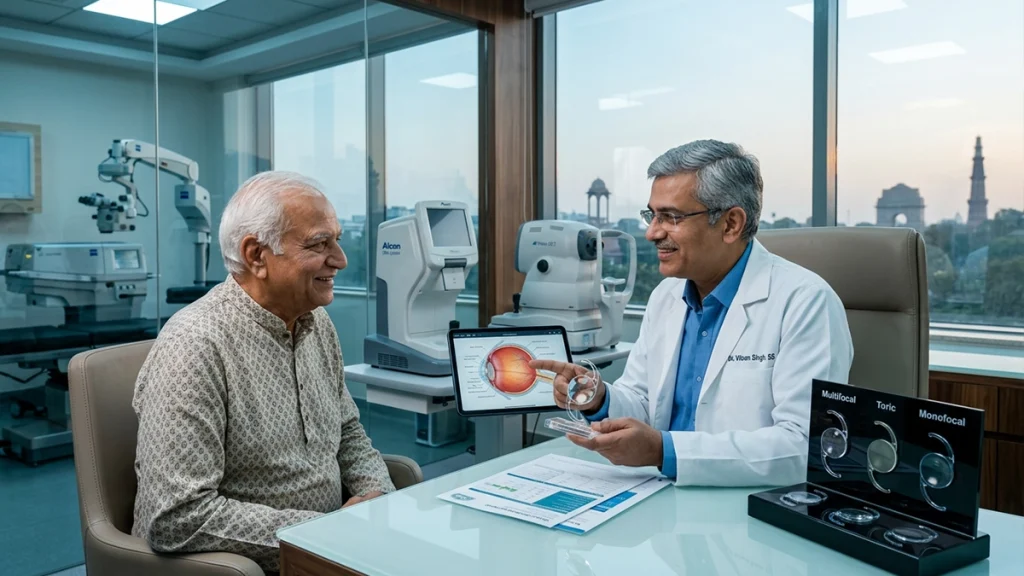
A monofocal IOL which usually is set for distance is what a monofocal IOL does which in turn means that for near vision reading glasses may still be required. In certain cases of regular corneal astigmatism toric lenses are used. Multifocal, trifocal, and extended depth of focus lenses are put in place to provide a wider range of vision. This issue of IOL choice is very much at the core of Cataract surgery in Delhi. In the process of Cataract treatment in Delhi the Cataract doctor in Delhi will look at retinal health, glaucoma, corneal shape, dry eye, and the patient’s night driving needs. Also the Cataract hospital in Delhi should put out info on the type of lens they are using. AIIMS New Delhi reports that toric, multifocal, trifocal, and extended depth of focus IOLs are options for custom visual rehabilitation.
Premium lenses reduce the need for glasses in right candidates but they are not inherently better. Multifocal and trifocal options may produce halos, glare, or reduced contrast, in particular in low light. In Delhi for Cataract surgery, go over the cost of Cataract surgery in Delhi and set realistic expectations. The Cataract surgeon in Delhi should go into what the lens will do and how it will play into the Cataract operation in Delhi.
Someone which you are into if you value dependability and distance focus and do not mind reading glasses is a monofocal IOL. If we look at the corneal astigmatism which is a good measure that is a plus a toric lens may be put in. As for multifocal, trifocal, and extended depth of focus lenses we do well to be very careful with which we choose, in particular in patients that also drive at night or which have retinal, corneal or optic nerve disease.
What Happens on the Day of Surgery?
Most of what we do is day care. We dilate the pupil, clean the eye out and apply numbing drops or local anesthetic. The cloudy lens is removed and the IOL put in. In Delhi for Cataract surgery patients may notice light or movement which is normal, sharp pain is not. In a complex case the Cataract treatment in Delhi may vary. Before theCataract operation in Delhi follow theCataract doctor in Delhi’s instructions carefully, particularly those concerning medicines and diabetes.
The issue covers prep, consent, the operation, monitoring, and discharge counseling. If the lens support is weak, the pupil is small, or there was past trauma, a Cataract surgeon in Delhi may change the surgical approach. That means the facilities at a Cataract hospital in Delhi are important. Before admission check the Cataract surgery cost in Delhi and arrange transport home, since driving immediately after Cataract surgery in Delhi is unsafe.
Recovery and Aftercare
Vision may improve within a few days but in some cases it takes up to a few weeks for full stability. At first after the surgery you may have some light sensitivity, irritation, or temporary blurred vision. Use as directed the prescription drops that have been given to you, do not rub the eye and to the extent possible avoid breaking any activities that your doctor has restricted. Follow-up remains part of Cataract surgery in Delhi and responsible Cataract treatment in Delhi. If pain increases, redness becomes marked or vision suddenly deteriorates, contact the Cataract doctor in Delhi or treat Cataract hospital in Delhi urgently.
Spectacle needs will be re assessed post healing. We find that recovery depends on the cornea, retina and optic nerve which in turn is a function of the surgical method. See through to each of your follow up visits which your Cataract surgeon in Delhi will use to check pressure, inflammation and IOL position. A higher Cataract surgery cost in Delhi does not take the place of aftercare; anyone undergoing Cataract surgery in Delhi should regard follow-up as part of the procedure.
Risks and Expected Results
Possible issues with Cataract surgery include infection, inflammation, corneal swelling, increased pressure, retinal problems, movement of the IOL and posterior capsule opacification. The outcome of Cataract surgery in Delhi also depends on the condition of the retina, macula, optic nerve and cornea. Before Cataract treatment in Delhi the Cataract doctor should explain that diabetes, glaucoma, trauma or previous retinal surgery may affect results.
A responsible surgeon does not promise perfect vision or that spectacles will be a thing of the past. Cataract operation in Delhi can become more complex when the cataract is hard, the pupil is small, or the lens support is weak. What an experienced cataract surgeon in Delhi can do is to see these issues coming, but at the end they may still play a role in recovery and the Cataract surgery cost in Delhi. Safe cataract surgery in Delhi is a result of personalized care.
Choosing a Cataract Specialist and Hospital
Choose out a specialist which does at length with your case, why it has come to surgery what other techniques may present itself to that eye, what the IOL measures were to suit your situation, and the results to which one can realistically look forward. In Delhi for Cataract issues get an all round evaluation from your health care professional instead of a supposition that any case of blurred vision is a simple cataract. If you are to go in for Cataract surgery in Delhi do your due diligence on the surgeon’s background in Cataract issues in Delhi and out also check that the Cataract hospital in the city has state of the art sterile operating facilities, emergency protocols in place, and a set out plan for post op care.
ASG’s in Delhi has at present centers in Lok Vihar, Pitampura, and Model Town. Dr. S. K. Narang is reported to do anterior segment and cataract surgery, also Dr. Shalini Mittal has fellowship in cataract surgery, phaco and refractive surgery. For patients that are a go for Cataract surgery in Delhi we advise you to check the current schedules, the Cataract surgery cost in Delhi, what is the proposal for your Cataract operation in Delhi and which IOL you will be given all of which you should go over with your Cataract doctor in Delhi.
Frequently Asked Questions
1. Can cataract be cured without surgery?
In the present time there is no medicine or eye drop which will cure a set in cataract. While new glasses and better lighting may provide some short term benefit, what does work is the surgical removal of the clouded lens which we do here in Delhi. A consultation for Cataract surgery in Delhi can determine whether the cataract is causing the problem and check if another disease is also limiting vision.
2. Is cataract surgery painful?
Numbness from the anesthetic or local anesthesia is what you can expect in this procedure which does not include sharp pain. Some mild irritation may follow. In a cataract operation in Delhi patients should bring to the attention of their performing surgeon any atypical symptoms they experience. The cataract hospital in Delhi also should go over with you the what of the anesthetic to be used, the monitoring which will take place, and care which is recommended post discharge.
3. Which lens is best?
No one size fits all when it comes to IOLs. Monofocal, toric, multifocal, trifocal, and extended depth of focus lenses are for different visual requirements and they suit different eyes. In Delhi for Cataract surgery the choice should take into account retinal health, corneal measurements, astigmatism, night driving, and also what our patients expect in terms of corrective wear post op. These points should be brought up with the Cataract doctor in Delhi instead of basing the decision only on the price.
4. How long does recovery take?
Many of our patients see improvement within a few days but the healing process may take weeks. After a Cataract operation in Delhi, recovery depends on the health of the eye and on properly using the prescribed drops.The Cataract surgeon in Delhi should explain when it is safe to drive, exercise, and return to work. Also the Cataract hospital in Delhi should give patients info on when to seek urgent help.
5. Does insurance cover cataract surgery?
Many programs and government initiatives cover included procedures which at times may have a limit on the IOL, network, or package. Prior to admission preauthorization should be obtained and which items that are non-payable determined. For the final Cataract surgery in Delhi what is put in the plan has to take into account clinical suitability and also the issue of verified financial coverage. Applicable CGHS treatment rates may be looked up on the Delhi government’s rate site, also personal eligibility must be confirmed separately.
Conclusion
An exact diagnosis, proper technique and IOL, realistic expectations, and reliable follow up. In terms of Cataract treatment in Delhi patients should look beyond what is advertised. Before Cataract surgery in Delhi ask for in writing what the costs are, which lens will be used and that you fully understand the after care plan. Choose an experienced Cataract surgeon in Delhi and a well equipped Cataract hospital in Delhi which will in turn help keep the process organized, transparent, and focused on the patient.