A cataract may present as a dimming, fuzziness or a halo around light which in turn affects recognition of familiar things. Reading becomes a tiresome task, driving at night may be a troublesome experience, and colors may not appear as vivid as before. As these changes start to impact independence, a full eye evaluation will lead to cataract surgery in Jaipur. Today’s cataract surgery includes removal of the opaqued natural lens and in its place is put in a clear artificial intra ocular lens also known as IOL.
Choosing cataract surgery in Jaipur involves more than selecting a hospital or fixing a date. We perform a diagnosis of the cataract, cornea and retina, we review your medical history, we compare lens options and we set realistic expectations regarding the need for glasses. A personal evaluation we do to match the treatment plan to your eye health, lifestyle and visual goals.
What Is a Cataract?
A cataract is when a usually clear lens in the eye turns cloudy. That lens’ role is to focus light on the retina; as cloudiness increases, contrast drops out, fine details become blurred and there is also reports of increased glare. While cataracts are a common issue as we age they also may be brought on by diabetes, eye injury, prolonged use of steroids, prior eye surgery and some birth defects. It is important to note that a cataract in one eye does not cause one to develop in the other, though it is not uncommon for them to appear in both at different times.
Early cataracts at times are treated with the use of updated spectacles, brighter lighting, anti-glare sunglasses and magnification for reading. While these options improve vision they do not cure the cataract. Surgery is the only option which removes the affected lens. An ophthalmologist generally recommends cataract treatment in Jaipur when vision loss begins interfering with reading, work, driving, household responsibilities or other activities important to the patient.
Common Signs That Need an Eye Examination
Cataract symptoms often progress slowly. An assessment for cataract surgery in Jaipur is worth considering when blurred vision persists despite the issue of new glasses or when you experience glare, poor night vision and color which appears faded. These should not be immediately attributed to cataracts which in fact may be a result of glaucoma, retinal diseases, corneal conditions and refractive errors. A full eye exam is the way to determine the root cause.
| Change noticed | Effect on daily life | Why examination matters |
| Cloudy or blurred vision | Faces, television subtitles and road signs appear unclear | The doctor can determine whether cataract or another condition is responsible |
| Glare or halos | Headlights and bright sunlight feel uncomfortable | Glare may increase as the natural lens becomes cloudier |
| Poor night vision | Driving or walking in dim areas becomes difficult | Visual function may be reduced even when daytime sight seems acceptable |
| Faded colours | Clothes, food and surroundings look less vivid | Cataracts can reduce colour perception and contrast |
| Frequent spectacle changes | New prescriptions provide only temporary improvement | The cataract may be progressing |
| Double vision in one eye | A single object appears as two images | A full examination is needed to identify the underlying cause |
When Is Cataract Surgery in Jaipur Recommended?
The right time for cataract surgery in Jaipur depends more on daily visual difficulty as opposed to age. One who drives a great deal, reads a lot, does fine detailed work or which lives independently may put off treatment until later compared to a person with different visual requirements. Also surgery may be called for when a cataract is the cause which precludes an ophthalmologist from evaluating or treating the retina.
A consultation with a cataract doctor in Jaipur should cover present symptoms, spectacle use, past eye procedures, diabetes, blood pressure, what you are on for current medications and also any history of glaucoma or retinal disease. Also do not stop blood thinning medicine or other prescribed treatments on your own. Any change in medication must be discussed with your treatment physician and eye surgeon.
Tests Before Cataract Surgery in Jaipur
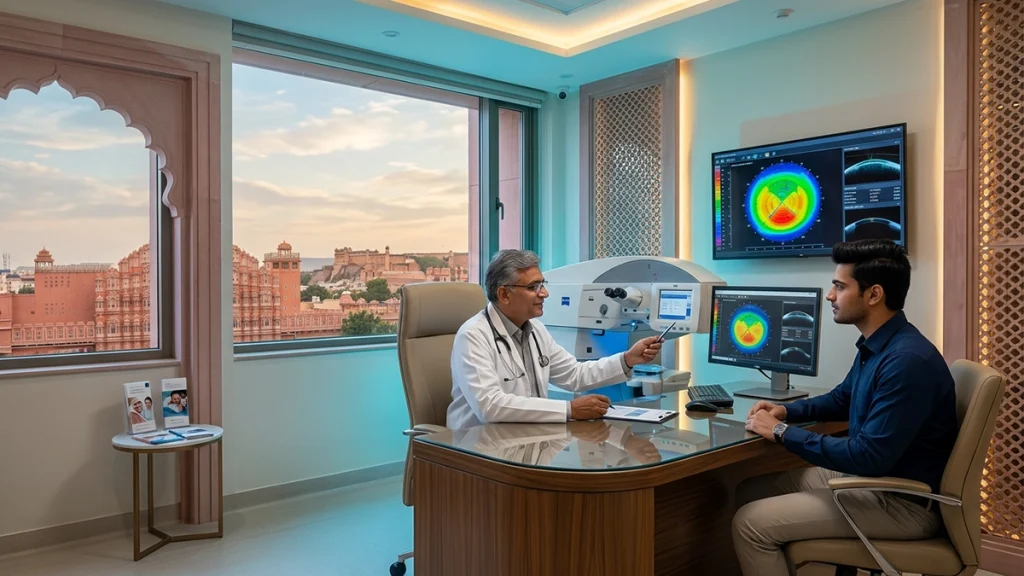
Before cataract surgery in Jaipur the eye care team usually assesses visual acuity, eye pressure, cornea, pupil, natural lens and retina. In biometry the size of the eye and it’s optical properties are measured which in turn allows for the calculation of the artificial lens power. Corneal measurements also help to identify astigmatism and determine what type of specialized lens may be required.
Retinal imaging, corneal mapping or other tests may be suggested when diabetes, macular disease, glaucoma, past eye surgery or an irregular cornea play a role in visual result.These tests help the cataract surgeon in Jaipur select an appropriate lens and identify conditions that may limit vision after surgery.
How Cataract Surgery Is Performed
During a modern cataract operation in Jaipur, the surgeon creates a small opening in the eye, removes the cloudy natural lens and places a foldable IOL inside the natural lens capsule. Phacoemulsification is what we see most of the time. Here the cataract is broken up into small pieces with ultrasonic energy which are then gently removed. The artificial lens stays in the eye and takes over the light focusing function after the cloudy lens has been removed.
Most of the time we use local anesthetics which include numbing eye drops and the patient goes home the same day. For very dense cataracts, small pupils, weak lens supporting fibers, corneal disease or prior eye surgery the treatment plan may be different. A cataract hospital in Jaipur should explain the technique, expected recovery, postoperative appointments and warning signs before the patient provides consent.
Lens Options for Cataract Surgery in Jaipur
The IOL is an important part of cataract surgery in Jaipur because it influences the patient’s visual range and possible dependence on spectacles. Not all lenses are the same for each patient. Choice is based on corneal astigmatism, retinal and optic nerve health, what a person does for a living, night time driving requirements, reading habits, budget and tolerance to optical side effects like glare or halos.
| IOL option | Main visual goal | Important discussion |
| Monofocal IOL | Clear vision at one principal distance, commonly far | Reading glasses are usually still required |
| Toric IOL | Treats the cataract while correcting selected corneal astigmatism | Accurate measurements and correct lens alignment are important |
| Multifocal or trifocal IOL | Provides more than one focal range | Some patients may experience glare, halos or reduced contrast |
| Extended-depth-of-focus IOL | Extends useful vision, often from distance to intermediate | Near glasses may still be required for small print |
| Monovision strategy | One eye is targeted more for distance and the other more for near | Not every patient adapts comfortably to this arrangement |
A patient considering a premium lens during cataract surgery in Jaipur should ask what is the degree of which they will be free of spectacles instead of looking for total independence. Multifocal and similar lenses do improve near and mid range vision but their use is dependent on the condition of the cornea, retina and optic nerve. The cataract doctor in Jaipur should explain the advantages, limitations and possible visual effects of every proposed lens.
Cataract Surgery Cost in Jaipur
The cataract surgery cost in Jaipur which is due to different quoted services. What you pay in the end may also depend on the type of surgery, IOL type and brand, pre-op diagnostic tests, quality of the hospital, medication costs, what is included in the follow up and if you also need to treat another related eye issue or if it is covered by your insurance.
ASG Eye Hospital’s Jaipur reports that the range of indicative prices for cataract service is between Rs 20,000 to Rs 1,20,000 which may vary according to the chosen procedure and intraocular lens. This is not a set price for all patients. The actual cataract surgery cost in Jaipur will be determined after an eye exam, lens counseling and a review of what is included in the put forth package.
When comparing the cataract surgery cost in Jaipur, request for a detailed report which includes preoperative tests, type of IOL which has been chosen, surgeon and facility fees, medication costs and what is included in the scheduled follow up visits. Also look at the price in relation to clinical suitability, what is put forth as counseling on the treatment options, infection control measures which are in place and access to postoperative support
Insurance and coverage for cashless treatment may differ by the insurance company, policy terms, hospital network and medical issue. Before you go in for cataract surgery in Jaipur it is best to check wait times, procedure sub limits, lens related caps, pre authorisation requirements and what will be covered out of pocket with your insurer and hospital help desk. Also government run cataract services may be an option for you. The National Program for Control of Blindness and Visual Impairment is into reducing avoidable blindness which includes that from cataracts. Also the Rajasthan health department puts out info on programs which support cataract surgeries for eligible and low income patients.
Choosing a Cataract Doctor, Surgeon and Hospital
A suitable cataract doctor in Jaipur should perform a thorough comprehensive exam, hear out the patient’s visual concerns, and present options at hand which include not the outcome of perfect vision. Patients also should put forth questions on the doctor’s training, experience with cataract procedures, which surgical method is that which they are to use, why a certain IOL is recommended, what in terms of infection control will be done, and if there is a pre existing diabetes, glaucoma or retinal condition how that will be managed.
The role of a cataract surgeon in Jaipur extends beyond performing the operation. We do accurate measurements, choose the right IOL, do careful planning and structure follow up. Patients should feel they can ask why a particular lens is chosen, what the visual range it is to provide is, and also if glasses may still be required.
A reliable cataract hospital in Jaipur should offer eye exam, biometry, sterile surgery and postoperative assessment. We put in that we present info to patients and family in a language they will understand. ASG Eye Hospital at present has two Jaipur centers. The New Sanganer Road site is by Shyam Nagar Metro Station, the second is on Bhagwan Das Road. Also on the Jaipur page we have listed doctors which practice in cataract, cornea, retina, phacoemulsification and refractive services. It is best to check doctor availability when you book an appointment because it may have changed.
What to Expect on the Day of Surgery
On the day of cataract surgery in Jaipur, patients should follow what the hospital says about food, which meds to stop or continue, use of the prescribed eye drops and what time to arrive. Also a responsible adult should be with the patient as we do not advise driving right after the procedure. The anesthetic is applied, the clouded lens is removed and the chosen IOL. During the procedure patients may note light, colors or movement in their vision which is normal but they won’t see the details of what is being done.
After the cataract operation in Jaipur, the medical team examines the eye and provides prescribed medicines and protective instructions before discharge. There is a chance of some weeping from the eye, irritation, light sensitivity or blurred vision at the start of the recovery. Do not rub the operated eye and please follow the prescription eye drop schedule as advised.
Recovery and Warning Signs
Recovery from cataract surgery in Jaipur is a slow process which may see vision fluctuation as the eye heals. Many patients report improvement within the first few days post op but full healing may take several weeks. Surgeons may ask to avoid heavy lifting, strenuous exercise, swimming, dusty settings, eye make up and direct water contact.
Follow up post cataract treatment in Jaipur gives the doctor a chance to check healing, eye pressure and the position of the IOL. Final spectacle power is usually determined after the eye has stabilized. In patients with diabetes, glaucoma, corneal disease or retinal conditions which have had what is otherwise a normal course of cataract procedure, they may require additional exams or treatment. If the patient reports sudden vision loss, severe or progressive pain, marked redness, increased discharge, new flashes of light, a sudden shower of floaters or a curtain like shadow in the visual field, an urgent exam is required. At the first sign of these issues contact your cataract hospital in Jaipur or go to the emergency ophthalmic care instead of waiting for your next routine appointment.
Benefits and Possible Risks
The objective of cataract surgery in Jaipur is to improve vision which is present in a patient with a cloudy natural lens. We may see an improvement in that which a person reads, walks, recognizes faces, watches TV and does other daily activities. But also it is important to note that the degree of improvement also depends on the health of the retina, optic nerve, cornea and other internal structures of the eye.
In the like manner as other medical procedures a cataract operation in Jaipur has risks which may include infection, inflammation, corneal swelling, retinal swelling, changes in eye pressure, bleeding, retinal detachment, IOL position problems or the need for further treatment. Also a membrane behind the IOL may become cloudy at months or years post op which is known as posterior capsule opacification and is a thing which in many cases is treated with a laser procedure after an ophthalmic evaluation. It is best that individual risks be discussed with the surgeon.
Why Consider ASG Eye Hospital in Jaipur?
Patients researching cataract surgery in Jaipur can consult ASG Eye Hospital which provides cataract assessment, biometry, lens counseling, surgical planning and post op care. Also the hospital’s public info material on their Jaipur services which they run into details of phacoemulsification, laser assisted options and info on monofocal, multifocal and premium IOLs. But to which IOL the patient is to be fitted is at the end at the discretion of the patient’s health profile and results of the clinical exam.
For patients seeking cataract treatment in Jaipur, ASG’s centres are accessible from areas such as Mansarovar, Vaishali Nagar, Malviya Nagar, C-Scheme, Raja Park, Tonk Road, Shyam Nagar and nearby localities. Booking into an eye exam is what it takes for you to know if your symptoms are that of cataracts, also to know if you need to go in for surgery today or still have some time.
Conclusion
A cataract is very common, but the choice to have cataract surgery in Jaipur we must leave to the individual. That said a detailed exam will determine if the cataract is the cause of vision problems, also what other eye issues may be present and which surgery and IOL is right. Also by getting to know the cost of cataract surgery in Jaipur, asking practical questions and following post op advice the treatment process may be made more predictable. It is especially important to see a qualified cataract surgeon in Jaipur if you have diabetes, glaucoma, retinal disease, prior eye surgery or atypical visual symptoms. At ASG Eye Hospital we allow patients to set up an eval to go over cataract treatment options in Jaipur, available lens choices and we put together a personal treatment plan based on our findings.
Frequently Asked Questions
1. Is cataract surgery painful?
Most cataract surgery in Jaipur is done after application of local anesthetic or eye drops which numbs the eye. Patients may notice pressure, fluid or movement but what we see is that pain is a rare report. Any discomfort which may present itself during the procedure should be reported to the surgeon at once.
2. How long does a cataract operation take?
The surgical part is for a short while but the full hospital stay is for a longer time which includes the time taken for admission, preparation, dilation of the pupil, post op observation and discharge counseling. Time for a cataract operation in Jaipur varies based on the stage of the cataract, associated eye conditions and which surgical technique is to be used.
3. Which cataract lens is best?
There is no single lens that is suitable for every patient. A cataract doctor in Jaipur should do the IOL recommendation only after going into detail in measurement and a discussion of lifestyle, retinal health, corneal astigmatism, what the patient requires out of reading and night driving.
4. Will I need glasses after surgery?
Some patients do require reading glasses after getting a monofocal distance lens, also some may need correction at more than one distance. Premium IOLs may reduce the use of glasses but do not guarantee total freedom from them. What we present to the patient in terms of options is thus a very important element of the cataract treatment in Jaipur.
5. How much does cataract surgery cost?
The cataract surgery cost in Jaipur depends on what is selected for IOL, surgical technique, investigations, hospital package and insurance coverage. ASG reports an approximate range of 20,000 to 120,000 Rupees for Jaipur which is indicative, but for accurate estimates you will get it after the exam.
6. How should I choose a hospital?
Go for transparency in assessment, proper diagnostic tools, in depth lens counseling, sterile environment, post op instructions and access to post op support. A cataract hospital in Jaipur must go over the expected benefits, what may happen which is out of the ordinary, costs and risks of treatment beforehand.
Reference Links
- The National Eye Institute,
https://www.nei.nih.gov/eye-health-information/eye-conditions-and-diseases/cataracts/cataract-surgery