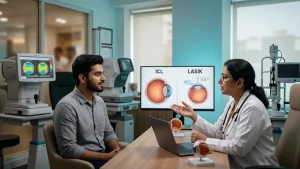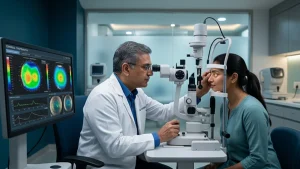

Laser Eye Surgery in some cases has improved vision which in turn has reduced the use of glasses or contacts for many. At the same time it does not suit all eyes or patients. Before we recommend the procedure we will do a full assessment of your cornea, prescription, health of the eye, medical history and what you expect out of the surgery.
Some put off the procedure and others may do better with a different vision correction option. Factors which include an unstable prescription, thin or irregular corneas, pregnancy, severe dry eye, and certain health issues may play a role in determining LASIK eligibility.
Understanding this information is key before you choose laser eye surgery. A detailed pre-LASIK exam allows your ophthalmologist to identify which may be issues that LASIK contraindications for you and to determine if the procedure is right for your eyes.
What Determines LASIK Eligibility?
LASIK changes the cornea which in turn causes light to focus better on the retina. Also the procedure affects the cornea tissue which is why the cornea has to be of good thickness, shape and health.
Your age, prescription stability, corneal health, tear film health, and in general your health play a role in LASIK eligibility. Also your ophthalmologist may go over the medicines you are on and past eye issues.
People wondering who cannot get LASIK should keep in mind that failing a single screening criterion does not necessarily mean permanent rejection. Some problems are temporary, while others may make a different refractive procedure the safer or more suitable choice.
The U.S. Food and Drug Administration states that refractive instability, certain medical conditions, medications, and preexisting eye disorders may make a person a poor candidate for LASIK.
Who Cannot Get LASIK?
Some health and ophthalmic issues which may cause you to be a poor candidate for LASIK. The below table includes what are perhaps the most common causes for an ophthalmologist to not perform the procedure.
| Condition or Factor | How It Can Affect LASIK |
| Unstable spectacle prescription | Vision may continue changing after surgery |
| Thin or irregular cornea | There may not be enough suitable corneal tissue for reshaping |
| Keratoconus or corneal ectasia | LASIK may further weaken an already abnormal cornea |
| Significant dry eye | Symptoms may worsen after surgery |
| Pregnancy or breastfeeding | Hormonal changes can temporarily alter vision and corneal measurements |
| Certain autoimmune or systemic conditions | Healing may be slower or less predictable |
| Active eye infection or inflammation | Surgery usually needs to wait until the eye becomes healthy |
| Certain uncontrolled eye diseases | Existing disease may affect safety or visual outcome |
Here are what we term as important LASIK contraindications, that said each case is unique. A full evaluation is required to determine who cannot get LASIK and which may improve with time.
An Unstable Eye Prescription
Prescription stability is a basic requirement for LASIK eligibility. If your eye power continues to change in strength then LASIK may not give you a predictably stable correction over the long term. The FDA reports that a change in prescription in the past year is a reason which may make you a poor candidate. Younger adults and people going through hormonal or medical changes may have more fluctuation.
This is why the answer to who cannot get LASIK sometimes changes with time. A patient may not be a candidate today but may later fit the criteria if their prescription has stabilized.
Thin or Irregular Corneas
Corneal thickness is a key issue which we pay attention to in LASIK procedures which remove a measured amount of corneal tissue. An ophthalmologist will check that you have enough healthy tissue to go ahead with laser eye surgery. We also use corneal topography and tomography which are able to identify atypical corneal shapes. These tests are of great importance when we screen for conditions like keratoconus.
A thin or anatomic variant of the cornea which may also include structural abnormalities is a reason which may affect LASIK eligibility. It may become a major issue of what we term LASIK contraindications based on the results of the patient’s tests and the health of the whole cornea. Also from MedlinePlus which is a resource for health information they note that preop testing includes evaluation of corneal curvature and thickness which are key in the LASIK process.
Keratoconus and Corneal Disorders
Keratoconus causes the corneal tissue to thin out and become more irregular over time. In an improper cornea, performing LASIK can cause additional structural damage. In terms of who cannot get LASIK, patients with diagnosed keratoconus are of primary concern. Also people with abnormal corneal maps may also need to go through more in depth testing prior to any refractive procedure.
Other corneal diseases, scarring, and past corneal disease may play a role in LASIK eligibility also. Each case must be looked at separately by the ophthalmologist instead of just by spectacle power.
Severe or Uncontrolled Dry Eye
Temporary dryness is a side effect post LASIK. In fact someone with pre pre-existing serious dry eye may have more issues post surgery. Dryness may bring on burning, irritation, fluctuating vision, a foreign body sensation or excessive tearing. Also during preop assessment we look at the tear film and eye surface. Severe uncontrolled dryness is to note a large factor in which we do not perform LASIK contraindications. But it is not a definitive outcome.
Treatment may improve the ocular surface which in turn may allow for reevaluation of LASIK eligibility at a later time. This is a key point to bring up with patients who cannot get LASIK.
Pregnancy and Breastfeeding
Pregnancy causes temporary visual change due to hormone fluctuations which affect the body and eyes. Also we see that in some patients’ breast feeding may bring about measurement changes. For this reason we generally delay LASIK during pregnancy and breastfeeding. MedlinePlus reports that it is best to forgo the procedure at these times because eye measurements may be affected.
Pregnancy is therefore usually a temporary answer to who cannot get LASIK, rather than a permanent exclusion. An ophthalmologist will reevaluate the eyes once the hormone and refractive changes have stabilized.
Autoimmune Diseases and Healing Problems
Some systemic issues can play a role in post surgical healing. For example rheumatoid arthritis, lupus, immune related disorders, and poorly controlled diabetes. The FDA recommends that patients bring to light diseases or medications which may play a role in wound healing before proceeding with refractive surgery. That said, having one of these conditions does not mean each patient will have the same issues with LASIK contraindications.
What a person’s disease activity is like, what meds they are on, health of the eye, and ability to heal all play a role. This is why a very careful medical work up is key in determining LASIK eligibility and deciding who cannot get LASIK safely.
Diabetes
Diabetes is a very individual matter which does not fit into simple yes or no boxes. Blood sugar levels may fluctuate to affect vision, also poor control of diabetes may impact healing. At MedlinePlus we put diabetes in the group of medical issues that should be brought up with the doctor when you are a candidate for LASIK. It is best that patients present their health history fully before laser eye surgery. The ophthalmologist may look at glucose control, retinal health, prescription stability, and other reports to determine LASIK eligibility.
Glaucoma, Cataract and Other Eye Diseases
LASIK does away with refractive errors. It doesn’t address issues like glaucoma or cataract. Patients with glaucoma, suspected glaucoma, high eye pressure, prior eye inflammation, or certain past eye surgeries require a careful work up. The FDA specifically says to have these issues brought up before proceeding with refractive surgery. A cataract may also cause change in your eye’s prescription and reduce vision. In such situations, treating the cataract may be more appropriate than undergoing corneal laser eye surgery.
These conditions help explain why who cannot get LASIK cannot be decided from spectacle power alone.
Active Eye Infection or Inflammation
Healthy eyes are a must prior to elective refractive surgery. An active infection or inflammatory process will interfere with healing and increase complications. Patients with present eye inflammation should get an appropriate evaluation and treatment first. A past herpes episode in the eye also requires in depth discussion as the FDA reports it as a condition which needs special care. Active eye disease may thus be a short term or long term LASIK contraindications, based on the diagnosis.
Age and LASIK
Age also is a factor in LASIK eligibility. For the most part LASIK is for adults which have had stable refractive error. The FDA reports that lasers which perform LASIK are not approved for use in people under 18. Also according to MedlinePlus the general minimum age is 18, and with some laser systems even an older minimum age is required. But also it is not the case that at 18 years old you are a sure candidate for the procedure. A changing prescription can still place someone among those who cannot get LASIK at that particular time.
Medicines That May Affect LASIK Suitability
Your ophthalmologist should be made aware of all prescription drugs, supplements and long term treatments prior to surgery. Certain drugs play a role in healing, tear production, or vision stability. The FDA reports that some medications, which include retinoic acid and steroids, may interfere with proper healing after refractive procedures. Do not discontinue any prescribed medications for the sake of getting laser eye surgery. Instead talk to your ophthalmologist and your primary care physician about your medications. Medication related issues can be a part of what is determined during the pre LASIK contraindications.
LASIK Eligibility at a Glance
| Assessment | What the Ophthalmologist Looks For |
| Prescription check | Stable and treatable refractive error |
| Corneal thickness | Adequate healthy tissue for the planned correction |
| Corneal mapping | Regular shape without suspicious weakening |
| Tear-film assessment | Healthy ocular surface and manageable dryness |
| Eye examination | No uncontrolled infection, inflammation, or significant disease |
| Medical history | Conditions that could affect healing or visual stability |
| Medication review | Medicines that may influence healing or vision |
| Expectations | Realistic understanding of benefits, limitations, and risks |
These assessments help ophthalmologists identify who cannot get LASIK, who can proceed, and who may need an alternative procedure.
What If You Are Not Eligible for LASIK?
Being out of the question for LASIK doesn’t mean that you don’t have other vision correction options at all. Based on your eyes’ specific issues an ophthalmologist may bring up glasses, contact lenses, PRK, SMILE, implantable lenses or some other option. What that option is will depend on what caused you to fail the LASIK eligibility pre-screen. For instance a person with a certain corneal measurement may have different options from a patient which has cataracts or unstable vision. This is to say that LASIK contraindications should not be used for do it yourself diagnosis. They are tools to help doctors make safer, personalized decisions.
Why Pre-LASIK Screening Matters
A very in depth evaluation is what we do before laser eye surgery. Don’t base your decision for LASIK only on your spectacle prescription. At MedlinePlus we are told that preop assessment may include corneal curvature, pupil size, refractive error, and corneal thickness. At ASG Eye Hospital we have patients who are looking into refractive correction talk to an ophthalmologist about their eye health, prescription, lifestyle, and what they expect from treatment. Proper screening also determines LASIK eligibility and also brings to light any issues which may be LASIK contraindications before going in for treatment.
If you are wondering who cannot get LASIK, an eye examination provides a much more reliable answer than age or spectacle power alone.
Conclusion
The answer to who cannot get LASIK depends on much more than spectacle power. Corneal thickness, stable prescription, dry eye, pregnancy, systemic illness, medications, and preexisting eye disease may play a role.
Some of the reasons to not do LASIK contraindications are temporary, while others may in fact point to a different procedure which is a better fit. Thus proper screening is key to the LASIK eligibility.
If you are thinking of having laser eye surgery do a full evaluation at ASG Eye Hospital. A detailed exam will determine if LASIK is right for your eyes and also will inform you of other options which may be available to you.
Frequently Asked Questions
1. Who cannot get LASIK eye surgery?
People which may not qualify include those with unstable prescriptions, certain corneal disorders, significant uncontrolled dry eye, active eye disease, or health issues that impair healing. During pregnancy and breastfeeding in most cases treatment is to be put on hold. In the end it is the ophthalmologist that will determine who cannot get LASIK after examination.
2. Can a person with thin corneas undergo LASIK?
Not all patients with thin corneas are turned away. Corneal shape, thickness and your prescription as well as the amount of tissue that is to be corrected play a role in determination of LASIK eligibility. Some patients may do better with a different procedure.
3. Can people with diabetes get LASIK?
Some people with well controlled diabetes may be put forward for surgery after a detailed assessment. But unstable blood glucose, changing vision, healing issues, or diabetic retinopathy play a role in LASIK eligibility. Diabetes thus is a key element of the preop medical review.
4. Is dry eye a LASIK contraindication?
A significant dry eye which is not well controlled is also a very important LASIK contraindication because LASIK as it may cause dryness to worsen which in turn may persist post op. Doctors may treat the issue first and reevaluate the patient’s suitability later.
5. Can I undergo laser eye surgery during pregnancy?
During pregnancy the majority of the time we wait to do LASIK as the hormones are playing a role in vision and eye size. Also MedlinePlus reports that it is best to forgo LASIK during pregnancy and while breastfeeding.
6. What happens if I am not eligible for LASIK?
An ophthalmologist may go over other vision correction options as per your eye health and prescription. To be in a group that who cannot get LASIK does not mean that all types of refractive correction are out of the question.