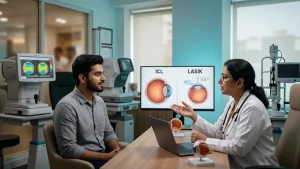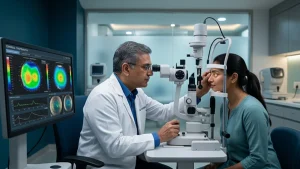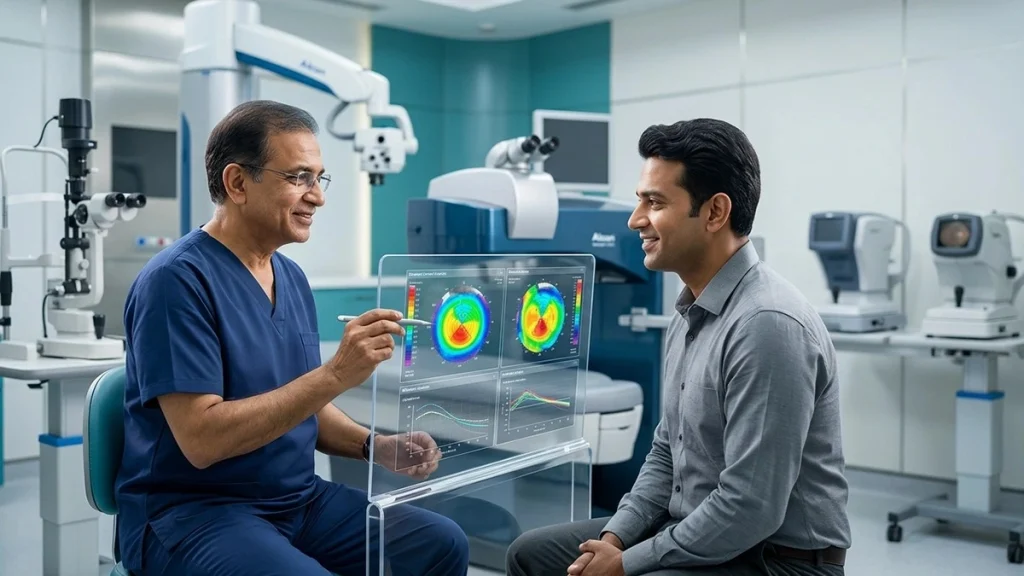
LASIK does offer many years of clear vision but your eyes may still see changes in healing, refractive regression or with age. As distance vision goes back to blur people often ask whether repeat LASIK is possible.
In some patients the answer may be yes. Also, LASIK enhancement is not a guaranteed repeat procedure. Second LASIK surgery should be put off until an ophthalmologist determines the cause of blur and which is proven to be from a cornea that may still have room for more treatment. LASIK revision may improve a steady residual prescription but will not fix issues of dry eye, cataract, retinal disease or an unstable cornea.
What Does Repeat LASIK Mean?
Remeasurement for LASIK is when a second refractive laser procedure is performed on a patient who has had previous LASIK. It is to fix leftover myopia, hyperopia or astigmatism, or to address stable refractive regression which has become annoying.
Doctors also report to use the term LASIK enhancement for this issue of retreatment. The term “enhancement” may seem simple but it is a medical decision of great importance because the cornea has already been modified once. The surgeon must determine what tissue was removed before, how the original flap was made and how much healthy stromal tissue is present.
Second LASIK surgery does not mean that every first step will be repeated. At times the existing flaps are what we lift, also we may go with a surface procedure like PRK for another patient. In some eyes we may not recommend a LASIK revision at all.
Why Can Vision Change After LASIK?
LASIK changes the shape of the cornea which in turn causes light to focus more accurately on the retina. It corrects the present prescription at the time of the surgery, but does not prevent future biological changes. Healed response varies from person to person and also we may see a little under correction or over correction.
Vision also may deteriorate at some point after a long span of good eyesight. This is what we call regression. It may be related to the original prescription of the glasses or contacts, the age of the patient, changes in the cornea or other variables which play a role in the health of the eye. Repeat LASIK is a choice we consider only once that change is proven and stable.
Blur does not always indicate the need for a second LASIK enhancement. An unstable tear film may present as vision which improves with a blink and then deteriorates again with continued use of the computer. At the age of 40 we usually see the onset of presbyopia which affects near focus. Cataracts at a later date will change in clarity and may also change your spectacles’ power. Before we go ahead with the second LASIK surgery we have to rule out that what is seen is a true residual corneal issue.
Can LASIK Be Done Twice?
Repeat LASIK may be performed again but that is on a case by case basis. The FDA reports that for some patients which have had a prior refractive procedure may not be recommended to have additional refractive surgery. In each instance the decision is made after a careful analysis of the patient’s particular situation.
The prescription should be stable before we do LASIK revision. FDA reports that for further correction to be done eye measurements should be the same at two consecutive visits which are at least three months apart. Also they note that vision may fluctuate for three to six months post surgery.
These reports present that a patient should not go in for a single bout of LASIK enhancement early on. Temporary dry eye, healing changes in the tissue, or variable refraction may put the results out of question. Responsible surgeons wait for repeatable results and they make sure that the proven benefit of a second LASIK surgery is greater than its risk.
Who May Be a Suitable Candidate?
A person who is a candidate for repeat LASIK may have a residual refractive error which impacts daily activities, is the same on multiple tests and improves when tried in the eye. Also the cornea should have a regular shape, proper thickness and no signs of keratoconus or post-LASIK ectasia.
The ocular surface has to be in good health. Large scale dry eye issues will present with variable results and may in fact present worse off post procedure. It is also a requirement that the eyelids, tear film or meibomian glands be treated first before we can properly assess the issue for LASIK enhancement.
Age, health status, pregnancy, breastfeeding, diabetes control, autoimmune conditions and medications which affect healing may play a role in eligibility. Also the natural lens and retina will be evaluated. Also it is not true that the Second LASIK surgery is for a very small change in refractive error.
| Clinical finding | Why it matters | Possible direction |
| Stable residual myopia, hyperopia or astigmatism | Confirms that blur is caused by a treatable refractive error | Consider laser retreatment after complete testing |
| Variable vision with dryness or burning | Tear-film instability can distort refraction and corneal maps | Treat the ocular surface before reassessment |
| Thin or irregular cornea | Additional tissue removal may weaken the cornea | Avoid or reconsider LASIK revision |
| Near-vision difficulty after 40 | Presbyopia is caused by loss of lens-focusing ability | Discuss reading glasses or carefully tested monovision |
| Cataract or retinal disease | Corneal laser treatment will not correct the underlying condition | Treat the primary eye problem instead of LASIK enhancement |
Tests Required Before Repeat Treatment
A very in depth consultation for another refractive procedure will include uncorrected and corrected visual acuity, refraction, slit-lamp exam, eye pressure measurement and a dilated look at the lens and retina. The surgeon should review past LASIK records if they are available.
A very in depth consultation for another refractive procedure will include uncorrected and corrected visual acuity, refraction, slit-lamp exam, eye pressure measurement and a dilated look at the lens and retina. The surgeon should review past LASIK records if they are available.
Tear film evaluation is key prior to second LASIK surgery as dryness may play a role in comfort and also in the accuracy of the results. Also to be discussed is pupil size, night vision issues, glare, halos and visual expectations. LASIK revision should be a total visual system based assessment and not to what is present in the spectacle prescription.
How Long Should a Patient Wait?
There is no one set waiting period for everyone. What is right for LASIK enhancement is based on healing, stability of prescription, the results of the primary correction, the state of the cornea and what has caused vision to change.
When in the early stages of the first procedure you see blur, the eye is to be monitored as it settles and at the same time dryness if present is treated. As for further treatment we wait until we see that the results are repeatable. What we are doing is preventing a temporary variation to be treated as a permanent refractive error which in turn is a waste of time.
When it comes to a second LASIK surgery which is performed years down the line the scope of evaluation broadens. The surgeon has to reevaluate the old flap, rule out the presence of cataract and see to it that the cornea is still in regular shape. A late in time LASIK revision may see the use of a different technique as against that used in retreatments which take place within the first year.
How Is Repeat LASIK Performed?
One way to repeat LASIK is to lift the existing flap, apply a planned excimer-laser correction to the tissue beneath it and put the flap back in place. What is suitable for this approach depends on the condition of the flap, time since surgery, corneal measures and also surgeon judgment.
Another choice is PRK which we do instead of LASIK. The outer layer of the cornea is removed, laser reshapin is done and a bandage contact lens is used while the surface heals. Recovery is usually slower and we don’t reopen the old flap.
Creating a new intersecting flap is a complex which is to say it is not automatic that it be done so the approach in LASIK enhancement is to preserve corneal structure and to minimize avoid which is to say to avoid related flap risks. Also the second LASIK surgery may present different characteristics from the first one.
| Retreatment method | What happens | Recovery considerations |
| Existing-flap lift | The old flap is lifted and laser correction is applied underneath | Often provides faster early recovery, but the flap and epithelial ingrowth require monitoring |
| PRK over previous LASIK | Surface cells are removed and laser treatment is applied without lifting the flap | Healing is slower and early discomfort may be more noticeable |
| Glasses or contact lenses | The remaining prescription is corrected without another operation | Suitable when the refractive error is small or surgery is inadvisable |
| Lens-based treatment | The natural lens is treated when cataract is the main cause | May be more suitable than LASIK revision in selected older adults |
Expected Benefits and Limitations
The primary goal of repeat LASIK is to improve uncorrected distance vision and reduce dependence on glasses for a stable residual prescription. In a large-scale back prospecting study which looked at 901 enhanced eyes it was reported that 86% achieved uncorrected distance vision of 20/20 or better at 12 months and that 93% were within plus or minus 0.50 diopters of the intended target. These results are from a selected study population which does not predict an individual patient’s result.
LASIK enhancement can correct blur from refractive error but it may not for glare, halos, starbursts, contrast issues or dry eye symptoms. The FDA also reports that while distance vision may improve with re-treatment, other visual issues like glare or halos may still persist.
Second LASIK surgery does not reverse age related changes. At that stage reading glasses may still be required because presbyopia is a function of the natural lens. Also cataracts may develop in the future and the power of correction may change again. Thus a good LASIK revision consult is for setting realistic functional goals instead of a promise of permanent spectacle free vision.
Risks of Another LASIK Procedure
Repeat LASIK has the same risks as the first which is dry eye, infection, inflammation, under correction, over correction, induced astigmatism, glare, halos, reduced contrast and corneal haze. Flap based retreatment may also present with flap wrinkles or epithelial ingrowth.
Epithelial outgrowth of cells was seen to occur under a lifted flap. In the study we looked back at past cases we reported that in 6.1% of enhanced eyes epithelial outgrowth took place and also found that the risk increased when the interval between the first procedure and the enhancement was over five years.
Rarely do we see that which has to do with more tissue removal causing corneal weakening or ectasia in a case of insufficient base tissue or an unstable shape. This is what corneal mapping and thickness calculation play into in a second LASIK surgery. When the safety margin is not adequate we may have no other choice but to go against LASIK revision from a medical standpoint.
Recovery and Aftercare
Recovery from repeat LASIK is a function of the technique. Post flap lift we may see a quick return of useful vision which in some cases is accompanied by blur and fluctuation as the eye heals. Following PRK discomfort and light sensitivity present more at the start and visual improvement is a slower process.
Prescribed antibiotics, anti-inflammatories and lubricating drops must be used as directed. Patients should not rub their eyes and they should follow the surgeon’s advice regarding bathing, swimming, exercise, use of make up, dust exposure and driving. At follow up visits the doctor will check the corneal clarity, flap position, surface healing, eye pressure and prescription stability.
Sudden pain, increase in redness, discharge, light sensitivity or change in vision requires prompt medical attention. Do not restart old prescription drops or over-the-counter redness drops without advice.
Repeat LASIK After the Age of 40
Age is not a determining factor for repeat LASIK, what does change is the cause of visual problems over time. Presbyopia which usually starts in the mid 40’s brings in difficulty with near vision. One may have 20/20 distance vision and still require reading glasses.
Monovision is also a topic which may come up in this case one eye is corrected for distance and the other for near. Also not all patients do well with this and we may recommend a contact lens trial before moving to permanent laser correction.
In in elderly people the natural lens should be looked at for early signs of cataract. If the lens change is the cause of blur or of repeat prescription changes, cataract surgery may be a better option then another corneal laser procedure.
Conclusion
Repeat LASIK is also an option for some patients, but do not consider it a routine follow up. The ophthalmologist has to determine what caused the change in vision, that the prescription has stabilized and that the cornea still has adequate healthy tissue for rework.
A close evaluation may present that which is best for the patient PRK, spectacles, contact lenses, dry-eye therapy or lens based care. At ASG Eye Care we do a full refractive evaluation which we present to the patient in detail so that they may choose a care plan that is focused on long term eye health as opposed to a quick fix.
Frequently Asked Questions
1. Is repeat LASIK safe?
Repeat LASIK may be a safe option for some patients, but it is not without risk. Stable refraction, regular corneal maps, adequate tissue and healthy tears are a must.
2. Is an enhancement the same as the first LASIK?
LASIK enhancement is a reapplication of the laser, also in this case the surgeon may raise the present flaps or go with PRK based on what we see in the cornea.
3. How soon can another LASIK procedure be done?
And also which is to say that a given procedure should be put on hold until we see stable results. The FDA reports that for a second issue to come up at which point you seek a correction.
4. Does a revision permanently stop eyesight changes?
Refractive errors present at the time of treatment are corrected by LASIK revision. It does not prevent presbyopia, cataract or future biological changes.
5. Can repeat LASIK correct reading vision after 40?
Repeat LASIK will not reverse presbyopia. In some patients which are selected care may reduce dependency on reading glasses.
6. Can another procedure treat glare and halos?
Another option is a laser procedure which may correct for a residual prescription which in turn may reduce symptoms but it may not completely eliminate all of the glare or halos. Corneal shape, pupil size and tear health will be evaluated.