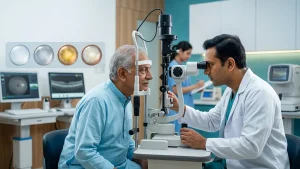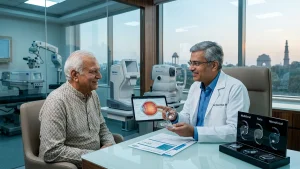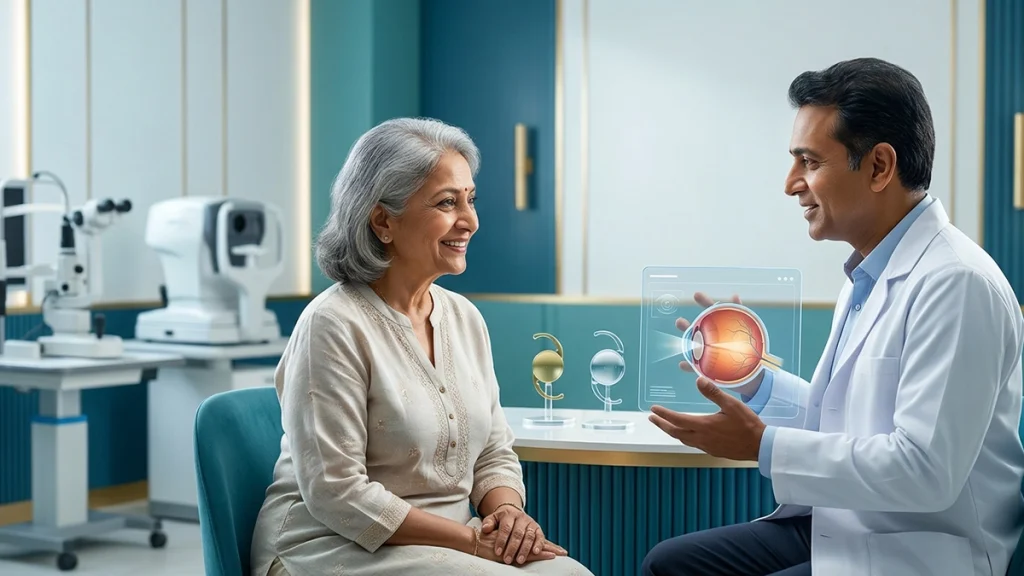
Cataract surgery which in many cases improves vision to be clearer, brighter and more colorful is a great result but is not a total fix for full restoration of natural vision. Many patients question if they will still require glasses after cataract surgery for reading, computer use, while driving or for distance vision. That answer is based on the care plan we have for you, the health of your eye pre and post op, the precision of the pre op measures we take and the intraocular lens which will be put in.
This guide goes over how lens choice plays a role in vision after cataract surgery, why spectacles requirements may change, and at what time a new prescription may be given during cataract surgery recovery.
Why Are Spectacles Sometimes Needed After Surgery?
A cataract forms when the natural lens within the eye becomes cloudy. In cataract surgery the surgeon removes that cloudy lens and puts in a clear artificial intraocular lens. The National Eye Institute reports that after healing some patients may still require a new prescription for glasses or contacts.
Need after glasses after cataract surgery doesn’t mean the operation was a failure. The surgery is to remove the clouded lens and restore usable vision. Also we may use spectacles for fine tuning focus, correct what may still be present astigmatism, to support near work, or to improve clarity for in depth activities like night time driving.
The result also is based on corneal shape, retinal and optic nerve health, and healing. Thus similar procedures may produce different results glasses after cataract surgery.
How an Artificial Lens Focuses Light
Before the procedure we take in depth measurements to determine the power of the intraocular lens Also the surgeon and patient go over what is preferred in terms of focal target. For some that may be improved distance vision for the task of driving, for others it may be to see up close for reading.
These we perform very carefully but it must be said that no calculation is perfect in biology. A small degree of short sightedness, long sightedness or astigmatism may still be present after healing. This residual prescription may have the result that glasses after cataract surgery when in overall the improvement is very great.
Most present day artificial lenses have what is for all intents and purposes a single primary focus. When the target is at a distance that is far away, reading glasses are the usual solution. When the target is up close, distance spectacles are what is put forward. Wider range of focus in lens design may reduce the need for glasses but we must not count on total freedom from them.
How Lens Choice Affects Spectacle Dependence
The chosen implant will determine which distances see clearly without glasses. Each design has pros, cons, and what is best for the individual. The right choice is based on eye health and lifestyle not which lens is the best for everyone.
| Lens option | Intended visual range | Likely spectacle requirement |
| Monofocal lens targeted for distance | Mainly far vision | Reading glasses are usually needed; minor distance correction may also be required |
| Monofocal lens targeted for near | Mainly close vision | Distance spectacles are generally needed |
| Mini-monovision | One eye is aimed more towards distance and the other towards near or intermediate vision | May reduce dependence, but glasses can still help with small print or night driving |
| Toric lens | Corrects a planned amount of corneal astigmatism at a selected focal target | Reading glasses may still be needed, and residual astigmatism can require correction |
| Multifocal or trifocal lens | More than one focal range | May reduce dependence, although some tasks can still require glasses |
| Extended-depth-of-focus lens | Usually distance through intermediate range | Near glasses may be required for small print |
A single focus intraocular lens is what we see most often for a clear focal point. At a distance this is the choice for many which improves far vision but reading glasses are still required. Also from the NHS info we learn that patients may still require reading and distance glasses and that the pre op prescription may not be the same as post op.
A toric intraocular lens is used to correct a certain amount of corneal astigmatism, but a monofocal toric lens does not at the same time provide near and far focus. Wider range designs may improve vision but it is important to consider eye health, visual priorities, and possible optical issues.
Factors That Determine Whether Spectacles Are Needed
The issue of what kind of glasses after cataract surgery is not determined by the type of lens used alone. Also in play are measurements, healing process, preexisting eye conditions, and daily visual demands.
| Factor | Effect on the final spectacle prescription |
| Selected focal target | A distance target usually leaves near work dependent on reading glasses, while a near target usually leaves distance dependent on spectacles |
| Corneal astigmatism | Uncorrected or residual astigmatism can blur vision at one or more distances |
| Healing response | Small changes in the cornea or effective lens position may alter the final prescription |
| Condition of the other eye | A large difference between the eyes can cause blur, imbalance, or difficulty using old glasses |
| Retina, optic nerve, or corneal health | Other eye diseases may limit clarity even after the cataract is removed |
| Tear-film stability | Dryness can cause fluctuating blur and affect the accuracy of spectacle testing |
| Lifestyle | Reading small print, prolonged screen use, precision work, and night driving may need more exact correction |
Glaucoma, macular disease, diabetic retinopathy, corneal irregularities, or optic nerve damage may play a role in vision after cataract surgery results. Cataract removal does not correct these separate conditions.
Distance, Reading, and Computer Spectacles
The use of glasses after cataract surgery may be a short term, task specific, or permanent issue. Stable refraction helps to identify which healing changes are permanent and which are normal.
A distance oriented implant will provide for far sight but in some cases glasses after cataract surgery may still be required for road sign correction or for a small residual prescription. Driving is to be resumed only with medical clearance.
Because as most artificial lenses do not have the same flexibility as a young natural lens which does, reading glasses are a common requirement. For computer work which is a mix of near and distance vision an intermediate or progressive prescription will be more comfortable. What is best is to fit the intraocular to screen distance, hobbies, and the set focus of the intraocular lens.
When Can New Spectacles Be Prescribed?
Focus varies in the early days of cataract surgery recovery from use of dilating drops, mild inflammation, swelling, dryness, and healing. Getting in for permanent glasses too soon may result in an inaccurate prescription.
The right time is at the discretion of the surgeon. Indian Council of Medical Research reports that for spectacle prescription to be determined at 2 to 4 weeks post cataract surgery which is a different timeline to the NHS which usually advises to wait until the follow up visit at around 4 to 6 weeks. Timings which are right for each patient depend on the stage of healing, the type of surgery, the state of the eye, also if second eye surgery is to take place.
Temporary readers may be used during cataract surgery recovery, but they should be approved by the care team. Personalized refraction is important when the eyes differ in prescription or astigmatism is present. which is to break up lines
During the post cataract surgery recovery review we also determine if the change in focus is due to the healing surface or a stable refractive error. This is to protect the quality of vision after cataract surgery which in turn may avoid the need for a permanent correction.
Why Sight May Not Feel Perfect Immediately
After vision after cataract surgery may be brighter which at the same time may also feel hazy or unbalanced. Pupils may dilate which in turn causes temporary blur, also you may experience surface irritation and different colored shades through the clear implant.
Old frames may not match your post surgical eye. In which only one eye is treated the difference between the pair can cause headaches, imbalance, or double vision. We may advise temporary correction or to wait until the second eye heals.
During cataract surgery recovery patients are to use all prescribed drops as directed. It is also important that they follow instructions on eye protection, washing, lifting, exercise, sleep, and driving. The National Eye Institute reports that early irritation and light sensitivity may be expected which may last for several weeks.
Can the Need for Spectacles Be Reduced?
Discuss pre op what to expect in terms of dependence on glasses after cataract surgery. Night time drivers may prefer better distance vision, office workers may care more about computer screen clarity, and readers may look for improved near vision.
The surgeon may test out a distance or near target, mini monovision, toric correction, a larger range of intraocular lens options. Not all eyes are the same in what they will do. We aim for less dependency, although some patients may still require glasses after cataract surgery for fine print, night time driving, or detailed work.
Stable vision after cataract surgery is to be evaluated for the particular distances which the patient uses at home and at work. The final prescription for glasses after cataract surgery can then be tailored to those tasks as opposed to a generic solution.
What If Sight Becomes Cloudy Again Later?
A step by step loss of clarity which may follow an early positive result is not a product of a spectacle change. Some patients will see the development of posterior capsule opacification also known as a secondary cataract. According to the National Eye Institute this may happen weeks, months or years after the initial issue and in the main is treated with a laser procedure.
An examination will see if your glasses after cataract surgery will do the job or that there is a different issue which needs to be addressed. Dry eye, retinal disease, glaucoma, corneal changes, inflammation, swelling or movement of the implant may also play a role in your vision after cataract surgery.
Warning Signs During Recovery
Mild grittiness, light sensitivity, and temporary blur is common but if symptoms worsen get in to see your eye care professional right away. Sudden vision loss, severe pain, marked redness, discharge, flashes, many new floaters, a curtain like shadow, or progressive blur cannot be managed with just stronger glasses after cataract surgery. The National Eye Institute says you should go to the emergency room for vision loss, persistent severe pain, marked redness, flashes, or a large number of new floaters.
Follow up appointments are a key element in the cataract surgery recovery. At these visits we check for inflammation, pressure, corneal clarity, implant position and the retina when required. Also we use the time to determine if and when spectacle testing should be done.
Patients who are worried about what to expect with glasses after cataract surgery should bring in their present lenses and also describe which areas of vision are affected. This will make the refraction and counseling more precise.
Conclusion
The issue is not just if you will need glasses after cataract surgery but which distances within your life you want to see without them. Cataract surgery puts in an intraocular lens which replaces the clouded natural one, also it is the result of lens design, focal point, measurements, health of the eye, healing process, and lifestyle.
Discuss your current health which includes reading, computer use, driving, hobbies, and any present eye conditions with your doctor before surgery. Post op, attend all follow up visits and wait for professional advice before getting a permanent prescription. With a practical approach to your post op care,vision after cataract surgery can be tailored to your everyday needs, which may range from occasional use of glasses to a custom prescription for best results.
Frequently Asked Questions
1. Does everyone need glasses after cataract surgery?
No. Some patients wear glasses for near work only, others for distance, computer work, or a range in between. Issues of astigmatism, eye health, healing processes and visual expectations play a role in the results.
2. Can an advanced intraocular lens guarantee spectacle-free vision?
No. A wider choice of lens or a toric lens may reduce the need for glasses in a suitable patient, but no implant is a guarantee that we will do away with the use of them. Small print, night time driving, residual prescription, or specialized work may still require correction.
3. Why do I need reading glasses after cataract surgery if distance vision is clear?
A distance oriented monofocal lens provides the best unaided far focus. It usually does not restore what a young natural lens does in terms of close focusing which is why reading glasses are very often a requirement.
4. When does vision after cataract surgery become stable?
Many of our patients report improvement in a few days’ time, but we see a range in terms of stabilization. We see changes in terms of dryness of the surface, swelling, inflammation, medication use, and healing which are all transient. We usually wait for the eye to stabilize before we do spectacle testing.
5. Can I wear my old spectacles during cataract surgery recovery?
Old glasses don’t always go with the operated eye. They may be worn for a while but at times cause blur, imbalance, or headache. Follow the advice of your health care team.
6. Will a toric intraocular lens remove the need for reading glasses?
A toric lens is used for preexisting corneal astigmatism. When a monofocal toric lens is for distance use, reading glasses will still be needed.
7. What can reduce vision after cataract surgery despite new glasses?
Residual refractive errors, dry eye, corneal edema, posterior capsule opacity, glaucoma, retinal disease, optic nerve disease, inflammation, or some other complication may be responsible. An ophthalmic exam is required to determine the cause.
8. Should I wait for both eyes before ordering glasses after cataract surgery?
When we have notice of the second operation which is to take place very soon it may be best to wait until full healing has taken place before getting a new prescription which may otherwise become invalid. Temporal correction may still be recommended if the difference between what the eyes have produced is still very great.
Successful cataract surgery recovery includes healthy healing and practical visual rehabilitation. Post op prescription for glasses after cataract surgery should be determined once cataract surgery recovery is fully stable. Properly prescribed glasses post cataract surgery can improve comfort and task specific clarity. We aim for comfortable functional vision after cataract surgery, with specs used where they add useful clarity.