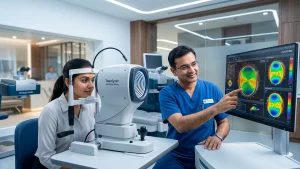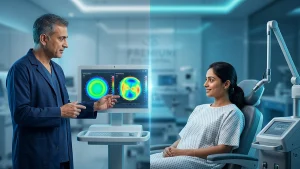
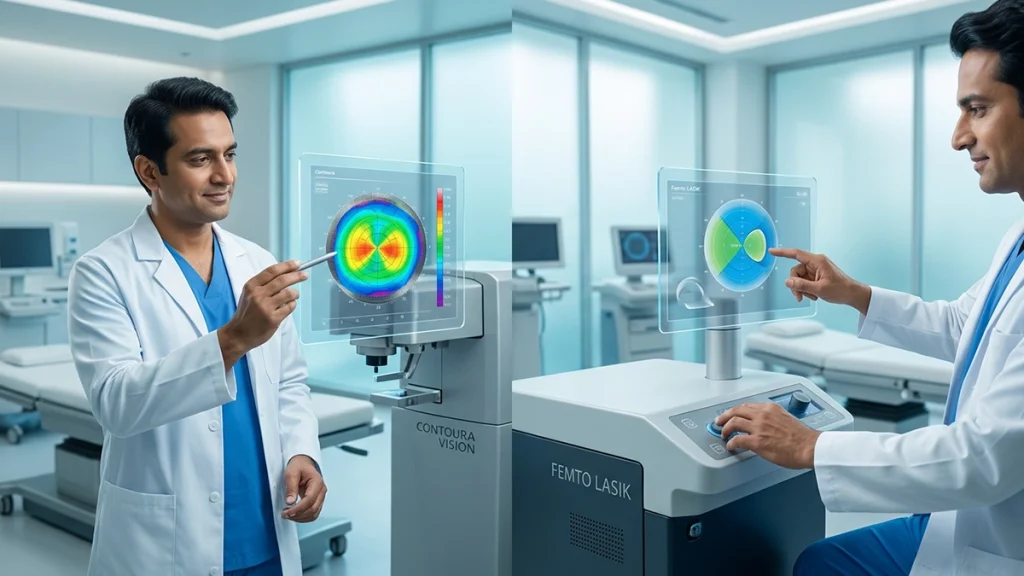
In fact the right choice between Contoura Vision vs LASIK is that we cannot say one is better for all patients. What is to be looked at is corneal shape and thickness, prescription stability, tear film health, age, lifestyle and visual expectations. A full refractive assessment and a personal LASIK comparison are thus recommended over1 to choose a procedure based only on which has a more advanced sounding name.
What Is LASIK?
LASIK is an acronym for laser assisted in situ keratomileusis. In this type of laser eye surgery, a thin flap is made in the cornea. The surgeon lifts the flap and out with an excimer laser the underlying tissue is reshaped so that light may focus better. The flap is put back in place.
LASIK is a choice for patients with myopia, hyperopia and astigmatism within the approved range of which the laser system is used. The FDA reports that LASIK is a treatment which is to largely do away with the use of glasses or contacts, at the same time they advise patients to be aware of what is and isn’t possible and to be informed before they decide. Also it is important to note that what we term standard LASIK may not be the same from one center to another. The diagnostic work up, treatment approach, which laser is used, surgeon’s approach and pre operative evaluation may different which in turn will affect the results.
What Is Contoura Vision?
Contoura Vision is the brand term for topography guided LASIK which is performed on a compatible WaveLight platform. Prior to the procedure a corneal topographer scans the front surface of the cornea. The software then uses these maps to design a custom ablation which takes into account refractive power and surface irregularities.
Contoura surgery’s role is beyond that of removing the eye’s prescription. In certain eyes it does what is to improve the smoothness of the corneal optical surface. Also it may be put to use in the right set of patients which include those with myopia, astigmatism or measurable surface irregularities which fall in the safe treatment range.
FDA records describe an approved topography-guided LASIK indication using the WaveLight system, Topolyzer and treatment-planning software for selected adults with stable myopia or myopic astigmatism within specified ranges. These device-specific ranges are not a personal recommendation and may differ by platform, country and regulatory approval. toura Vision vs LASIK Main Differences
In terms of what each procedure does differently Contoura Vision vs LASIK differ in the info they use to design the treatment of the cornea. With conventional treatment we mainly see focus on refractive error, but with what is modern as wavefront optimized profiles we also see an attempt to keep the cornea’s natural optical shape intact. Also in the case of topography guided treatment we are using a very detailed map of the anterior corneal surface.
| Comparison factor | Conventional LASIK | Topography-guided Contoura |
| Treatment planning | Based mainly on refraction, with the profile determined by the laser system | Uses refraction together with detailed anterior corneal surface maps |
| Main objective | Correct eligible myopia, hyperopia or astigmatism | Correct eligible refractive error while addressing measured surface irregularities |
| Diagnostic requirement | Refraction, pachymetry, corneal imaging and suitability tests | Similar screening plus repeatable, high-quality topography scans |
| Potential advantage | Established correction with predictable outcomes in suitable patients | May reduce selected corneal optical irregularities |
| Important limitation | Does not guarantee freedom from glasses or visual symptoms | Customisation does not guarantee a superior result |
When considering Contoura Vision vs LASIK, this LASIK comparison shows why a marketing label cannot decide the procedure. Both options do the same thing to the cornea, also in the case of LASIK a flap is created and also a thick, healthy and very regular cornea is required for both.
Which Option May Give Better Visual Quality?
People researching Contoura Vision vs LASIK may be after more than just 20/20 vision on a chart. Issues like contrast, glare, halos, starbursts and confidence when driving at night also play a role. With topography guided treatment which is designed to address the measured surface changes of the eye it may present an advantage in visual quality for certain eyes.
Research does not prove that topography guided treatment is the best. In a prospective LASIK comparison study we see similar refractive and visual acuity results between topography guided and wavefront optimized LASIK which also reported fewer induced higher order corneal errors in the topography guided group. Also a randomized study which put to the question topography guided vs wavefront guided LASIK reported very strong results at 12 months’ mark and did not find any significant difference in terms of higher order aberrations. evidence which we have is that Contoura Vision is a choice which you have to make as an individual. A person with a regular cornea and simple refractive error may do well with a more traditional profile. But for someone who has specific surface asymmetry or optical irregularities Contoura surgery may be an option provided the maps are good and we are within safe parameters.
Who May Be Suitable?
For a person to go through with Contoura surgery they must have a stable prescription, healthy ocular surface, adequate corneal thickness and a that doesn’t present keratoconus or any other corneal issue. Also the refractive error has to be in the safe and approved range for what is put out by the system.
Testing before laser eye surgery often includes refraction, pachymetry, corneal topography or tomography, pupil assessment, tear film evaluation and a full eye exam. Contact lens wearers may have to stop use of their lenses before testing as lenses can temporarily change corneal shape.
The choice between Contoura Vision vs LASIK may be put off when you are still in the process of getting a change in your prescription, you have uncontrolled dry eye, very thin or irregular corneas, are in the middle of an active eye disease, or there is a medical issue which may complicate the healing. Also during pregnancy and breastfeeding may be a reason to delay these types of procedures as at that time your refraction and corneal measurements tend to change.
Benefits and Limitations
| Consideration | What patients should understand |
| Customisation | Contoura surgery uses surface data, but customisation does not mean a guaranteed outcome |
| Recovery | Many patients resume routine activity relatively quickly, although clarity and comfort may fluctuate |
| Night vision | Good visual quality is possible, but glare, halos and starbursts can occur after either option |
| Dry eye | Temporary dryness is common after corneal laser eye surgery, and persistent symptoms can occur |
| Glasses dependence | Both aim to reduce dependence, but reading glasses or an enhancement may still be required |
| Safety | Careful screening reduces avoidable risk, but no refractive operation is risk-free |
For Contoura Vision vs LASIK, this LASIK comparison puts the procedures in a real world context. We are after improved unaided vision which is a promise we can make not perfect vision for a lifetime. Presbyopia still brings in the need for reading glasses and also future cataract development may change vision which in turn may nullify the results of an earlier refractive procedure.
Risks and Possible Side Effects
In Contoura Vision vs LASIK there is a great deal of overlap in terms of risk. We see dryness, fluctuating vision, glare, halos, starbursts, light sensitivity, undercorrection, over correction and residual astigmatism as common effects. Also we have less common but very important issues like infection, inflammation, problems with the flaps, loss of best corrected vision and corneal ectasia.
The FDA reports that patients should balance benefit against risk which also some report reduced low contrast or night vision performance even when the standard vision chart results are good. As for LASIK comparison the pre op tear film health in addition to the laser type. Also it is important to discuss pre existing dry eye, allergy, eyelid gland issues and contact lens tolerance beforehand. And that by treating the ocular surface issues first we may see better pre and post op results.
Procedure and Recovery
On the day of laser eye surgery, anesthetic drops are put into the eyes. A flap is created with the chosen approved method and the excimer laser is used to reshape the cornea to fit the treatment plan. With Contoura surgery, the ablation profile includes preoperative surface map data.
The patient experience between Contoura Vision vs LASIK is very much the same which is a point to bring up in any practical LASIK comparison. What mainly differs is in the diagnostic mapping and software guided planning aspect of the procedure not in the experience itself on the operating table.
Recovery usually has patients using prescribed eye drops, wearing protection as advised and in for follow up. At first we see mild burning, watering, light sensitivity and hazy vision. Post procedure patients should steer clear of rubbing their eyes and to follow the given instructions on washing, make up, exercise, swimming, driving and screen use. Should pain go up, vision loss happen suddenly, redness or discharge get worse — that is an emergency.
How Does a Surgeon Decide?
A surgeon who has performed Contoura Vision vs LASIK notes that in the review process we look at more than just the glasses number. We check if the corneal maps are symmetrical and repeatable, if sufficient tissue will be left post treatment and if the tear film is stable enough for accurate results.
For Contoura surgery, we see that which astigmatism is prescription based and which is from topography plays a role. We have that different planning methods produce varying results when what is measured for cylinder power or axis does not agree between tests. Thus clinical interpretation is required of the software output instead of automatic acceptance. Also in the case of LASIK comparison we may see another recommendation. Some patients do better with PRK, SMILE, an ICL or may continue on with glasses or contact lenses.
Contoura Vision vs LASIK: Which Is Better for You?
When patients put the question again on Contoura Vision vs LASIK, the best response is to go with the procedure which fits the eye’s measurements, safety profile and visual needs. Contoura surgery does well when what we see with the topography indicates that we can improve corneal regularity. As for Modern conventional LASIK it does the job well when the cornea is regular, the prescription is a good fit and the profile we choose will present safe results.
In a choice between Contoura Vision vs LASIK price should not be the sole determinant. What is more important are the quality of pre op screening, reliability of the imaging, surgeon’s judgment, which technology is proven and accepted, infection control measures and post op care plan.
At ASG Eye Care we present for a refractive surgery consultation that will determine the suitability of you for laser eye surgery and which technique is best for you. We will go over what you can expect in terms of benefits, limitations, alternatives, recovery and possible complications before you give us your consent.
Conclusion
The choice of Contoura Vision vs LASIK should begin with accurate diagnostics, also at the same time the final LASIK comparison report should not assume that what is new is automatically best. Contoura has topography guided custom options which may be useful for certain eyes, also we see that at present conventional LASIK may do very well at correction for many appropriate patients.
Before undergoing laser eye surgery, discuss your night driving, screen use, dry eye history, sports, what you expect from your reading vision in the future and the post operative care. We will tailor each laser eye surgery plan to your corneal health and to what is realistic for you which in turn creates a safer and clearer path to vision correction.
Frequently Asked Questions
1. Is Contoura Vision different from LASIK?
Contoura Vision which is a topographic type of LASIK, not some other procedure. In the Contoura Vision vs LASIK discussion LASIK tends to refer to the standard wavefront optimized profile whereas Contoura includes in depth corneal surface mapping.
2. Is Contoura Vision always better than conventional LASIK?
No. In terms of what we see in LASIK comparison studies there isn’t a clear winner. Both methods do very well and which one is best is based on corneal measurements, prescription, state of eye health and what the surgeon thinks. Does Contoura do astigmatism? Yes Contoura surgery does correct myopia that includes astigmatism within the safe clinical range for the platform’s approved use. The plan also takes into account the type of astigmatism present, corneal shape and the agreement between what we see refractionally and topographically.
3. Is laser eye surgery painful?
Most folks report feeling pressure or a mild discomfort as opposed to sharp pain which is due to the use of numbing drops. Irritation, watering and light sensitivity may present them in the early stages of recovery from laser eye surgery. Severe or increasing pain requires prompt medical attention.
4. How long does vision take to stabilise?
In many cases we see improvement in just a few days, but at the same time variation in the corneal and tear film repair may be present. Post op results for laser eye surgery are variable which is why follow up is so important even when your vision seems to have clarified.
5. Can either procedure guarantee perfect vision?
No refractive surgery can promise perfect or lifetime spectacle free vision. In a real Contoura Vision vs LASIK discussion we talk of residual vision issues, dry eye, night vision symptoms, the need for reading glasses as you age and also the issue of possible retreat procedures.
6. Who may not qualify?
People who have unstable refraction, which may include certain corneal thicknesses and shapes, active eye disease, uncontrolled dry eye, or some medical conditions may not be eligible. The choice between Contoura Vision vs LASIK is based on a detailed exam.
7. Is Contoura Vision safer?
Both out of them have the same set of risks in that they are performed as LASIK. In terms of preoperative mapping which is a feature of Contoura surgery we have found that it does not remove the risk of dry eye, infection, glare, under correction, ectasia or flap issues.