Clear vision is a result of the cornea and lens’ accurate bending of light onto the retina. When the eye’s shape causes light to focus at the wrong spot a person may present with myopia, hyperopia or astigmatism. We have glasses and contact lenses as very effective options still, but some adults look to PRK eye surgery to reduce their dependence on corrective eyewear. This laser based vision correction surgery changes the shape of the cornea which in turn causes light to focus more precisely.
PRK is not for every case and every eye. Corneal shape, thickness, tear film health, prescription stability, age, general health, expectations, and daily activities play a role in determination of suitability. We explain the procedure, what to expect in terms of benefits, limitations, risks and PRK recovery time which aids patients in making an informed decision with their ophthalmologist.
What Is PRK Eye Surgery?
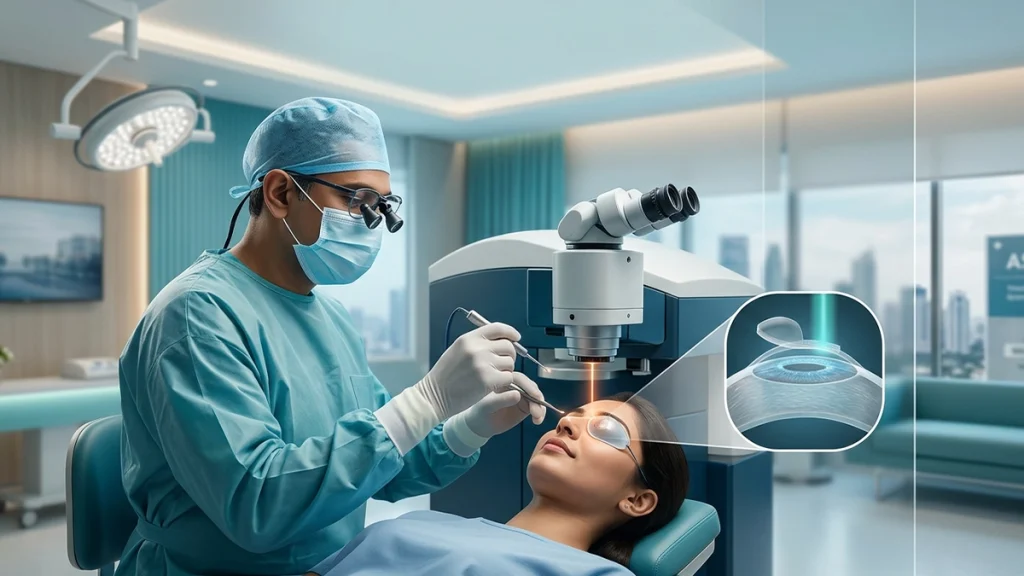
PRK eye surgery which is also a form of refractive laser treatment includes the removal of the cornea’s outer layer or epithelium which is thin. An excimer laser is used to remove a precise and small amount of the stromal layer. During the healing process the epithelium grows back. NICE reports that they do a removal of the epithelium which is followed by excimer laser ablation of the stromal bed.
The medical term for the procedure is photorefractive keratectomy which is a surface based cornea reshaping. Unlike LASIK it does not produce a permanent corneal flap.That issue plays into early recovery, visual results, and which patients may be a good fit. Although developed before LASIK PRK is still a key player in modern vision correction surgery.
Which Vision Problems Can PRK Correct?
PRK eye surgery is a choice for certain degrees of myopia, hyperopia and astigmatism. What that range is will vary by laser platform, eye measurement, surgeon’s skill and what is approved. The FDA reports that indications between different excimer laser systems may include specific age, prescription, astigmatism and stability requirements.
A stable prescription is key to what is put in place for treatment which is based on the eye’s current refractive error. For some procedures like. Photorefractive keratectomy we do not have success in preventing presbyopia which is the age related loss of near focus or in stopping the development of conditions like cataract. Also after a successful vision correction surgery,
the use of reading glasses or other eye wear may still be required at a later date
PRK Eye Surgery Versus LASIK
Both procedures which in effect what is done to the cornea is altered but the method which is used is different. In the case of LASIK a flap is created and that is lifted. In PRK eye surgery, we remove the surface epithelium and allow it to regrow. This does away with issues related to flaps but the exposed surface requires more time to heal
| Comparison | PRK | LASIK |
| Access to the cornea | Surface epithelium is removed | A corneal flap is created |
| Early comfort | More irritation and light sensitivity may occur | Early discomfort is often milder |
| Initial visual recovery | Usually gradual | Usually faster |
| Flap considerations | No corneal flap | Flap-related complications are possible |
| Return to routine | Often requires more patience | Often earlier, depending on healing |
| Suitability | Based on full eye and corneal assessment | Based on full eye and corneal assessment |
A surgeon may bring up PRK when surface treatment is a choice which we have with corneal measurements, contact sport exposure, or work which has a high risk of eye trauma. This does not mean PRK is automatically the better option. What is right for vision correction surgery is based on the patient’s eye health, what the results will be like, lifestyle and recovery
Who May Be a Suitable Candidate?
A large group of people that may undergo PRK eye surgery are adults which have healthy eyes, a stable prescription, a correctable refractive error, and also in which the expectations are real. FDA approvals of each laser system do report minimum age requirements as well as the amount of time which the prescription has to be stable but the values do vary by device.
Suitability is not based only on the spectacle number. Prior to photorefractive keratectomy the eye care team will measure corneal thickness and curvature, map out the corneal surface, assess pupil size and tear film health, look at the retina and optic nerve, and review medical history. A full dilated exam will identify issues which may change the risk or treatment plan.
People who have unstable prescriptions, active eye infections, severe dry eye, certain corneal diseases, uncontrolled health issues, pregnancy related prescription changes, or unmet expectations may be told to put off or to not have vision correction surgery.. Spectacles, contact lenses, or some other refractive procedure may be more appropriate.
How Is the Procedure Performed?
Before PRK eye surgery anesthetic drops are put into the eye. A device which does the needful keeps the eyes open. The surgeon removes the epithelium from the treatment area which in turn brings to the fore the stromal surface.
The excimer laser is used based on the patient’s measurements and prescription. It puts out controlled pulses which remove small tissue amounts and remodel the cornea. In photorefractive keratectomy we aim to change how the cornea bends light instead of putting a lens in the eye. Also according to NICE and Medline Plus refractive laser treatment is a way to reshape the cornea which in turn improves focus.
At present post PRK eye surgery, what we do is place a soft bandage contact lens over the cornea as the epithelium is growing back in. This protects the healing tissue and we remove it at the advised follow up. Also we prescribe you antibiotic, anti-inflammatory and lubricating drops to support the healing process during the early stages of PRK recovery.
Benefits of PRK Eye Surgery
In PRK eye surgery the primary benefit is that it reduces the use of glasses or contact lenses for daily vision. Also because a flap is not created in this procedure it avoids the issues related to flap displacement and other complications. For certain eyes a surface approach may also be put forth when a flap based procedure is not what is best.
NICE reports that there is support in the evidence for photorefractive laser surgery which they say is safe and effective in the right patient population. We also stress the issue of informed consent and discussion of risks. We see the benefit as an improvement in unaided vision which is not to say we guarantee perfect vision or permanent freedom from glasses.
A person that is not a good candidate for LASIK may instead be evaluated for photorefractive keratectomy or other vision correction surgery. What is put forth is that eligibility and results depend on the health of the eye, treatment range, healing response, and realistic expectations.
Risks and Possible Side Effects
PRK eye surgery is like any other in that they all do have risks. In the early stages of healing pain, burning, tearing, light sensitivity, foreign body experience, and blurred vision can present itself. Dryness, changes in visual sharpness, glare, halos, and a reduction in night vision may continue as the surface and tear film heal.
Less common but very important issues include infection, delayed epithelial healing, corneal haze, scarring, undercorrection, overcorrection, and residual astigmatism which also may cause loss of best corrected vision. The FDA reports that issues like improper correction, glare, halo, foreign body sensation, corneal scarring, ulceration, infection and microbial keratitis are identified as possibilities.
| Possible experience | Typical timing | What patients should know |
| Irritation and light sensitivity | First few days | Use prescribed medicines and avoid rubbing |
| Blurred or fluctuating vision | Early weeks and sometimes longer | Clarity usually improves gradually |
| Dryness | During surface and nerve recovery | Use lubricants as advised |
| Glare or halos | Often noticed at night | Report severe or persistent symptoms |
| Corneal haze | May develop during healing | Follow-up and prescribed drops are important |
| Infection or worsening inflammation | Uncommon but urgent | Increasing pain, redness, discharge, or falling vision needs prompt review |
Some still have the need for glasses after photorefractive keratectomy; in some cases for night time driving, near work, or with very fine visual tasks. Also it is true that enhancement is not always a good option. A responsible vision correction surgery eye care professional will go over what results you can expect and also what is out of the question.
PRK Recovery: What to Expect
The first stage of PRK recovery is which many report as very uncomfortable as the epithelium is growing back. For a few days the eyes may present with a gritty or watery feeling, also there may be a soreness or light sensitivity. Also during this time vision is very often blurred which is why we ask that you make other arrangements for getting home and in fact do not get behind the wheel until you are cleared by us.
Once the surface has healed the bandage contact lens is removed at the doctor’s discretion. Comfort usually improves but vision may still be hazy or variable. Return to screen use, reading, work, and driving will be based on how you are feeling, visual recovery and what the medical team says rather than a set schedule.
Over the coming weeks what we see improves in definition, at the same time there may be ups and downs. Fine detail and night vision may take more time to improve. The extended phase of PRK recovery may play out over several weeks to months in which case the ophthalmologist will change the eye drops as required and watch for the development of haze, dry eye, inflammation, or that the refractive error has not fully corrected.
Medline Plus says to report to your surgeon any steady decline in vision, growing pain, also if you see new symptoms like flashes, floaters, double vision, or light sensitivity. These signs should not be dismissed as normal to PRK recovery.
Aftercare During Healing
Successful PRK eye surgery is a result of proper after care. At the right times and for the specified period drops should be used. Do not put the bottle tip to your eye, eyelid, fingers or any surface. The bandage contact lens should not be removed or adjusted at home.
During PRK recovery, which is a tip to patients that they should steer clear of eye rubbing, swimming, dusty settings, eye make up, and direct water contact for the time frame which the surgeon says. Also wear of sunglasses may improve comfort. MedlinePlus also says to protect your eyes from impact and to wear sunglasses in the sun after refractive corneal surgery.
Follow up visits allow us to assess epithelial healing, remove the bandage lens when it is time, check vision, and to modify medicines safely. Omitting follow ups after treatment may delay recognition of infection, inflammation, haze, or abnormal healing.
When Should You Seek Urgent Care?
After PRK eye surgery, slight discomfort and blur are noted but for more serious things that present themselves see your health care provider immediately. Contact the treating ophthalmologist if pain gets worse, vision drops suddenly, redness increases, discharge present, the bandage contact lens falls out at which time also check that the other is healing similarly.
New reports of a sudden increase in floaters, a curtain like shadow, marked swelling, or intense light sensitivity also require professional evaluation. Early in office visit may identify issues and support better healing.
Is PRK the Right Choice for You?
The choice for PRK eye surgery is best made after a full refractive consultation instead of just a cost analysis or someone else’s experience. Two people who have the same corrective lens need may have different corneal thicknesses, ocular health, pupil sizes, lifestyle issues, and risk factors.
For the right patient, photorefractive keratectomy can substantially improve vision without corrective lenses. Someone else may be better served by LASIK, SMILE, an implantable lens, spectacles, or contact lenses. Before consent, a sound vision correction surgery plan should cover the expected results, available alternatives, limitations, recovery requirements, and possible complications.
At ASG Eye Care we present to you our refractive evaluation which is to determine if your eyes are good candidates for treatment. We are not only into performing PRK eye surgery, what we do is to find the best option for your corneal health, prescription, visual needs and in the long term health of your eyes.
Frequently Asked Questions
1. Is PRK painful?
Numbness is a result of what is used during the PRK eye surgery so at the time of the laser application, you do not usually experience sharp pain. What you can expect during the first few days is soreness, burning, watering, and light sensitivity. Prescribed medicines and the bandage lens will help you with the early PRK recovery.
2. How soon can I see clearly?
Vision post photorefractive keratectomy is usually blurry which improves over time. Many see useful improvement within the first few weeks but in some it may take longer. You may resume driving and complex visual tasks only after you are cleared by a health care professional.
3. Can PRK permanently remove glasses?
PRK eye surgery may better correct your vision and thus can reduce the use of glasses however complete independence from glasses does not always happen as a result. Results can be impacted by what we call residual prescription, which means some degree of vision correction was required to be left, healing variation in results between patients, presbyopia, or other changes to the eye that develop later may also require you to return to wearing glasses. The main goal of the vision correction surgery is to improve what your vision can do without any corrective lenses, as long as it’s done in a safe way for your health.
4. Is PRK better than LASIK?
Neither option is universally better. Photorefractive keratectomy avoids creating a corneal flap, though early vision typically improves more slowly and surface discomfort is often greater. With LASIK, recovery is usually faster at first, but the flap introduces its own considerations. The choice depends on the eye’s measurements and health, as well as the person’s occupation, sports, and priorities.
5. How long should screens be avoided?
Screens don’t typically change the results of laser correction, but for some patients may experience increased dryness and comfort issues in PRK recovery Short treatments that are broken up by frequent breaks are usually better. As always, follow your surgeon’s instructions which may differ from what is provided here.
6. Is PRK suitable for thin corneas?
Some patients that do not have ideal corneas for a flap will be evaluated for PRK eye surgery,but a thin cornea does not in and of itself make treatment safe. Thickness, shape, prescription, biomechanical risk, and planned tissue removal will be looked at as a group.
7. Does PRK treat presbyopia?
Standard photorefractive keratectomy does not prevent the age-related decline in near focusing. Monovision may be an option for some patients, though it involves trade-offs. Even after vision correction surgery. reading glasses might still be necessary.
8. Why are follow-up visits necessary?
Reviews report that the surface has healed, we assess vision, watch for infection or haze, and change medication as needed. They are a key element in safe PRK recovery even when the eyes feel fine.